




Skiing in the U.S. is becoming a luxury few can afford. Lift ticket prices have surged by 546% over the last 40 years, with some resorts charging over $350 for a single day. A family of four can easily spend $1,300 or more on a single trip when factoring in rentals, meals, parking, and lodging. Meanwhile, European resorts charge significantly less, with daily tickets ranging from $27 to $98.
Why the spike? Corporate consolidation by Vail Resorts and Alterra Mountain Company has driven up single-day ticket costs to push season passes. This strategy alienates casual skiers and first-timers while overcrowding slopes and straining infrastructure. Parking shortages, traffic jams, and high lodging costs further complicate the experience.
Some alternatives are emerging. Community-driven models, like Malibu Ski League, lower costs through ride-sharing, group housing, and gear-sharing programs. Independent ski areas also offer more affordable options, preserving the sport’s accessibility and sense of connection.
Skiing needs a reset: one that prioritizes affordability and brings back the joy of the mountains for everyone.
What It Actually Costs to Ski for a Day
Rising Prices: What You'll Pay
Hitting the slopes for a full day comes with more expenses than just the lift ticket. While we've already touched on the rising cost of lift passes, there are plenty of other costs to consider. For example, renting gear can set you back anywhere from $25 to $125 per day, depending on the quality of the equipment. Parking fees at big-name resorts like Vail or Alta often range between $25 and $30. And if you grab a quick slope-side meal - say, a burger, fries, and a drink - you’re looking at $25 to $40 per person.
Even resorts that are considered more budget-friendly come with a hefty price tag. Take Alta Ski Area in Utah, for instance. A family of four could spend $815 for a single day. This breaks down to $636 for lift tickets, $110 for rentals, $25 for parking, $8 for gas from Salt Lake City, and $60 for lunch. And that’s just the daytime costs - lodging is a whole other expense, ranging from $70 for a basic motel to $2,750 for a luxury slope-side condo.
"The pass right now on a weekend for an adult is $250 a day, and that's just your lift ticket... Ski lessons are almost $200 an hour per person. Just for one meal, you're talking, going cheap, probably $40."
– Mike Maloney, Skier
These rising expenses are making it harder for families to enjoy the slopes, shifting skiing into a luxury activity for many.
Who Can't Afford to Ski Anymore?
The increasing cost of skiing has drastically altered who can afford to enjoy the mountains. Middle-class families, who once cherished skiing as an annual tradition, are now being priced out. A single weekend trip can easily surpass $3,000 once you add up lodging, meals, and transportation.
Younger people are also feeling the pinch. The median age of skiers has climbed significantly, jumping from 24 to 35 years old over the years. Many in their twenties are finding it impossible to afford the sport. For newcomers or those who just want to try skiing for a day, the barrier to entry is steep - simply getting on the lift can cost between $200 and $350.
"Anyone who's not rich or willing to make their entire life revolve around skiing is barred from enjoying the mountains."
– Ella Boyd, Writer/Photographer
Even locals who live near ski towns are finding themselves priced out of their own backyard. With mega-passes offering discounts to those who ski 20 or more days a season, single-day tickets have skyrocketed, making occasional trips unaffordable for many working families. What was once a sport for everyone now feels increasingly exclusive, catering primarily to the wealthy.
How Over-Commercialization Changed the Skiing Experience
Crowded Slopes and Lost Connections
The ski industry has seen a dramatic shift, with two corporate giants - Vail Resorts and Alterra Mountain Company - now controlling over half of the U.S. lift capacity. In states like Colorado and Utah, that grip tightens to 86% and 74%, respectively. This surge in commercialization has fundamentally altered the skiing experience, affecting both the enjoyment of visitors and the preservation of the natural environment.
Take Vail Resorts, for example. They sold a staggering 2.1 million pre-purchased passes for the 2021–22 season, a 76% jump compared to 2019–20. But the infrastructure hasn’t kept pace. The result? 30-minute lift lines, gridlocked roads leading to resorts, and slopes so congested they feel more like amusement parks than serene mountain escapes. At Crystal Mountain, one powder day caused a 57-mile traffic backup, stretching all the way to Auburn.
"Vail Resorts took really aggressive pricing action this year on the Epic Pass, and that was undoubtedly going to trigger high sales... I think it might have exceeded their expectations."
– Tom Foley, Ski-industry Analyst
This commercialization hasn’t just crowded the mountains; it’s also eroded the soul of ski culture. The once-vibrant "ski bum" lifestyle is fading, as corporate policies create cookie-cutter resort experiences. Gone are the quirky gathering spots, live music, and unique local traditions. Instead, visitors encounter standardized cafeterias and high-end real estate developments. For locals, this shift is particularly painful. In Avon, Colorado - near Vail - the median home price has tripled since 2015, far outpacing national trends and effectively pushing out the local workforce.
"The quirky, unique, individual characteristics and hospitality of individual resorts is being replaced by a homogenous corporate experience."
– Travis Swiger and Adam Looney, University of Utah
Some resorts are trying to push back. Take Arapahoe Basin, which left the Epic Pass in 2019 to protect its community vibe. By the 2022–23 season, visits had dropped 40%. While this decision preserved its culture, it highlights a broader issue: the mega-pass model prioritizes sheer volume over meaningful experiences. And the environmental cost of this expansion is becoming harder to ignore.
What Resort Expansion Does to the Environment
The environmental impact of over-commercialization runs deep. With climate change creating shorter, warmer winters, resorts are increasingly relying on artificial snowmaking systems - a practice that demands significant energy and water resources. Meanwhile, Vail Resorts has unveiled a $320 million plan to add 21 new chairlifts across 14 resorts, further straining fragile mountain ecosystems.
Skiing's popularity is also contributing to environmental strain. Last year saw a record 65.4 million ski visits in the U.S., a 6.6% increase largely driven by mega-pass sales. This rise has led to more cars on the road, higher emissions, and infrastructure that can’t keep up - parking shortages are a common complaint at major resorts.
The focus on expansion isn’t about creating new resorts but squeezing more capacity out of existing ones. Resorts are adding lifts and expanding terrain to handle the crowds, but the irony is hard to miss: an industry that relies on snow is intensifying the very climate crisis that puts its future at risk.
The Logistics Problem: Getting to the Mountain
Transportation and Parking Problems
Even if you snag an affordable lift ticket, just getting to the mountain can feel like an uphill battle. Major ski routes are plagued with traffic jams, with eager skiers leaving home before sunrise only to end up stuck in bumper-to-bumper lines. By the time they finally reach the resorts, parking is often a lost cause.
Sam Bass, spokesperson for Eldora Mountain Resort, summed it up: "It's the issue of the age that we're all dealing with... whether they're part of your company or not, it's always parking." Many resorts are nestled in tight valleys, leaving no room to expand parking facilities. This means lots fill up fast - sometimes hours before the lifts start spinning. At Crystal Mountain, for example, "lots full" signs went up as early as 7:48 a.m., over an hour before the lifts even opened. To manage the chaos, Crystal Mountain’s President, Frank DeBerry, stopped selling walk-up tickets on weekends, requiring visitors to book in advance just to ensure they wouldn’t be turned away after a long drive.
When you do find parking, don’t expect it to be free. Many resorts now charge between $20 and $30 per day. For instance, parking at Vail's main lots costs $30, while Arapahoe Basin charges $20 for weekend reservations. Some resorts have introduced reservation systems to keep things under control. Arapahoe Basin’s program, for example, covers 36 weekend days from January through May, requiring skiers to reserve a spot ahead of time to avoid being turned away.
"That's the worst thing that can happen, if a guest drives all the way up and you have to turn them around on a great day."
– Loryn Roberson, Spokeswoman, Loveland Basin
The rise of mega-passes has only made these problems worse. Vail Resorts sold 2.1 million passes for the 2021–22 season - a staggering 76% increase compared to two years prior. However, the infrastructure hasn’t kept pace. Colorado’s I‑70 corridor, a vital highway for reaching many major resorts, remains a bottleneck on weekends. Even with pricey toll lanes, drivers only save about five minutes on average. And if the parking and traffic weren’t frustrating enough, finding nearby lodging adds another layer of difficulty.
Limited and Expensive Lodging
Parking isn’t the only headache - lodging has become a major hurdle for skiers and snowboarders. The housing crunch isn’t just driving up costs for visitors; it’s also creating staffing shortages that disrupt resort operations.
"The biggest problem with paying for a ski day might be affording the cost of housing in a city nearby."
– Philip Kiefer, Outside Online
Take Avon, Colorado, near Vail. From 2015 to 2023, the median home price tripled, rising at a pace four times faster than the national average. This surge has pushed workers out of mountain towns, leaving resorts short-staffed. At Stevens Pass in February 2022, 60% of the terrain remained closed despite excellent snow conditions because the resort couldn’t find enough workers to run the lifts. Frustrated locals, like Jeremy Hunter Rubingh, started petitions to call out these logistical failures, with one Change.org campaign gathering nearly 44,000 signatures.
For visitors, the lack of affordable lodging close to the slopes presents a tough choice: pay sky-high prices to stay nearby or book cheaper accommodations further away, adding hours to an already traffic-heavy commute. This shortage not only drives up the cost of a ski trip but also highlights the growing challenge of keeping the sport accessible and community-focused.
Why you can't afford to ski anymore
sbb-itb-236ebff
How Malibu Ski League Solves the Access Problem

As corporate resorts continue to make skiing feel like an exclusive luxury, Malibu Ski League takes a refreshingly different approach. By creating a membership-based community, they pool resources to make skiing more accessible and affordable. Their strategy is straightforward: organize ride-sharing, split housing costs, and use proceeds from branded apparel to fund gear programs. This collective effort tackles the major barriers - transportation, lodging, and equipment - that often keep people off the slopes.
Shared Rides and Group Housing
To address the high costs of getting to and staying near the mountains, Malibu Ski League encourages shared rides and group housing. Members arrange carpools, cutting down on transportation expenses like $20 to $30 parking fees per person. For lodging, they organize group stays, allowing members to split costs and stay close to the slopes without breaking the bank.
This approach fosters a sense of camaraderie often missing in the commercialized resort scene. The league has even coined a term for its members: the "Mountain Town Mob." This community-driven vibe stands in stark contrast to the cookie-cutter, high-cost experience offered by corporate resorts. By promoting shared travel and affordable housing, Malibu Ski League is redefining what it means to access the mountains.
But they don’t stop there - making equipment more affordable is another key part of their mission.
Community Gear Programs
Equipment costs can be a major hurdle, with rentals often running as high as $78 per day. Malibu Ski League tackles this by selling branded apparel, such as the "Gravity Unit" Hoodie ($78) and "Proper Aprés" Quarter-Zip ($118). Proceeds from these sales fund gear-sharing programs and provide support for athletes.
This revenue model not only lowers equipment costs but also reinforces a sustainable, community-centered approach to skiing. Unlike corporate resorts, which prioritize luxury real estate developments, Malibu Ski League invests directly in its members. As skier Andreas Bergfjord aptly put it:
"It is sad that skiing becomes something reserved only for the wealthy."
Malibu Ski League is proving that skiing doesn’t have to be a privilege reserved for the few. Instead, they’re building a model where the sport is accessible to anyone with a love for the mountains - not just those who can afford a $500 day pass.
Making Winter Sports Accessible Again
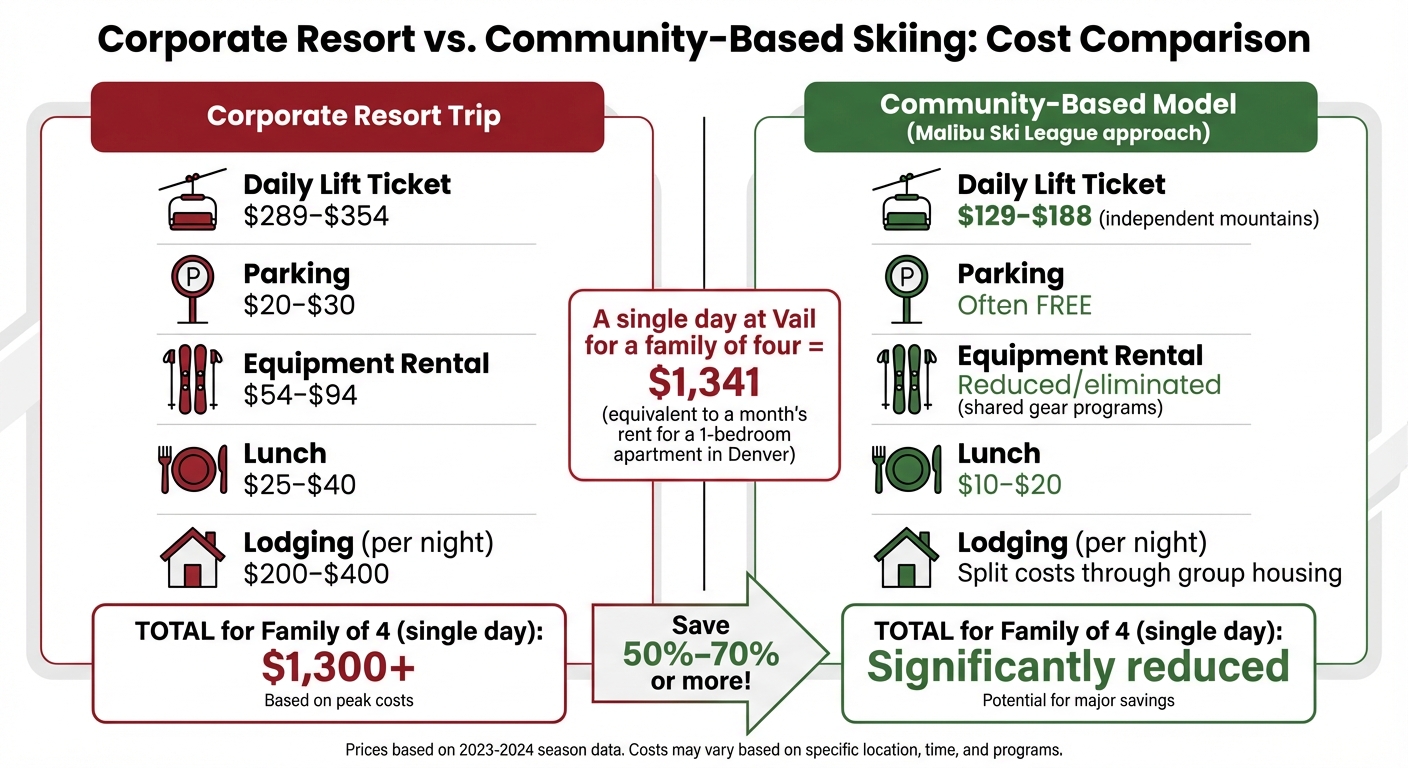
Cost Breakdown: Corporate Resort vs Community-Based Skiing for a Family of Four
Reimagining winter sports through community-driven models puts people first. These approaches prove that skiing doesn’t have to cost a small fortune or require months of planning. By pooling resources and emphasizing shared experiences, the mountains become a place for everyone - not just the wealthy. Inspired by initiatives like the Malibu Ski League, these models bring communities together around affordable, collective adventures. This shift signals a broader movement toward making winter sports more inclusive and accessible.
Growing Community-Based Models
The rise of community-focused skiing is already underway. Take Arapahoe Basin, for example. When they left the Epic Pass in 2019, visits dropped by 40%, but profitability remained steady, showing that localized, people-centered models can succeed.
Independent ski areas offer a refreshing alternative to the corporate resort experience. These smaller, often family-owned mountains typically have shorter lift lines and much lower prices. Consider this: a season pass covering more than 180 independent resorts costs just $399, and after the 2020–21 season, sales skyrocketed as skiers sought less crowded, more affordable options. Beyond lift tickets, these community models address other barriers, like equipment costs. Shared rental programs and grants from organizations like the Challenged Athletes Foundation and the Kelly Brush Foundation provide access to gear. Some programs even offer free, volunteer-led lessons, eliminating the hefty $200-per-hour price tag for professional instruction. Together, these initiatives help families overcome the financial challenges that often keep them off the slopes. By focusing on affordability and accessibility, these models not only save money but also bring back the sense of connection and joy that skiing is all about.
Cost Comparison: Resort Trips vs. Malibu Ski League
Let’s break down the costs to see how these models stack up:
| Expense Category | Corporate Resort Trip | Community-Based Model |
|---|---|---|
| Daily Lift Ticket | $289–$354 | $129–$188 at independent mountains |
| Parking | $20–$30 | Often free |
| Equipment Rental | $54–$94 | Shared gear programs reduce or eliminate costs |
| Lunch | $25–$40 | $10–$20 |
| Lodging (per night) | $200–$400 | Split costs through group housing |
For a family of four, a single day at a corporate resort can easily top $1,300 when you factor in rentals, parking, and food. In contrast, the Malibu Ski League’s approach - relying on shared rides, group housing, and community gear programs - slashes these expenses dramatically. But it’s not just about saving money. These models foster camaraderie and rekindle the shared joy that makes skiing special in the first place. By making the sport more affordable and accessible, they bring back its true spirit - one of connection, adventure, and fun.
Conclusion: Bringing Back the Human Side of Skiing
Skiing has gradually shifted from a beloved outdoor pastime to a luxury reserved for the wealthy. Over the past 40 years, ticket prices have soared by 546%. For context, a single day at Vail for a family of four now costs $1,341 - an amount comparable to a month's rent for a one-bedroom apartment in Denver. This dramatic rise in costs has transformed the sport, replacing its local charm with a profit-driven, standardized experience. It's clear that skiing needs a reset, one that prioritizes community and affordability.
The solution lies in bringing the focus back to skiers and fostering community-driven models. Initiatives like Malibu Ski League demonstrate that skiing doesn’t have to break the bank. By embracing practices like shared rides, group housing, and gear pooling, these models not only cut costs but also revive the sense of camaraderie that once defined the sport. For example, when Arapahoe Basin stepped away from the Epic Pass in 2019, visits dropped by 40%, but the mountain held onto its cherished community atmosphere.
"If resorts continue to alienate those customers, the sense of community so cherished in snowsports will be dead." - Ella Boyd
Malibu Ski League exemplifies how skiing can return to its roots. By prioritizing shared resources and accessibility, it transforms the sport back into a shared adventure rather than an exclusive luxury. This approach is a reminder of what skiing should be: a way to connect with nature and each other, not just a privilege for the few.
FAQs
Why are ski lift tickets so expensive in the U.S.?
Ski lift ticket prices have soared in recent years, driven by corporate consolidation, rising operational costs, and broader economic pressures. Today, many ski resorts are controlled by large corporations that dominate the industry, giving them significant power to set high prices with minimal competition. These companies often employ dynamic pricing models, where discounts are only available to early buyers or those purchasing multi-day passes. For those seeking a single-day ticket, prices at popular resorts can exceed $200.
On top of that, operating costs have climbed sharply. Warmer winters force resorts to invest heavily in snowmaking equipment and energy, while inflation has pushed up labor and equipment costs. Add legal and regulatory expenses to the mix, and it's clear why resorts are passing these costs onto skiers. As a result, skiing has become less affordable for many families, with some resorts charging upwards of $300 per day for lift tickets.
How can community-based models make skiing more affordable?
Community-based models are changing the game for skiing enthusiasts by making the sport more affordable and inclusive. Instead of shouldering all the costs individually, participants share expenses like fuel, parking, and lodging through carpooling and staying in shared accommodations. This approach slashes transportation and lodging costs significantly. Plus, by organizing group purchases for lift tickets, gear rentals, and even meals, these communities can take advantage of bulk discounts, saving everyone money.
But the benefits don’t stop there. Many of these models offer perks like shared coaching sessions, group lessons, and equipment swaps. This means participants can split the cost of professional instruction and gear, making it easier for families and first-timers to get involved. By replacing the high costs of traditional resort experiences with a collective, community-driven approach, skiing becomes a more accessible adventure for everyone.
How has corporate consolidation changed the skiing experience?
Corporate consolidation has reshaped the skiing world, often at the expense of affordability and community spirit. Today, a handful of major companies dominate the industry, controlling numerous resorts and setting steep lift ticket prices - ranging from $188 to $289 for just one day. For many families, what used to be a fun winter outing has become a luxury. Even season passes, which provide access to multiple locations, can cost over $900, making skiing less attainable for casual enthusiasts.
But the changes go beyond just the price tag. Consolidation has brought a sense of sameness to many resorts, with overcrowded trails, long lift lines, and a focus on profits over individuality. Corporate decision-making has replaced the charm and character of mountain towns with a more standardized, commercial feel. What was once a community-driven activity with a personal touch now feels like a mass-produced experience, leaving many to reminisce about the family-run resorts of the past.