




Skiing and snowboarding share the same mountains, but their origins and values couldn’t be more different. Skiing, with roots in European alpine traditions, has long emphasized precision, skill, and status. Snowboarding, born from skateboarding and surfing in the 1960s, grew around camaraderie and self-expression. This contrast created a rivalry that shaped the slopes for decades.
- Skiing: Historically tied to wealth and exclusivity, skiing values technical mastery and tradition. It’s known for its structured evolution, high costs, and performance-driven culture.
- Snowboarding: Emerging as a rebellious alternative, snowboarding prioritized inclusivity and community. Early bans at resorts only strengthened its outsider identity.
Over time, the rivalry softened. Skiers adopted freestyle tricks from snowboarders, while snowboarders benefited from skiing’s infrastructure. Today, the choice between skis and snowboards is less about culture and more about personal preference. Both sports now thrive on shared love for the mountains, proving that connection matters more than competition.
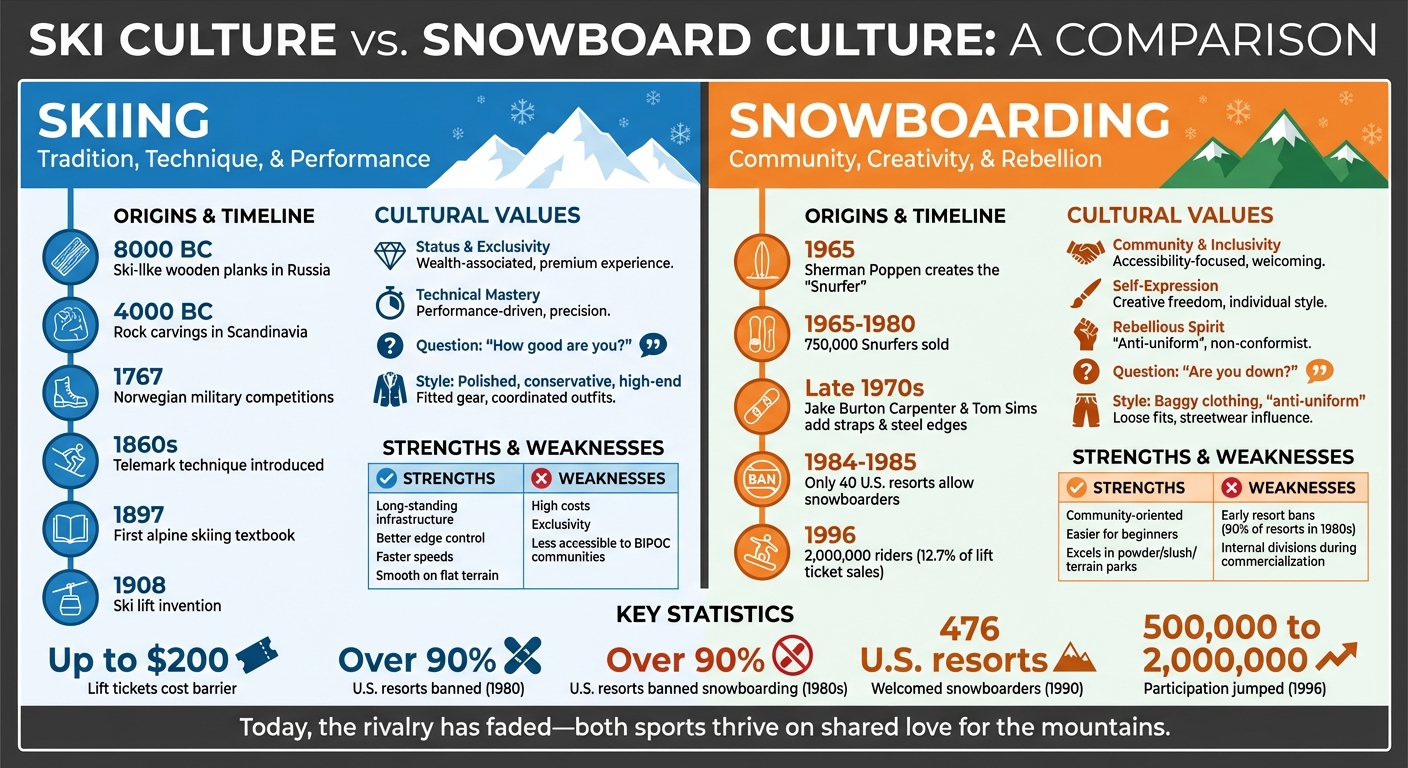
Ski Culture vs Snowboard Culture: Origins, Values, and Strengths Comparison
Once an Outlaw: A Brief History of Snowboarding and Snowboard Style
sbb-itb-236ebff
How Each Sport Began
Skiing started out of necessity for survival. Archaeological finds in Russia reveal ski-like wooden planks dating back to 8000 BC, serving as essential tools for enduring harsh winters. Rock carvings in Scandinavia from around 4000 BC further depict figures gliding on skis, highlighting their role in helping communities navigate snowy terrains.
Fast forward to the 18th century, Norwegian military units began holding skiing competitions. A major shift occurred in the 1860s when Sondre Norheim introduced the Telemark technique and innovative bindings, giving skiers better control on the slopes. By 1897, Mathias Zdarsky published the first alpine skiing textbook in Austria, solidifying the sport's foundation in Europe. Over time, skiing evolved from a survival skill into a recreational activity, but it also became associated with wealth and exclusivity. Holly Thorpe, a professor at the University of Waikato, summed up this shift:
Skiing was an expensive bourgeois sport framed by a strong set of rules of conduct. Participants were mostly white, from middle and upper classes.
The invention of the ski lift in 1908 made skiing more accessible to those who couldn’t climb mountains on their own. However, skiing’s legacy remained tied to a culture of mastery and exclusivity, shaping it as an elite pastime. This structured evolution set the stage for a very different kind of winter sport.
Snowboarding, by contrast, emerged much later and followed a less formal path. In 1965, Sherman Poppen created the "Snurfer", a simple plywood board with a rope for steering. It was marketed as a toy rather than serious sporting equipment. Despite this, over 750,000 Snurfers were sold between 1965 and 1980, mainly to kids looking for backyard fun. By the late 1970s, innovators like Jake Burton Carpenter and Tom Sims added adjustable straps and steel edges, turning snowboarding into a legitimate sport.
Initially, snowboarding faced resistance. During the 1984–1985 season, only about 40 ski resorts in the U.S. allowed snowboarders on their slopes. Unlike skiing, which catered to a wealthy and rule-bound clientele, snowboarding was youthful, rebellious, and heavily influenced by skateboarding, surfing, and punk culture.
While skiing invested in infrastructure and exclusivity, snowboarding built its identity through community. Early riders, often banned from groomed runs, created their own jumps and cultivated a culture of camaraderie. Professional snowboarder Peter Line reflected on those early days:
In the early days... every other boarder was your buddy.
This sense of belonging wasn't about skill or wealth but about shared experiences of being outsiders. These contrasting origins shaped skiing’s emphasis on status and snowboarding’s focus on community and inclusion.
1. Ski Culture
Origins and Accessibility
Skiing started as a survival skill but eventually evolved into a symbol of privilege. Competitions, first organized by Norwegian military units in 1767, introduced discipline and a focus on performance to the activity. By the early 20th century, skiing had become what Sam Baldwin described as an elitist sport, primarily accessible to the wealthy.
Ski lift infrastructure further reinforced this exclusivity. Professional skateboarder John Cardiel pointed out that participating in skiing required being "semi wealthy", with gear and lift tickets costing up to $200. These financial barriers turned ski resorts into spaces where money determined access and belonging.
This exclusivity shaped a culture where technical ability became closely tied to social status.
Cultural Values and Priorities
With its exclusive roots, ski culture placed a high value on technical skill and insider knowledge. Norway opened the world’s first ski school in 1881, and by 1932, France’s Ecole de Haute Montagne had established a professional qualification for skiing. This created a hierarchy where those who displayed speed and control earned respect, while beginners were often dismissed with nicknames like "Jerrys" or "Gapers" for their lack of skill.
Cultural analyst Chloe Zeller summed up the mindset:
You should ski as fast, confidently, and in-control as possible. If you aren't trying to ski like this, you're afraid.
This emphasis on performance extended beyond skiing technique to include specialized jargon, which acted as a gatekeeping tool for insider status. By the 1980s, snowboarding was banned at over 90% of U.S. resorts, a move aimed at preserving the exclusivity of the slopes and catering to a wealthier, more traditional clientele.
2. Snowboard Culture
Origins and Accessibility
Snowboarding grew out of youth culture, breaking away from the mountain traditions tied to skiing. Its roots can be traced to surfing and skateboarding, giving enthusiasts of those board sports a winter alternative. The journey began in 1965 when Sherman Poppen invented the "Snurfer", initially marketed as a toy. This simple creation struck a chord, with over 750,000 units sold between 1965 and 1980. The Snurfer’s success brought snowboarding into the hands of teenagers, bypassing the exclusive world of ski shops and country clubs.
Part of snowboarding's appeal lay in its accessibility. It was easier to learn than skiing and performed well in varying snow conditions. By 1996, the sport's popularity had exploded, with participation climbing from 500,000 to 2,000,000 riders. Snowboarders made up 12.7% of all lift ticket sales in the U.S. that year. This rapid growth helped shape a community that valued attitude and inclusivity over technical skill.
Cultural Values and Priorities
While skiing often revolved around the question, "how skilled are you?", snowboarding offered a more open invitation: "are you down?" This shift in perspective fostered a tight-knit, welcoming community. Professional snowboarder Peter Line summed up the early spirit of the sport by saying:
When snowboarding was in the minority, every other boarder was your buddy.
The emphasis was on fun and connection rather than competition or credentials.
Style played a big role in shaping snowboarding's identity. Riders leaned into oversized clothing - a look cheekily referred to as the "Big Jean Fantasy" - pulling inspiration from skateboarding, punk, and hip-hop subcultures [4,6]. This wasn’t just a fashion statement; it was a deliberate rejection of skiing’s more conservative aesthetic. Greg Dacyshyn, Creative Director of Burton Snowboards, captured this sentiment when describing the 2010 U.S. Olympic uniform:
a uniform, but also an anti-uniform at the same time.
The sport’s countercultural vibe was further fueled by early restrictions at ski resorts, which only solidified snowboarding's rebellious spirit [1,4,6]. This "outlaw heart and soul" became part of its DNA. A defining moment came at the 1998 Nagano Olympics when Canadian snowboarder Ross Rebagliati tested positive for trace amounts of marijuana. After an appeal, he kept his gold medal, becoming a symbol of snowboarding’s refusal to conform to traditional rules.
What Each Culture Values
The values at the heart of skiing and snowboarding reflect their unique origins and tell two very different stories. Skiing built its identity around mastery, performance, and status, while snowboarding grew from a foundation of style, community, and self-expression.
Skiing has long been associated with exclusivity. From its early days, it was defined by strict rules, high-end gear, and precise technique. Status came from more than just skill - it was about having top-tier equipment, following slope etiquette, and showcasing technical proficiency. Skiers often asked each other one clear question: how good are you? In this world, performance was the ultimate currency.
Snowboarding, on the other hand, broke away from these traditions. It thrived on rebellion and individuality, prioritizing personal expression over perfection. Professional snowboarder Terje Haakonsen summed it up well when he said:
was about personal expression and self-enjoyment, not about governing bodies, big money and being judged.
For snowboarders, the question wasn’t about skill alone - it was, are you down? Authenticity and commitment to the culture mattered far more than credentials.
This divide is visible in everything from fashion to technique. Skiing embraced a polished, conservative style, with high-end clothing that often signaled wealth and status. Snowboarding, inspired by skateboarding and hip-hop, leaned into baggy clothing that defied convention. As Burton's Creative Director Greg Dacyshyn put it:
Yeah, it's a uniform, but it's also an anti-uniform at the same time.
Even on the slopes, the two cultures diverged. Skiers earned respect by carving precise, high-speed turns. Snowboarders valued "soul" - a blend of skill, attitude, and staying true to the community's ethos.
While both sports require dedication, skill, and investment, skiing emphasizes technical mastery, while snowboarding celebrates individuality and authenticity. This contrast between proving mastery and expressing style highlights how these two cultures have shaped - and continue to influence - each other.
How They Changed Each Other
By the late 1990s, the lines between skiing and snowboarding began to blur, leading to a transformation in mountain sports. Skiers started venturing into terrain parks originally designed for snowboarders, driven by both curiosity and the desire to join in on the fun. Resorts had created these parks and halfpipes to cater to snowboarders, but young skiers saw an opportunity to try something new and exciting.
This shift gave rise to what became known as the "New School" skiing movement. Skiers began adopting tricks straight from snowboard and skateboard culture, like riding switch, sliding on rails, grinding handrails, and performing off-axis spins. The introduction of twin-tip skis made these tricks more accessible, and Jonny Moseley’s iconic 360 mute grab at the 1998 Olympics brought park skiing into the spotlight.
The cultural exchange didn't stop at tricks and gear - it also reshaped the style on the slopes. Skiers moved away from the traditional, tight-fitting outfits of the past and embraced a looser, more casual look. Baggy pants, oversized hoodies, and the "steeze" mindset - a mix of style and ease - became the new norm. This evolution was a testament to how both sports borrowed from and influenced one another, creating a fresh, youthful energy.
Sam Baldwin summed it up perfectly:
What snowboarding took from skateboarding, skiing took from snowboarding, thus skiers began sliding rails, riding switch and performing huge aerial spins, which served to attract new, young recruits to the skiing crowd.
Strengths and Weaknesses
Each sport carries its own set of strengths and challenges, shaped by its unique history and values.
Skiing benefits from its deep-rooted heritage and well-established infrastructure, which allows for better edge control, faster speeds, and smoother navigation on flat terrain. However, this rich legacy comes with a hefty price tag, making the sport less accessible, particularly for BIPOC communities. Garry Schlag, a multiracial skier and advocate, highlighted the issue:
Class and race are inextricably linked... the barriers to entry in skiing keep BIPOC folks from participating in large part due to centuries of systemic racist policies.
On the other hand, snowboarding's youthful and community-driven culture has made it a more inclusive and rapidly growing sport. It’s easier for beginners to pick up and excels in conditions like powder, slush, and terrain parks. Between the early 1980s and 1990, the number of U.S. resorts welcoming snowboarders skyrocketed from less than 10% to 476 locations. Yet, the sport faced its own challenges, such as early bans at resorts and internal divisions between "core" enthusiasts and perceived outsiders as commercialization grew.
Here’s a quick comparison of the two:
| Aspect | Ski Culture | Snowboard Culture |
|---|---|---|
| Primary Strength | Long-standing infrastructure; excels on hard pack and icy terrain | Community-oriented; easier for beginners |
| Terrain Advantage | Ideal for high-speed groomed runs and flat traversing with poles | Performs best in deep powder, slush, and terrain parks |
| Cultural Appeal | Focus on tradition, precision, and status | Highlights personal expression, freedom, and youthful energy |
| Key Weakness | High costs and exclusivity; historically unwelcoming language | Early resort bans; internal cliques during commercialization |
These comparisons illuminate the trade-offs in performance and culture that continue to shape the identities of skiing and snowboarding today.
Conclusion
Their conflict wasn’t about equipment. As Sam Baldwin, Editor and Founder of SnowSphere, explained:
In reality, the war was never really about snowboards and skis, it had more to do with a clash of classes, an older generation fearing the changes brought about by the younger generation.
This generational divide reshaped mountain culture entirely.
Snowboarding didn’t push skiing aside - it reminded skiing of its roots. When resorts welcomed snowboarders in the 1990s, it wasn’t just a survival tactic. It was a chance to reconnect with the essence of the mountain experience. Skiing absorbed freestyle influences from snowboarding, while snowboarding leaned on the established ski infrastructure to grow. Instead of competing, the two evolved together. This mutual growth fostered a more inclusive mindset on the slopes.
Today, the old rivalries have faded, and the choice between skis and snowboards is purely personal. Baldwin summed up this shift perfectly:
The bottom line is, young skiers and snowboarders today don't care whether you ride one plank or two... Today, we are all just in it for the snow.
Status symbols may come and go - fashion trends change, and high-end gear loses its allure as it becomes widespread. But the sense of community remains. Whether it’s helping a beginner, hitting the park with friends, or chasing fresh powder, the connections forged over a shared love for the mountain endure far longer than any brand or price tag.
FAQs
How did snowboarding grow from a backyard toy into a global sport?
Snowboarding traces its origins back to 1965 when Sherman Poppen created the Snurfer. This toy, crafted for his children, merged elements of surfing and skiing, laying the foundation for what would become a whole new sport. Over the following decades, improvements in board design and gear, combined with a youth-driven enthusiasm for the sport, helped snowboarding carve out its place in winter sports culture.
By the 1980s, snowboarding started appearing at ski resorts, though it initially faced pushback from traditionalists. That resistance didn’t last long. In 1998, snowboarding hit a major turning point when it became an official event in the Winter Olympics, cementing its place on the world stage. Today, snowboarding thrives as a sport that blends skill, artistry, and a tight-knit community.
How did skiing and snowboarding develop such different cultures?
The cultures of skiing and snowboarding have grown from very different beginnings. Skiing, with its roots in Europe, started as a sport closely linked to class, skill, and performance. It was a discipline where mastery and technique were held in high regard. Snowboarding, on the other hand, came from a more rebellious and youth-centered background. It focused on self-expression, personal style, and creating a close community.
These origins gave rise to two distinct vibes on the slopes. Skiing often highlighted expertise and status, while snowboarding nurtured a sense of creativity and connection. This cultural contrast has shaped the way both sports evolved and impacted the mountain experience for everyone.
Why is skiing often linked to wealth and exclusivity?
Skiing has a long-standing reputation for being a sport tied to wealth and exclusivity, a perception rooted in its early history within European aristocratic circles. Back then, ski resorts were designed with the affluent in mind, offering access primarily to those who could afford the high costs and met certain social expectations.
Within ski culture itself, respect was often tied to factors like credentials, technical prowess, and performance on the slopes. This focus on skill and status fostered an environment that prioritized achievement and prestige, reinforcing skiing’s image as a luxurious and elite pastime for decades.