




Skiing used to be about loyalty to your local mountain - a place that shaped your identity and community. But the rise of multi-mountain passes like the Epic and Ikon Pass has shifted the focus from local traditions to global access. With affordable passes offering entry to dozens of resorts, skiing has become a nomadic experience. Remote work, housing price surges, and social media have further transformed ski towns, pushing out traditional ski bums and replacing them with affluent travelers. Technology and digital tools now connect skiers across locations, creating portable communities that prioritize shared experiences over fixed destinations. While this new model offers flexibility, it comes at the cost of losing the unique charm and deep connections once tied to a single mountain.
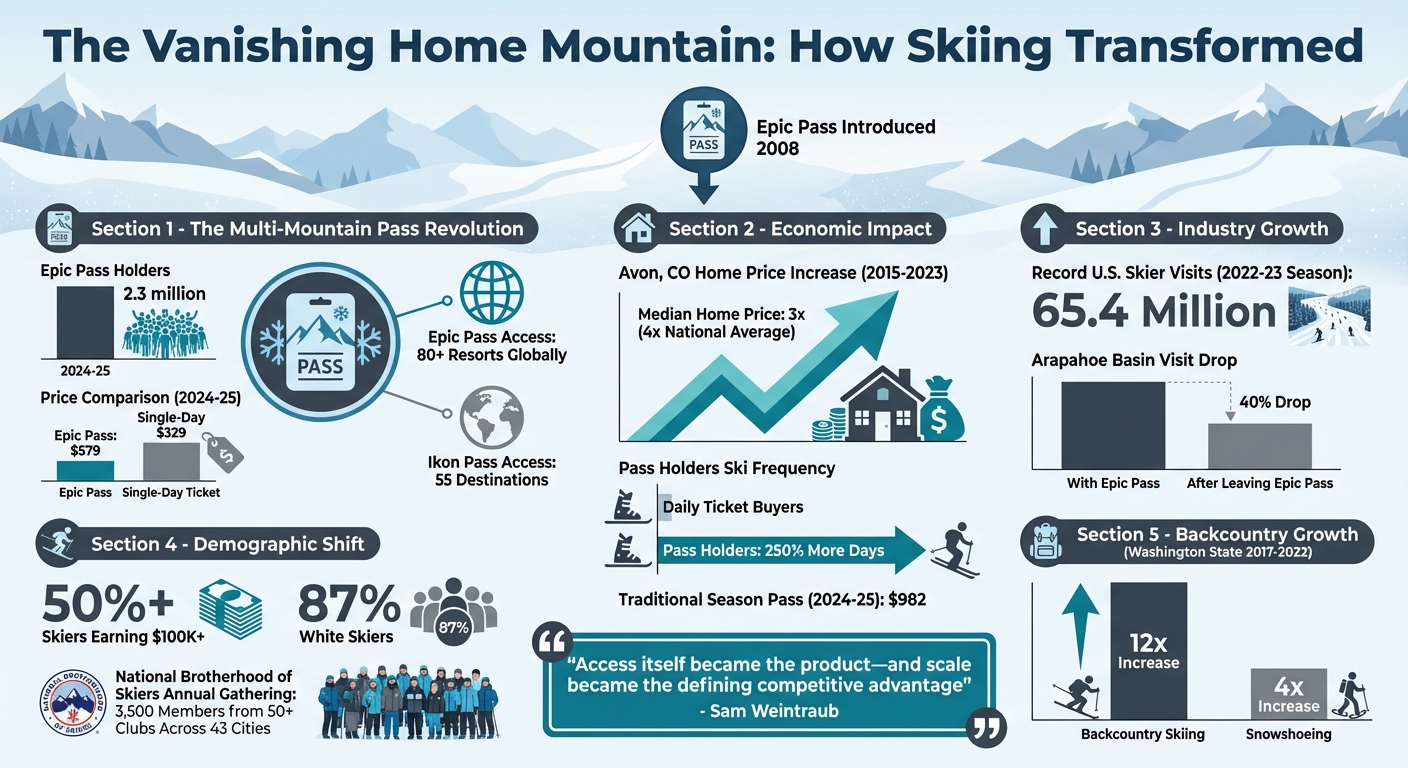
The Transformation of Skiing: Key Statistics on Multi-Mountain Passes and Changing Demographics
IKON is Trying to Turn Your Ski Hill Into DISNEYLAND (And why I Hate it): Ski Industry Gossip
sbb-itb-236ebff
The Decline of the Home Mountain
Then, winter stopped being local.
In 2008, Vail Resorts introduced the Epic Pass, followed by Alterra's Ikon Pass. These multi-mountain passes changed everything. For under $1,000, skiers gained access to over 40 resorts across the globe. By the 2024–25 season, Vail alone had sold 2.3 million Epic Passes. Suddenly, the $329 price tag for a single day at one mountain seemed absurd when a season pass unlocked dozens. The ski industry had shifted, and Reed Hastings, CEO of Powder Mountain, summed it up perfectly:
"I look at Epic and Ikon, and I'm like, 'That's a great business model!' It's an innovation... but it sort of turns a lot of skiing into Costco"
This shift moved skiing away from the idea of a "home mountain" and toward a sprawling, borderless experience.
Remote work only sped things up. Professionals who once visited ski towns for a weekend started moving in full-time, laptops in hand. These higher-income newcomers transformed ski towns into year-round lifestyle destinations. Housing prices skyrocketed. In Avon, Colorado, the median home price tripled between 2015 and 2023 - four times the national average. The traditional ski bum, once a fixture of mountain culture, couldn't keep up. Malachi Artice, a skier in Jackson, Wyoming, put it bluntly:
"A lot of people here are living a fantasy I can't obtain"
This economic shift reshaped ski culture, and digital platforms added fuel to the fire.
Social media redefined skiing. Instagram turned powder days into global spectacles. Sitting in Colorado, you could scroll through photos of Japan's untouched backcountry and suddenly feel like your local mountain wasn't enough. Geotagging exposed once-hidden stashes, and the culture shifted from local camaraderie to global bucket-list chasing. Skiing became less about knowing the bartender at your mountain and more about collecting experiences across continents.
The numbers tell the story. The 2022–23 season set a record with 65.4 million skier days in the U.S.. But that growth wasn’t evenly spread. Resorts tied to the Epic and Ikon networks were packed. Former U.S. Congresswoman Mary Bono described the scene:
"The photos out of Vail are epic. Epic Pass, oh my God, those crowds. Epic lines"
In contrast, Arapahoe Basin, which left the Epic Pass to preserve its local vibe, saw visits drop 40% during the same season. The message was clear: access had become the product, and scale was the key to staying competitive.
The concept of a home mountain began to fade. The industry’s focus shifted to mobility and global access. Loyalty to a single mountain gave way to a more fluid sense of belonging, tied to people rather than place. The tradition of returning to the same mountain every winter started to feel like a relic of the past. This isn’t about losing passion - it’s about belonging evolving from a fixed location to a shared experience with others.
1. Cultural Shifts in Skiing
From Identity to Inventory
Skiing has transformed over the years from being a deeply personal pursuit tied to a single mountain to a broader quest for access and variety.
Back in the 1990s, skiers were often loyal to one mountain, locked in by the high cost of single-resort passes. But the introduction of affordable multi-mountain passes changed everything. As Sam Weintraub, founder of PeakRankings, explained:
"Access itself became the product - and scale became the defining competitive advantage"
This shift redefined skiing. Instead of being about a skier's connection to one mountain, it became about gaining access to as many slopes as possible. The result? A push toward corporate standardization. Unique mountain personalities, once brimming with local charm and traditions, were replaced by streamlined operations aimed at efficiency and brand consistency. Quirky features like secret smoke shacks, lively tailgating scenes, and independent shops started disappearing, sacrificed in the name of uniformity.
These changes have hit local communities hard. The traditional "ski bum", known for working odd jobs just to spend 100 days on their favorite mountain, is slowly being edged out. Replacing them is a wealthier, more transient crowd that prioritizes variety over deep-rooted connections. Sierra Shafer, editor-in-chief of SKI Magazine, put it bluntly:
"If we lose the ski bum as that north star, it just starts to become a very homogenous, corporate production and not an experience, not a way to like, find your identity"
The numbers paint a clear picture: over 50% of U.S. skiers now earn more than $100,000 annually, and 87% are white. This growing homogeneity underscores a cultural shift. Skiing is becoming less about the mountain itself and more about a mobile sense of community, where belonging is tied to the group you’re with, not the slopes you call home.
2. Impact of Multi-Mountain Passes
The Economics That Killed Spontaneity
The introduction of the $579 Epic Pass by Vail Resorts in 2008 marked a turning point in skiing’s economic landscape. This pass not only made skiing more accessible for some but also fundamentally changed how people approached the sport. Single-day ticket prices skyrocketed, reaching as high as $329, while season passes climbed to $982 by 2024–25. These shifts made skiing less of a last-minute decision and more of a pre-season financial commitment.
This pricing model didn’t just affect budgets - it reshaped how skiers planned their trips. Sam Weintraub, founder of PeakRankings, captured this change perfectly:
"The era of planning destination ski vacations a few weeks in advance is dead here in North America - and if you want to practically spend time in the mountains now, you either need to commit well before the season starts or stick with a smaller, independent ski area."
The rise of multi-mountain passes like the Epic Pass encouraged skiers to prioritize expansive resort networks over local favorites. With over 2 million Epic Pass holders, the focus shifted from loyalty to one mountain to exploring a system of resorts. Once someone invests over $1,000 in a pass, it’s hard not to make the most of it. Pass holders now ski 250% more days on average compared to those who buy daily lift tickets.
This shift had a profound impact: the idea of a "home mountain" started to disappear. Instead, skiing became a nomadic experience, driven by financial commitments and the desire to maximize value. What was once a spontaneous weekend activity transformed into a carefully planned season-long endeavor.
3. Rise of Nomadic Skiers
The New Breed: Jet-Setters Replace Ski Bums
Gone are the days when skiers stuck to their local mountains. Today’s skiers are crisscrossing continents, hitting 50 to 80 resorts in a single season. Passes like the Epic Pass, which opens the door to over 80 ski areas, and the Ikon Pass, with access to 55 destinations, have made this jet-setting lifestyle not just possible but increasingly common. The idea is simple: why ski one mountain when you can explore dozens with a single pass?
But this shift has come at a cost. The traditional ski bum - once a year-round fixture in mountain towns - is being edged out. Skyrocketing housing prices and the high costs associated with modern skiing have made it difficult for them to stay. Instead, affluent travelers, who can afford both the passes and the pricey accommodations, are taking their place. As one analysis from Slate puts it:
"The new business model is attracting jet-setters and displacing ski bums. Mountains are losing their culture as the same two companies take over lodge after lodge after lodge." – Slate
This corporate-driven transformation is reshaping mountain communities, replacing their local charm with a more polished, commercial atmosphere.
Climate change is also playing a role in this trend. With snowfall becoming less predictable, having a pass that covers multiple regions acts as a safety net. If Colorado has a weak season, skiers can pivot to Utah or British Columbia to find better conditions. For today’s nomadic skier, it’s not just about chasing thrills - it’s about staying one step ahead of nature’s unpredictability.
This shift in mindset naturally leads to the growing importance of digital tools and group strategies in shaping the modern winter sports experience.
4. Digital and Crew-Based Coordination
The Tech Stack That Keeps Crews Connected
Skiing today is as much about staying connected as it is about hitting the slopes. Modern ski crews rely on real-time tech tools that were once unimaginable. Apps like SkiLynx and Snoww allow groups to track each other's precise locations on resort maps, making meet-ups on the mountain seamless.
Communication has gone hands-free, too. With BONX, Bluetooth earpieces create "talk rooms" for up to 10 people, using Voice Activity Detection so you can chat without ever pulling out your phone. Professional snowboarder Kazuhiro Kokubo explains how this tech transforms teamwork:
"When I'm in the backcountry building my own kickers, I can hear the other members while they are filming and deciding on camera angles in different places. I love how we can communicate so easily"
Sarah Stocker, co-founder of SkiLynx, sums it up perfectly:
"Skiers want to stay connected on the hill, but they don't want to be on their phones the whole time"
These tools create a moving village - a connected, roaming community. Crews use Fatmap for immersive 3D terrain mapping in unfamiliar backcountry areas. They challenge each other with Carv scores, which provide Ski:IQ ratings based on metrics like pressure and edge angles, helping them compete and improve. With pre-set, one-tap messages, they can coordinate meet-ups without the hassle of taking off gloves.
This isn't just about convenience - it's the backbone of nomadic skiing. These technologies make it possible for crews to stay connected and reassemble anywhere there's snow. Without them, every adventure might feel like starting over with new people. With them, shared winter journeys become easier and more memorable.
5. Future of Belonging in Winter Sports
The Portable Community Model
Thanks to digital networks, winter sports communities are evolving in a major way. Belonging is no longer tied to a single mountain or resort - it’s now about being part of a portable community. The focus has shifted to finding your crew and sharing the thrill of snow-covered adventures, no matter where they take place.
Take the National Brotherhood of Skiers (NBS) as an example. Every year, this organization brings together 3,500 members from over 50 clubs across 43 U.S. cities for their annual Black Summit. They don’t rely on a single home base; instead, they create their own unique culture wherever they go. Donny O'Neill from Protect Our Winters puts it perfectly:
"When the NBS brings a few thousand people to a ski resort, it changes the complexion of that mountain and helps move that shift along. It helps keep the industry aware that everybody deserves a part of the outdoors and the happiness that comes along with it."
This idea of portable communities, supported by clubs and digital networks, is reshaping how winter sports enthusiasts come together.
Now, the mountain is just the backdrop. The real focus is on the shared experience and connection among people. Adaptive sports communities are breaking down physical barriers, groups like Protect Our Winters are rallying around climate action, and organizations such as The Snow League are building a global snowsports network. Digital platforms make all of this possible by connecting people across resorts, organizing group activities, and even enabling real-time storm chasing. Social media also plays a key role, helping coordinate responses to policy changes and uniting people under shared goals. In this new model, you’re part of a network - a pass ecosystem, a crew, or a movement - that spans across locations instead of being anchored to just one.
The numbers back this up. Between 2017 and 2022, backcountry skiing in Washington State grew by 12×, while snowshoeing saw a 4× increase. This shift highlights how loyalty to a single resort is being replaced by the flexibility and connectivity of digital communities. The future of winter sports is less about owning a piece of a mountain and more about embracing a network that travels with you, wherever the snow takes you.
Conclusion
The disappearing concept of a "home mountain" reflects broader changes in how we live and connect. Today, belonging often feels less tied to a fixed place and more to fluid communities. We rent instead of owning, subscribe rather than committing, and prioritize networks over neighborhoods. This shift is evident in the ski world, where the 2022–2023 season saw a record 65.4 million visits to U.S. mountains. Multi-mountain passes have enabled skiers to chase powder across continents rather than staying loyal to one valley. It’s not about losing loyalty - it’s about redefining what it means to belong. But with this evolution comes new challenges, both on and off the slopes.
This mobility isn’t without its costs. As Heather Hansman, author of Powder Days, explains:
"Ski towns - some of the most elite and economically unequal places in the country - are microcosms for the way our social fabric is splitting".
While affluent skiers embrace the flexibility of expensive passes, many long-time locals find themselves priced out, struggling to keep up with rising costs. The idea of portable communities fosters new connections, yet it often leaves behind the very people who shaped the culture of these mountains in the first place.
Interestingly, technology is playing a surprising role in bringing back the importance of shared on-mountain experiences. In an era where algorithms fine-tune decisions and AI chatbots handle nearly a million guest interactions, the value of physical presence in extreme environments is growing. As platform architect Enrico Piovesan observes:
"The mountain requires no metrics - it simply invites movement".
On the chairlift, a CEO and a ski bum can sit side by side, sharing the same cold air and anticipation of the next run. This unfiltered, physical connection reminds us of a collective winter identity that no algorithm can replicate.
The future of skiing won’t mirror its past. The idea of a fixed "home mountain" is fading, replaced by a dynamic world of traveling crews and portable communities. Yet, this new model offers something unique: a sense of belonging that moves with you, wherever the snow falls. The real question isn’t whether skiing can adapt to these changes - it’s whether the heart of the sport, with its spontaneous camaraderie, shared challenges, and stories told in person, can thrive in a world increasingly driven by efficiency and optimization.
FAQs
Do Epic and Ikon passes actually make skiing cheaper?
Skiing frequently can become more budget-friendly with Epic and Ikon passes. These passes bring the average daily cost down to about $33, making them a smart choice for avid skiers. However, it's important to remember that the overall expenses for a ski trip - like lodging, equipment rentals, and other travel-related costs - can still add up quickly. While these passes help with lift ticket savings, planning for the full range of expenses is key to managing your ski budget effectively.
Why are ski towns getting so expensive so fast?
Ski towns are seeing rising costs, largely due to industry consolidation. The popularity of multi-mountain passes has led to increased demand, which in turn has driven up rents. As a result, many of these areas now resemble company towns, where both locals and visitors face higher expenses to enjoy or live near these destinations.
Can skiing keep its culture without a home mountain?
Skiing can preserve its spirit through shared experiences and strong community ties, even in the absence of a permanent home mountain. As the sense of belonging moves from a specific location to the camaraderie of the group, skiers bring the culture along wherever they go. They build connections through traveling together, coordinating online, and spending meaningful time carving turns on the slopes.