




Skiing has shifted from being all about speed and skill to offering a full mountain experience. It's no longer just about performance or high-end gear; it's about enjoying the day, connecting with others, and embracing the social aspects of the sport. Long lunches, après-ski parties, and shared moments now define the slopes as much as the skiing itself.
Key takeaways:
- Performance is still valued, but it's not the sole focus anymore.
- Social experiences like après-ski and events have become central.
- Fashion blends functionality with everyday style, making ski gear versatile.
- Snowboarding's influence has helped skiing prioritize self-expression and community.
- Social media highlights memories and moments over stats, reshaping how people engage with the sport.
Skiing today is about welcoming everyone, whether you're a seasoned pro or just there for the atmosphere. The sport has grown to reflect a broader, more connected experience.
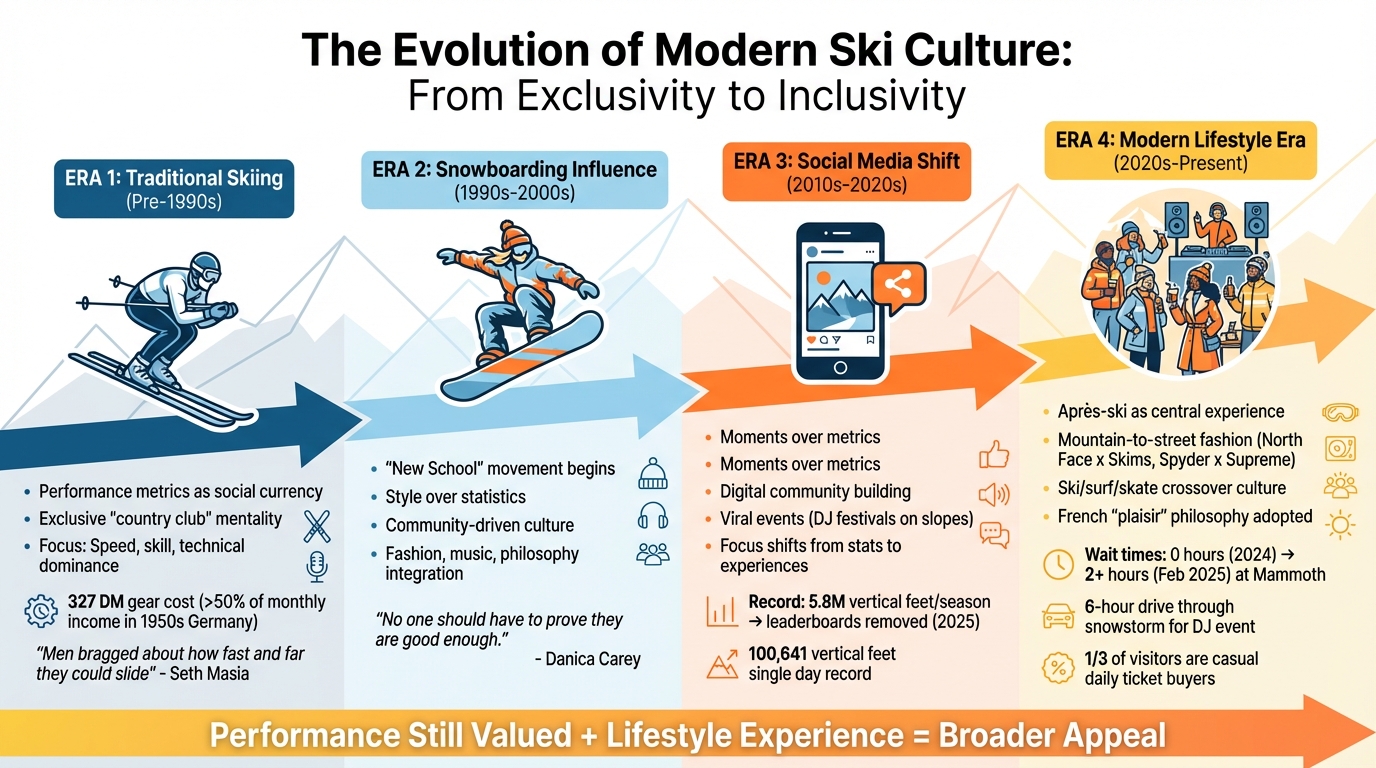
Evolution of Ski Culture: From Performance-Driven Exclusivity to Inclusive Lifestyle Experience
Performance Used to Be the Entry Ticket
Gear and Skill as Social Currency
Skiing wasn’t always about casual fun or family vacations. Back in the day, it was a sport where your skill and style did the talking. If you could carve a perfect turn or tackle a steep black diamond run with ease, you earned respect on the slopes. And it wasn’t just about how you skied - it was also about what you skied with. As Seth Masia, President of the International Skiing History Association, explains:
"By medieval times it was seen as a macho skill; men bragged about how fast and far they could slide".
This mentality carried over into modern ski culture, where gear became just as important as technique. A pair of custom-made skis or a sleek Moncler jacket were more than just tools or outerwear - they were badges of status. In early 1950s West Germany, for instance, ski equipment and clothing cost around 327 Deutsche Marks, which was over half the average monthly income at the time. These high costs made skiing a luxury, ensuring that only a select few could afford to participate. Being part of this exclusive group wasn’t just about skill - it was also about showing you belonged.
Gatekeeping in Old-School Ski Culture
The exclusivity of skiing didn’t stop at expensive gear. The sport itself became a gated community, where insiders decided who was in and who was out. Danica Carey, Director of Marketing Operations at Seirus Innovation, put it bluntly:
"Skiing became a country club-level powerhouse in exclusion. Some people want to maintain the perception that skiing has to be an exclusive club because it makes them feel powerful".
This sense of exclusivity showed up in everyday interactions on the slopes. Wearing the wrong brand or showing up in outdated gear? You’d likely face judgment - or worse, outright mockery. In the U.S., skiing was treated as a test of dominance, with a coaching style that emphasized aggressive, performance-based techniques like keeping a squared chest and flexed ankles.
Even the infrastructure reinforced this exclusivity. When Walter Paepcke opened Lift No. 1 in Aspen, Colorado, in 1947, it wasn’t just about giving skiers access to the world’s longest chairlift - it was about creating a destination for the elite. Paepcke wanted Aspen to remain a haven for the select few, not a place overrun by the masses. The message was clear: skiing wasn’t for everyone, and that was by design.
sbb-itb-236ebff
The Lifestyle Layer Took Over
As the focus on performance metrics faded, skiing evolved into a full-day lifestyle experience, blending adventure, social connections, and style.
Après-Ski as the New Social Hub
What used to be a quick post-ski stop has transformed into a centerpiece of the experience. Take Mammoth Mountain, for instance - by February 2025, their weekly après-ski parties featuring Los Angeles DJs drew such massive crowds that wait times stretched over two hours. Compare that to the previous year when there were no lines at all.
The appeal of après-ski now reaches a diverse crowd. At Vail’s "Experts Only" festival the same month, attendees braved a snowstorm and turned a two-hour drive into a six-hour journey just to catch DJ John Summit’s set. Resorts are tapping into this energy by booking big-name EDM artists and constructing custom stages, turning ski areas into vibrant day clubs accessible straight from the chairlift.
Travel-First Adventures
Ski trips today are less about tallying up vertical feet and more about the destination, atmosphere, and camaraderie. As freelance writer Kristy Alpert noted during a trip to France, the difference in approach was clear. While Americans munched on protein bars between runs, her French guide questioned, "Why don't you eat lunch?" Over there, skiing is about plaisir - a full mountain experience that includes leisurely meals and meaningful conversations.
This European mindset is gaining traction in the U.S., especially as the economics of skiing shift. With lift tickets, gear rentals, and food prices climbing, the focus is moving away from maximizing runs to embracing the overall experience.
Naturally, this broader perspective on skiing extends to what people wear, merging technical performance with everyday style.
Mountain-to-Street Apparel
The shift in lifestyle is mirrored in ski fashion, which now blends mountain functionality with street-ready style. This trend dates back to the 1950s when Bogner introduced stretchy pants that worked both on the slopes and at après-ski. Fast forward to today, and collaborations like The North Face with Skims and Gucci, or Spyder with Supreme, have taken this concept to new heights.
These hybrid designs now go beyond the mountain, becoming everyday wardrobe staples. As Anna "Teddy" Tedstrom, owner of Hoohah, explains:
"You choose your clothes because they fit your personality and they describe who you are. And I don't think that should be different from the clothing you wear outdoors".
Modern ski fashion embraces versatility with 3-in-1 designs, retro-inspired silhouettes, and luxurious "chalet-ready" looks from brands like Moncler and Prada. It’s a reflection of a culture where the full-day experience - both on and off the slopes - takes center stage.
Snowboarding Changed the Rules First
Long before skiing embraced a lifestyle and community-driven ethos, snowboarding had already broken away from tradition. It introduced a rebellious spirit that valued creativity and self-expression over rigid technical benchmarks [1,3,14]. This fresh perspective didn’t just challenge the norms - it redefined them. Snowboarding’s approach laid the groundwork for two major shifts: a focus on personal style and a sense of community.
Style and Expression Over Numbers
Snowboarding turned its back on the idea that success was measured by speed or stats. Take the example of snowboard instructor Ester Francus, who logged an impressive 100,641 vertical feet in a single day at Jackson Hole in January 2023 - equivalent to more than 24 Aerial Tram laps. While the resort celebrated her feat as a marketing highlight, online communities like Reddit were less enthused, dismissing it as "trivial noise" and "vert farming". For many snowboarders, the focus isn’t on how much you ride but how you ride.
This philosophy stood in stark contrast to traditional skiing, where performance metrics often determined social standing. Snowboarders saw these metrics as distractions from what truly mattered: connecting with the mountain and enjoying the experience. Jackson Hole local Robert "Buddha" Baker summed it up perfectly:
"That's the best part of the mountain experience - it's your personal signature regardless of the metrics".
By prioritizing individuality, snowboarding opened the door to a more inclusive and connected mountain culture.
A Community-Driven Culture
Snowboarding also brought a new social dynamic to the slopes. While skiing could sometimes feel exclusive - like a country club where skill was a barrier to entry - snowboarding embraced camaraderie. Danica Carey, Director of Marketing Operations at Seirus Innovation, highlighted this shift:
"No one should have to prove they are good enough at skiing to get an invitation to the conversation".
This emphasis on shared experiences over individual achievements became a blueprint for change. Snowboarding infused mountain culture with elements of fashion, music, and philosophy, turning resorts into vibrant hubs for youth culture. It welcomed people who didn’t fit the traditional mold, showing skiing another way to create a sense of belonging. The result? A mountain culture that felt more inviting, dynamic, and alive.
Social Media Didn't Kill Skiing - It Reframed It
With a shift in ski culture and lifestyle, social media has reshaped what matters most on the slopes. While some critics claim platforms like Instagram and TikTok have diminished the essence of skiing, they’ve actually redefined it, moving the spotlight from sheer performance stats to shared experiences.
Moments Over Metrics
In the past, apps that tracked vertical feet turned skiing into a numbers game. For instance, one skier managed to rack up 5.8 million vertical feet in a single season, while another set a single-day record of nearly 125,000 vertical feet. Resorts even encouraged skiers to share their stats on social media, treating it as free advertising.
But by January 2025, Jackson Hole's CEO Mary Kate Buckley decided to remove the public leaderboard from the JH Insider app. The reason? Concerns that glorifying performance metrics encouraged reckless, high-speed skiing. This marked a shift in focus - from how much you skied to how you experienced it. Social media played a big role in this transformation, celebrating scenery, friendships, and shared moments as equally worthy of attention. Skiing was no longer just about the numbers; it was about the memories.
Building Community Through Digital Platforms
As the focus moved from individual accomplishments to collective enjoyment, digital tools became essential for connecting ski communities. A perfect example of this came in February 2025, when DJ John Summit hosted the "Experts Only" festival in Vail and Tahoe. The stage was set against a double black diamond run, and the event went viral, attracting crowds who braved a six-mile trek through a snowstorm to attend. Interestingly, many attendees didn’t even ski.
This shift has broadened participation. Resorts are now places where community and camaraderie matter as much as skill level. Ian Greenwood, a writer for Powder Magazine, reflected on this change:
"I could go to these features without a crew and capture the action with a GoPro, immediately reducing the moment to a two-dimensional social media clip. Instead, these memories, with repeated tellings, deepen, warp, and become pieces of group lore".
Social media hasn’t replaced the magic of the mountains. Instead, it’s given skiers new ways to share, remember, and build connections around their experiences.
Why This Isn't a Decline (It's an Expansion)
Skiing is no longer just about chasing performance; it's about creating space for everyone to enjoy the mountain in their own way. This shift has broadened the sport's appeal, drawing in more enthusiasts and fostering a sense of community. Instead of being a test of skill, skiing has become a platform for shared experiences, especially among groups with mixed abilities.
Welcoming Mixed-Skill Groups
The days of mixed-skill groups splitting up to accommodate different levels of expertise are fading. In the past, the pressure to tackle tougher terrain or hit faster speeds often left beginners on the sidelines. Now, skiing is more about inclusivity. A beginner can enjoy a few easy runs in the morning, join friends for a leisurely lunch, and feel like an integral part of the group throughout the day.
"No one should have to prove they are good enough at skiing to get an invitation to the conversation."
This shift is particularly important when you consider that about one-third of skier visits come from people purchasing daily lift tickets rather than committing to season passes. These casual visitors are there to enjoy the mountain without the weight of a performance-driven culture, making the sport more accessible and enjoyable for everyone.
Different Entry Points into Ski Culture
Skiing’s growing inclusivity also means that people can now connect with the culture in ways that suit them best. Some are drawn to the lively social scene, others to the fashion crossover, and many to the sense of community that skiing fosters.
This lifestyle-focused approach takes the pressure off newcomers. It’s no longer about mastering the sport immediately but about embracing the joy of the experience. Kristy Alpert describes this as the French concept of "plaisir" - a full mountain experience that prioritizes connection over competition. Whether you’re learning to ski in your 30s, wearing hand-me-down gear, or sticking to groomed trails, there’s room for everyone. As local skier Robert "Buddha" Baker puts it:
"That's the best part of skiing - it's your own personal signature on whatever program you want to be on".
What Modern Ski Culture Actually Looks Like
Ski culture has undergone a transformation, shifting from a focus on pure performance to embracing a broader lifestyle. Today, it blends the aesthetics of surf and skate cultures with mountain sports, creating a unique fusion of performance and urban style.
Ski, Surf, and Skate Crossover
The lines between skiing, surfing, and skateboarding have blurred into a shared lifestyle. Back in the 1990s, the "New School" movement brought a punk-inspired, DIY attitude to skiing, prioritizing creativity and self-expression over competition. That spirit lives on today, with skiers emphasizing artistic "flow" and "lines" in their runs, while their clothing reflects a street-style vibe influenced by skate and surf culture.
In October 2021, Danica Carey, Seirus Innovation’s Director of Marketing Operations, pushed for redefining what’s considered "cool" in skiing. She highlighted how styles like "skiing in denim" and using "hand-me-down gear" challenge the sport’s historically exclusive image tied to elite country clubs. This shift in aesthetics signals a broader cultural change, where being authentic and creative matters more than sporting the latest high-performance gear.
Off-season training has also evolved to reflect this crossover culture. For example, in December 2025, Powder Gear Editor Max Ritter spotlighted the Arbor Collective X Carver Ryan Lovelace Shaper Surfskate as a crucial tool for skiers. Surfskating - using skateboards designed with surf-inspired trucks - helps skiers maintain skills like "upper/lower body separation" and build leg strength during snowless periods. This blend of skiing, surfing, and skateboarding has become a go-to training method, keeping athletes sharp year-round.
Community-Focused Events and Brands
Events in the ski world have shifted from being all about competition to becoming vibrant social gatherings. One standout example is DJ John Summit's Experts Only Festival, held in February 2025 at Vail and Tahoe. This event drew massive crowds to a stage dramatically set against a double black diamond run, despite stormy weather. Similarly, Mammoth Mountain’s weekly après-ski parties, featuring high-profile DJs and long entry lines, demonstrate how music and socializing have become central to the ski experience.
Brands are also embracing inclusivity and community in new ways. In 2022, Deluxe Skate Distribution (DLX) made waves by integrating There Skateboards, a queer-run company, into its roster. Jim Thiebaud of DLX expressed the power of skateboarding as a platform for positive change:
"This platform of skateboarding gives you this really loud voice to try and do great shit, to try and help people, to try and change the world".
This ethos - using outdoor sports as a force for connection and progress - perfectly captures the essence of modern ski culture. By prioritizing creativity, inclusivity, and a sense of community, today’s ski scene is breaking away from its traditional roots and embracing a broader, more dynamic identity.
Conclusion: Skiing Didn't Lose Its Edge - It Gained Range
The evolution of ski culture isn’t about watering down the sport - it’s about making it accessible to more people. While hardcore skiers still chase vertical feet and push technical boundaries, the sport has grown to welcome a wider range of participants. This shift has created a balance between high-performance thrills and a sense of community.
Gone are the days when skiing was dominated by gear-obsessed gatekeeping. Today, the sport offers multiple ways to join in. Whether you’re the type to clock endless runs or someone who prefers to savor long lunches while enjoying the mountain views, both approaches now define what skiing is all about.
The lifestyle aspect - think après-ski, music festivals, and fashion that transitions from mountain to street - has opened new doors without overshadowing the sport itself. Someone might come for a DJ set at the base lodge, fall in love with the vibe, and eventually decide to give skiing a try. Or they might simply become part of the broader community that helps sustain the resorts. This inclusive atmosphere is reshaping what it means to belong in the ski world.
What’s happening is a cultural shift that prioritizes inclusivity over exclusivity. The idea of “cool” has evolved to celebrate shared experiences and welcoming groups rather than rigid cliques. Elements like après-ski gatherings and versatile mountain-inspired clothing enhance this new standard, creating a richer, more layered experience. The French have long embraced skiing as plaisir - a joyful mountain experience that blends relationships, scenery, and indulgences like wine and chocolate. American ski culture is finally catching on.
This isn’t a loss for the sport - it’s growth. Performance still holds its place, but it’s no longer the only measure of value on the mountain.
FAQs
How has après-ski transformed the culture of skiing?
Après-ski has transformed from a simple post-ski ritual into a cornerstone of ski culture. These days, it’s less about tracking your speed, flaunting the latest gear, or perfecting technique. Instead, the focus has shifted to the social side of skiing - whether that means sharing drinks, indulging in a leisurely lunch, or kicking back in a warm, inviting lounge.
This change has opened the slopes to a broader crowd, welcoming those who cherish the camaraderie and lifestyle as much as the skiing itself. For many, the true highlight of the day isn’t just the runs but the connections made and the moments shared, turning skiing into an experience that’s as much about the people as it is about the mountain.
How has snowboarding influenced modern ski culture?
Snowboarding has significantly reshaped the world of skiing, turning it into much more than a sport centered on performance. By highlighting individuality, style, and a sense of community, snowboarders helped shift the focus from just technical skill to embracing a full lifestyle. This evolution inspired skiers to adopt elements like casual fashion, social hangouts, and outings that welcome all skill levels.
The skateboarding and surfing roots of snowboarding brought a fresh energy to ski culture, making it feel more open and inviting. Skiing began to move away from its traditional emphasis on precision and technique, evolving into a scene where creativity, shared moments, and social connections hold just as much value as time spent carving down the slopes.
Why is fashion and self-expression becoming more important in ski culture?
Modern ski culture isn’t just about carving the perfect turn or racing down the slopes anymore. It’s become a way for skiers to express themselves, blending performance with personal style. This evolution has shifted the focus from traditional markers like speed or technique to a broader celebration of individuality. Now, everything from clothing and accessories to how a skier spends their day at the resort is an opportunity to showcase personality.
The rise of après-ski culture has been a game-changer. Ski resorts have transformed into lively social hubs where the vibe, shared experiences, and eye-catching outfits are just as important as the runs themselves. Add social media into the mix, and the emphasis on aesthetics and community has only grown. Fashion has become a powerful way for skiers to connect and feel like part of the scene, making the slopes as much about self-expression as they are about skill.