




I see one clear lesson for skiing: give people a group to join, then help them get onto the snow. Start with beginner lessons, shared rides, and low-cost meetups - not just clothing.
Malibu Ski League reported more than 500 orders in its first eight months, but sales alone don’t tell us how many people started skiing. I’d track first-time visits and return days separately from revenue.
Here’s what I take from the six brands:
- Malibu Ski League: Use ski-and-surf clothing and year-round trips to keep people connected.
- Malbon Golf: Make the sport feel less tied to old dress codes, without mistaking private events for open access.
- Metalwood Studio: Give heritage designs a new look, then give buyers a reason to play.
- Eastside Golf: Show who belongs through founder stories and representation, while keeping price barriers in view.
- Bogey Boys: Turn a founder’s love of the game and retro style into reasons to gather.
- Random Golf Club: Put friendship and casual play ahead of scores and status.
My takeaway: <u>belonging is a start, not a substitute for access.</u> Apparel, memberships, media, and trips can support a community. But skiing still requires snow, equipment, instruction, and travel. The test is whether those connections help people learn, participate, and come back.
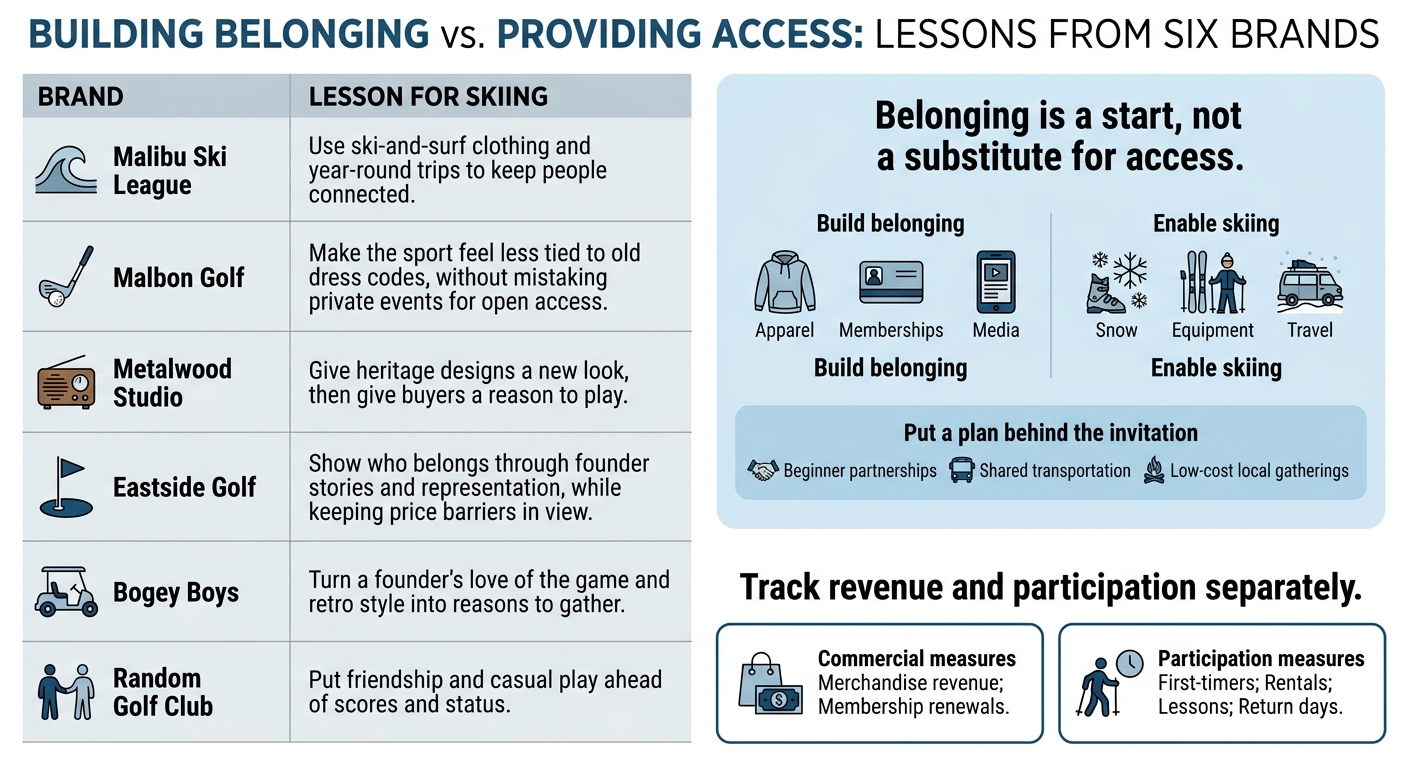
Six Brand Lessons for Building Ski Communities
1. Malibu Ski League
Style and Heritage
Like golf’s new brands, Malibu Ski League sells a scene before it sells ski gear. Malibu Ski League fuses skiing and beach culture, reflecting founder Lichota Seidewand’s own life. Its ski-and-surf apparel uses “USA Snow Team” heritage styling and playful names like “Seasonally Confused” and “Le Malibomber.” The goal is identity, not performance: familiar winter imagery feels current without losing its roots.
Stories and Participation
Seidewand launched the brand in January 2024, after leading more than 30 group ski trips over seven years.
Its “Forever Summer” retreats extend the brand beyond ski season with sunrise surfs, beach volleyball, and bonfires. Those gatherings make the ski-and-surf identity feel real instead of purely aesthetic.
Revenue and Access
Apparel gave Seidewand a practical place to start, drawing on his e-commerce experience while working with limited capital.
In its first eight months, Malibu Ski League reported selling more than 600 items and shipping more than 500 orders, with no marketing spend. Those figures show demand for the brand, not measured growth in skiing participation.
Apparel and membership revenue fund trips, events, and donations, including to the Share Winter Foundation. The result is a brand built to turn apparel sales into real-world participation.
That is the pattern golf’s newer brands proved first: identity and gatherings can matter as much as product.
sbb-itb-236ebff
2. Malbon Golf
Malbon helped change the world around golf, not the game itself. If Malibu Ski League shows the lifestyle side of the shift, Malbon shows how far golf could go when fashion and heritage were treated as part of the product.
Style and Heritage
Malbon made golf look contemporary without stripping away its codes; it treated heritage as something to remix, not preserve behind glass.
Stories and Participation
Malbon’s value is not just what it sells, but the permission it gives people to belong before they look like traditional golfers.
Revenue and Access
Cultural pull and access are different. Limited drops, private events, and members-only moments deepen loyalty, but they do not solve participation by themselves. Ski brands can borrow the same idea, but only if they build real ways to gather, travel, and play - not just better-looking product. The next question is how far that model can stretch before access becomes only a marketing tool.
That model opened the door for brands that pushed even further into design, subculture, and media. From there, the category split into more design-driven and culture-first models.
3. Metalwood Studio
Style and Heritage
If Malbon proved golf could look fresh, Metalwood pushed the idea further into design culture. Metalwood shows how golf heritage can feel current when it is filtered through design culture rather than nostalgia alone. Skiing can borrow that approach: pair heritage imagery with contemporary design rather than relying solely on technical performance.
Stories and Participation
Apparel becomes the entry point; community makes it stick. For skiing, that means giving people a wearable connection to the sport before bringing them into gatherings and a membership model. It speaks to people drawn to mountain and ocean culture.
Revenue and Access
Merchandise can spark interest, but it does not prove participation. For skiing, the real test is whether a brand turns identity into time on snow and repeat involvement.
That is where the strongest golf brands move next: from style alone to a wider community model. The next step is bigger than aesthetics: brands have to turn identity into places to gather and play.
4. Eastside Golf
Style and Heritage
Where Metalwood leaned on design culture, Eastside Golf centers representation. Olajuwon Ajanaku and Earl Cooper founded Eastside Golf to address golf’s lack of representation. Ajanaku’s difficulty finding sponsorship as a professional golfer helped inspire its Sweatshirt Golfer logo, connecting Black culture to golf while challenging traditional dress codes.
Skiing can modernize its look without changing the sport.
Stories and Participation
Eastside Golf’s clothing comes from founder experience, not just design. That story gives the apparel a clear job: make belonging visible.
Revenue and Access
Eastside Golf’s apparel and collaborations support its inclusion mission, but premium pricing can limit its reach among the audience it aims to welcome.
For skiing, the harder question is whether culture can lower the barrier to entry, not just sharpen the image.
5. Bogey Boys
Style and Heritage
Bogey Boys makes golf heritage feel current through retro-inspired apparel. For skiing, the lesson is that heritage can signal belonging without locking the sport into old rules: identity first, product second.
Stories and Participation
The brand matters most when its story becomes a reason to gather, not just a reason to buy. Founder Macklemore’s enthusiasm for golf gives Bogey Boys a personal narrative; the participation test is whether that interest encourages people to play.
Revenue and Access
Cultural access is not financial access. An inviting identity can lower the social barrier to entry, but selling apparel does not by itself make either golf or skiing more affordable.
6. Random Golf Club
Style and Heritage
Random Golf Club sells belonging through participation, not country-club status. The shift is cultural, not technical: golf feels social before it feels technical.
Stories and Participation
Random Golf Club’s “All Are Welcome” mantra puts the round ahead of the score for people put off by golf’s rigid etiquette. For skiing, that means making room for first-day nerves, learning, and friends - not just showcasing performance.
Revenue and Access
Merchandise can start the community, not define it. The next question is how events, trips, and casual formats turn interest into actual participation.
How Stories and Gatherings Bring People Into the Sport
Random Golf Club showed that casual formats make a sport feel social before it feels technical. Skiing needs the same kind of invitation: if the entry feels closed, most people never reach the mountain.
Malibu Ski League puts that invitation plainly: "You can show up solo - you’ll leave with a group chat."
That invitation lowers the barrier to entry by putting belonging before athletic ability. But the message needs people to show up - not just like the idea.
Malibu Ski League backed its invitation with member trips and in-person events in 2024–2025.
Repeat turnout offers stronger proof than an initial visit.
"The signal that mattered most was simple: people kept coming back and word of mouth continued to grow."
The brand’s posted 2025–2026 plans should be read as invitations, not turnout data.
The next question is how to turn that energy into lasting access, not just a good atmosphere: how to help people participate again and again without making the sport’s story all about products.
Revenue and Access: What Skiing Can - and Cannot - Borrow
Golf’s lifestyle brands sell participation before equipment. Skiing can borrow that model, but not its economics. Newer golf businesses reach beyond equipment into apparel, media, memberships, and travel. Those revenue streams can draw a larger audience, but changing the sport’s culture takes actual participation.
| Factor | Golf’s lifestyle brands | Skiing’s access reality |
|---|---|---|
| Revenue streams | Apparel, media, memberships, and travel supplement equipment sales and green fees | Apparel, memberships, and trips can broaden reach, but gear, lift tickets, and travel still shape the sport |
| Geography and frequency | Nearby courses and ranges can allow shorter, repeated outings | Mountain travel can make skiing an occasional trip rather than a weekly habit |
| Seasonality | Suitable climates allow year-round play | Skiing depends on snow; off-season gatherings can keep people connected |
| Equipment and costs | Clubs, balls, and shoes add costs; rentals and range visits can lower the initial commitment | Gear, lift tickets, rentals, transportation, and lodging costs can stack up |
That gap between a lifestyle audience and actual participation is where ski brands have the most to learn.
Malibu Ski League started with 10 apparel items in January 2024.
Belonging is not access. Premium clothing can replace one status barrier with another. Golf’s lifestyle shift does not remove equipment costs or premium-club barriers; skiing’s version cannot remove snow, lifts, gear, or travel.
An invitation needs a plan behind it: beginner partnerships, shared transportation, and low-cost local gatherings.
Malibu Ski League’s donation to the Share Winter Foundation is a separate, concrete step toward supporting youth access.
Track revenue and participation separately. Measure merchandise revenue and membership renewals on one side, and first-timers, rentals, lessons, and return days on the other.
The harder job is turning revenue into reasons to gather, learn, and return.
Conclusion: Build More Around Skiing
Skiing can borrow golf’s stories and gatherings without changing the sport itself. The test is whether that style gets more people involved.
That history shows skiing grows faster when people organize shared experiences, not just products.
Malibu Ski League’s year-round identity points to the real opportunity: keep friendships active beyond ski season and measure success by whether those connections bring people back to the mountain. Tell stories about the people who teach, organize, and keep local ski communities going - not just the clothes they wear.
Could skiing’s next wave of growth come from making the world around it more appealing, easier to join, and more connected to people’s lives - rather than changing the sport itself?
FAQs
How can I find beginner-friendly ski gatherings?
Join community-focused organizations like Malibu Ski League, which puts welcoming events ahead of strict skill requirements. These groups often host group trips, weekend pop-ups, and opening-day gatherings for all skill levels. Membership may also give you early access to event dates and announcements.
Look for gatherings with activities for different experience levels. Gear-care and safety workshops can be approachable ways to get started.
Can ski communities stay affordable as they grow?
Ski communities can grow while staying affordable by putting community-led development ahead of expensive, top-down marketing. Group trips, social meetups, word of mouth, and stories from community members help people get involved and support long-term growth - without the high costs of resort advertising.
Affordable, accessible apparel, events that welcome everyone, and mentorship give people more ways to connect. That keeps participation rooted in a shared love of skiing, rather than exclusivity or high costs.
What makes a ski community genuinely welcoming?
A ski community feels welcoming when shared experiences and human connection come before technical skill or familiar ski imagery. Events, trips, and pop-ups give people of every skill level a place to join in and feel at ease.
Welcoming language, activities for beginners and experts, storytelling, and time to connect help make skiing less intimidating. A shared lifestyle - and an invitation to take part, whatever your ability - helps build a lasting sense of belonging.