




Skiing has a people problem, not a terrain problem. My take is simple: resorts are good at selling access, but weak at making people feel known, which is why golf clubs, ski groups, and town hangouts often build stronger loyalty than a season pass alone.
In plain terms, the article says skiing should borrow the membership mindset without copying old club snobbery. That means more than lifts and lodges. It means repeat events, familiar staff, shared rituals, off-season meetups, and visible identity through things like group trips and apparel. A pass can bring skiers back 10, 20, or 30 days a winter. But repeat visits do not automatically turn into repeat relationships.
Here’s the core idea in one glance:
- Ski resorts sell entry
- Clubs sell belonging
- Ski towns often fill the social gap
- Independent groups can extend that feeling beyond the mountain
- The best path is a distributed clubhouse, not an old gated club
What I’d keep from the club model:
- familiar faces
- recurring events
- year-round touchpoints
- shared symbols and rituals
- staff-member connection
What I’d leave out:
- high barriers to entry
- status games
- rigid hierarchies
- pay-to-belong social sorting
MOUNTAINS NOT FOR PROFIT - OFFICIAL FILM
sbb-itb-236ebff
Quick Comparison
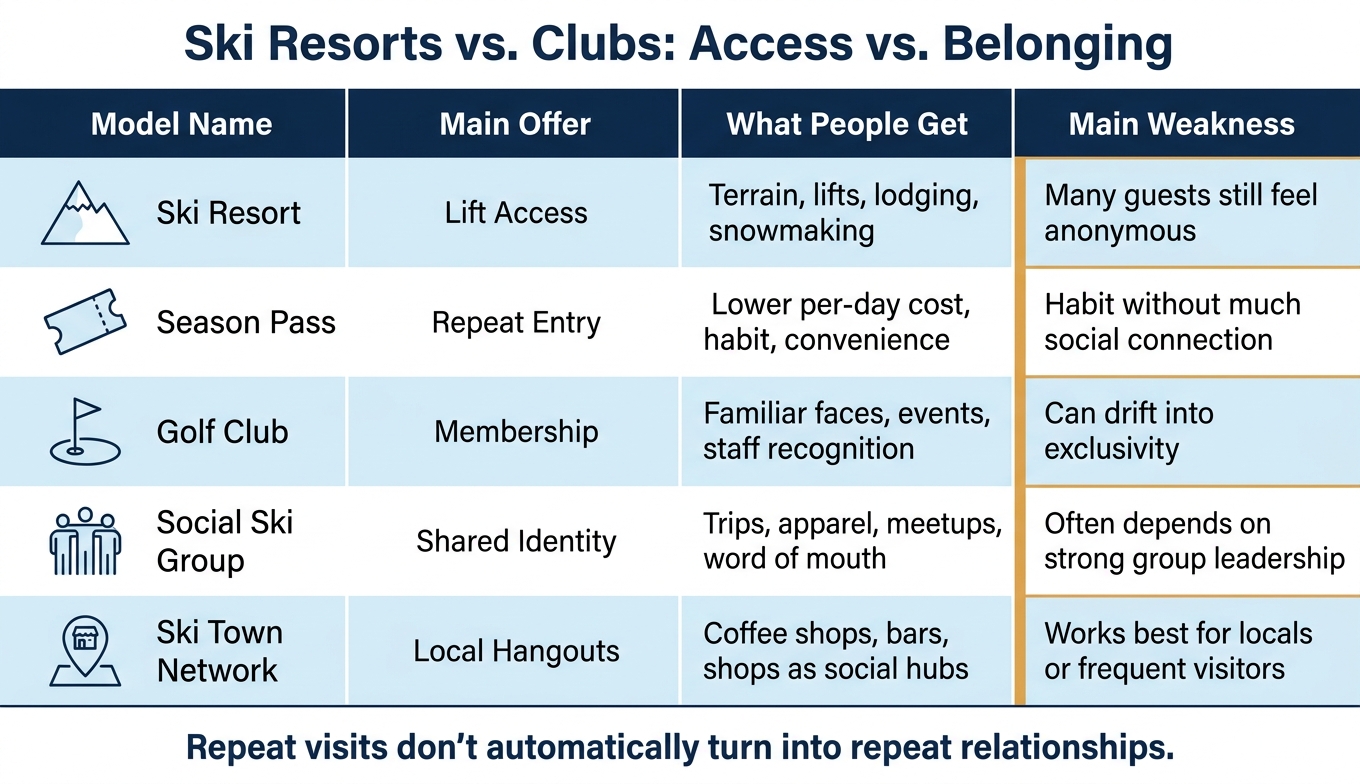
Ski Resorts vs. Clubs: Access vs. Belonging Compared
| Model | Main offer | What people get | Main weakness |
|---|---|---|---|
| Ski resort | Lift access | Terrain, lifts, lodging, snowmaking | Many guests still feel anonymous |
| Season pass | Repeat entry | Lower per-day cost, habit, convenience | Habit without much social connection |
| Golf club | Membership | Familiar faces, events, staff recognition | Can drift into exclusivity |
| Social ski group | Shared identity | Trips, apparel, meetups, word of mouth | Often depends on strong group leadership |
| Ski town network | Local hangouts | Coffee shops, bars, shops as social hubs | Works best for locals or frequent visitors |
If I had to boil the full piece down to one sentence, it would be this: skiing does not need a fancy clubhouse - it needs more ways for people to return, connect, and feel like they belong.
1. Malibu Ski League
Most ski communities come together by chance. The same friends book the same trip, year after year, and a loose circle starts to form.
Malibu Ski League took that pattern and gave it shape. Founded in 2024 after years of putting together group ski trips, the club turned an informal social habit into a defined community.
Belonging
The name says a lot on its own. Malibu Ski League is meant to feel a little contradictory: beach culture meets mountain culture. That tension is the idea. It points to a certain type of person: professionals connected by a life outdoors.
That shift matters. Many modern clubs aren't just selling entry. They're selling recognition and a sense of identity.
"MSL consists of a growing network of professionals across all industries that are united by life outdoors." - Lichota Seidewand, Founder, Malibu Ski League
Social Infrastructure
Skiing often gives people access to a place. This model adds more than that. It gives members repeat ways to stay connected. Trips, events, and apparel keep the group in touch whether there's snow on the ground or not.
The apparel also works as a public signal of membership. Designs like Seasonally Confused give people something to wear that reflects who they are, not just which sport they like.
Recurring Connection
The league grew through word of mouth and social sharing. People passed it along because it felt worth talking about. That's the part that stands out.
The main lesson isn't the mountain. It's the system of repeated recognition built around it, and the way that same idea has been turned into a club model at scale inside the modern private golf club.
2. Modern Private Golf Clubs
The best modern private golf clubs don’t fit the old country club mold anymore. They’re not just selling access to a course. They’re selling a recurring sense of belonging.
That’s the big split between golf clubs and ski resorts. Golf clubs build an ongoing relationship around the sport. Ski resorts often stop at the sale. The gap isn’t about prestige. It’s about having a system that gives people a reason to come back again and again.
Belonging
Members start seeing the same faces, falling into the same routines, and feeling part of a club instead of a crowd. That’s what separates membership from simple access: repeated recognition.
A season pass usually doesn’t create that same feeling. You might ski the same mountain all winter and still feel like you’re just moving through it.
That familiarity is what turns membership from access into identity.
Staff Familiarity and Personal Connection
At well-run modern clubs, members know the leadership team and staff by name. Staff often know members right back. That changes the whole feel of the place.
It’s the difference between buying a day and joining a place.
Recurring Events and Social Spaces
The clubhouse, restaurant, leagues, tournaments, and trips are a big part of what the club actually is. They’re not extras on the side. They give members reasons to show up even when they’re not playing, and they help the community stay active between rounds.
That’s the layer skiing still doesn’t have in most cases: a place where repeat visits grow into relationships, not just routine. And this approach isn’t limited to golf anymore. You can see it showing up in newer social and hospitality clubs too.
3. Newer Social and Hospitality Clubs
The modern private golf club has moved past the old setup. A newer wave of social clubs builds belonging around shared identity, often without a fixed clubhouse. That makes these clubs a useful bridge between the old clubhouse model and the more spread-out social ecosystems skiing still doesn’t have.
The way people join says a lot. Often, the first touchpoint is a piece of apparel, a group trip, or an online community that already matches how members see themselves. The community forms around people who share a lifestyle.
Belonging
Malibu Ski League founder Lichota Seidewand put it this way:
"MSL consists of a growing network of professionals across all industries that are united by life outdoors. Builders, creatives, operators of all ages that clock in during the week but find themselves on the mountains or in the ocean by the weekend."
That framing keeps the group active all year. Belonging becomes part of who members are, not just something tied to a winter season. Skiing rarely creates that kind of continuity, even for people who return to the same mountain again and again.
Recurring Events and Social Spaces
Instead of relying on a clubhouse, these clubs use group trips, in-person events, and branded gear to give members repeat reasons to show up. In other words, trips, events, and gear do the job a clubhouse once did. The difference is that those touchpoints are spread across many moments rather than tied to one place.
That’s a big shift from how skiing usually works, where access often stops at the lift ticket or season pass. In this model, the community is the product and the setting comes second. That contrast matters because skiing already has the destination. What it lacks is the structure that keeps people tied to it between visits.
4. Ski Resorts and Season-Pass Programs
Ski resorts do a lot well on the physical side. Lifts, snowmaking, grooming, and lodges are what make a day on the mountain work in the first place.
But that’s not the gap here.
The missing piece isn’t terrain. It’s the social layer that turns a place people visit into a place they feel tied to.
Belonging
A season pass gets you through the gate. It doesn’t give you a name, a familiar face, or a spot in a community.
That’s the difference.
A skier can show up at the same resort all winter and still feel anonymous. You might ride the same lifts, park in the same lot, and stop at the same lodge, yet no one knows who you are. In golf, routine tends to build recognition. In skiing, a season pass usually doesn’t. The deal ends when you buy the pass. After that, what you mostly have is access.
Recurring Rituals
Season-pass programs do help bring people back. They create repeat visits.
But repeat visits aren’t the same as repeat relationships.
They build habit, not social structure. And habit is fragile. It shifts with weather, work, family plans, and whether the conditions are worth the drive. Then the season ends, and the connection often ends with it too.
The Anonymity Problem
Skiing has some of the most passionate people in any outdoor sport. That part isn’t the issue. The issue is that the industry’s setup often does little to help those people connect with each other.
Resorts have built the access layer extremely well. What’s often missing is the part that helps people meet, return, and feel known. So that social layer gets built somewhere else:
- In town
- In local businesses
- In the spaces around the mountain
If skiing is going to feel more like belonging than access, part of that clubhouse role may need to live off the mountain.
5. Ski Towns and Independent Business Networks
Ski towns often provide the social layer that resorts don't. The same coffee shop, gear shop, and après bar can start to feel like an unofficial clubhouse. But that kind of belonging is shaky and tied to place. It builds over time, and mostly for people who live in town or close by. If you don't live in a mountain town, you have to build that social layer somewhere else.
That's where independent networks come in. They can stretch that feeling of belonging beyond the mountain and give weekend skiers a place to plug in between trips. In practice, that can look like a clubhouse that's spread across trips, events, and a shared identity instead of one physical space. The trip isn't the whole point. The repeat structure around it is what gives the group shape.
Recurring trips and word of mouth keep the community going.
Apparel matters too, because it makes belonging visible. When a group doesn't have a fixed building, gear becomes the signal.
The raw pieces of belonging are already there. What's missing is the structure and programming that turn a loose group of regulars into something that feels like an actual community. That opens up the bigger question: which parts of a clubhouse should skiing borrow, and which parts should it leave behind?
What Skiing Should Borrow - And What It Should Leave Behind
The club model does have something to offer skiing. But skiing shouldn't copy golf from top to bottom.
Here's the big divide: skiing should borrow the repeat connection that membership creates, not the exclusivity that made old clubs so closed off. The real challenge is plain enough: can skiing build a sense of belonging without rebuilding the old club system?
Repeat touchpoints are what turn one-time visitors into an actual community. When staff and founders are visible, the community feels human instead of purely transactional. Rituals matter too. Shared symbols, inside language, and familiar routines help membership feel concrete instead of vague.
What skiing should leave behind is gatekeeping. Leave behind the fees, the hierarchy, and the social filtering that made old clubs exclusionary.
The ski club worth building looks more like an open network: professionals, creatives, weekend warriors, and outdoor enthusiasts connected by a shared lifestyle, not a shared tax bracket. That network may not live in one building. It might stretch across ski towns, independent businesses, group trips, and a common identity - a distributed clubhouse instead of a fixed one.
That's the part worth borrowing. The tougher question is how far skiing can take that idea without bringing back the same old barriers.
The Case For and Against a More Club-Like Future in Skiing
The case for a club-like ski model is pretty simple: resorts sell access, but clubs sell repeat belonging. Resorts tend to chase volume - more passes sold, more visits, more lift capacity used. Clubs push on a different idea: how do you make someone feel like they’re part of something?
That shift matters. Shared identity, recurring events, and social connection can build deeper loyalty and keep people involved all year, not just when the snow is good. It’s the difference between buying entry and feeling known.
But there’s a catch. Club language can also bring back the worst parts of the old model: higher costs, status signaling, and one more barrier to get through. If a membership costs more but doesn’t create any real sense of belonging, it’s not much of a club at all. And if skiing adds another layer of formality to a sport that already looks expensive from the outside, the access problem could get worse, not better.
This isn’t just a branding tweak. It changes how people return, connect, and stay involved. Traditional resorts optimize capacity. Club-like models focus on recognition, ritual, and reasons to come back year-round. Resorts are built to move people up a mountain with as little friction as possible. Clubs are built to make people want to return - even when they aren’t skiing.
Those are different goals. And they lead to different kinds of ski culture.
The demand is already there. The next question is which parts of the club model skiing should borrow, and which parts it should leave alone.
Conclusion: Skiing Doesn't Need a Clubhouse - It Needs a New Idea of One
Skiing already has strong terrain and deep loyalty. What it often misses is repeat social connection. That's where the country club idea starts to matter.
The old country club itself isn't the model. Membership is. Golf built a world where the game is just one part of the draw. Skiing hasn't fully done that yet. The modern version would be less formal, more social, and a lot more flexible.
The goal here is simple: a better product, clearer storytelling, and a stronger lifestyle layer around the sport. That same thinking can work for skiing, too.
A distributed clubhouse - spread across lodges, cafés, trips, and off-season events - doesn't need one grand building or a $50,000 initiation fee. It needs intention. It needs a network of places, people, and rituals that makes someone feel known, not just let in.
So the real issue isn't whether skiing can copy a clubhouse. It's whether skiing can recreate the feeling a clubhouse gives.
Skiing doesn't need a clubhouse. It needs a new idea of what a clubhouse is.
FAQs
What is a distributed clubhouse?
A distributed clubhouse is a modern, decentralized take on the old-school clubhouse. Instead of relying on one private building, it runs through a network of social spaces, repeat gatherings, and community-led programming that helps people feel like they belong.
In skiing, that might look like ski towns, independent businesses, member networks, and pop-up events all working together as the clubhouse.
Why doesn’t a season pass create belonging?
A season pass is mostly a transactional purchase. It gives someone access to the mountain, but it doesn’t make them part of a social circle on its own.
People can ski all winter and still feel like they’re just showing up, riding, and heading home. What’s missing? The stuff that turns access into connection: repeat touchpoints, recognition, shared rituals, and places to gather.
That’s the gap. A pass helps people ski. It does not automatically build relationships or a lasting sense of belonging.
How can skiing build community without exclusivity?
Community grows when the focus shifts from simple access to shared identity and mentorship. People are more likely to stick around when every skill level feels welcome and more experienced members take the time to help newcomers find their footing.
Accessible, in-person events like pop-up shops, workshops, and group trips help make that happen. They create casual spaces where people can meet, talk, and build real connections without feeling like they have to prove themselves first. In that kind of setting, belonging comes from steady, open participation - not from gatekeeping or high barriers to entry.