




Skiing has become a year-round global adventure. Thanks to multi-resort passes like the Ikon Pass, skiers can now access 70 resorts across 13 countries and five continents, making it easier than ever to chase snow across the Northern and Southern Hemispheres. From Japan's legendary powder in January ("Japanuary") to the towering peaks of the Alps in March, and the Andes' high-altitude terrain in July, skiers are redefining the sport as a lifestyle of constant travel and connection.
Key highlights:
- Global Access: Multi-resort passes cover destinations worldwide, offering both affordability and convenience.
- Year-Round Skiing: Opposite winters in hemispheres allow for continuous skiing - Japan in January, Europe in spring, and South America in summer.
- Cost Comparison: Skiing internationally can be cheaper than domestic trips, with lift tickets in Japan costing $40–$70/day compared to $329 at Vail.
- Community: Shared ski houses and après-ski gatherings create a global network of skiers who reconnect seasonally.
This shift is fueled by affordable travel, social media inspiration, and remote work flexibility, making global skiing accessible to more people. The result? A worldwide community of powder chasers who follow snowstorms, build friendships, and turn skiing into a lifestyle of endless exploration.
The Best Ski Getaways for Every Kind of Trip | Travel Smart
sbb-itb-236ebff
The Passport Generation
Skiers today are redefining winter sports by chasing snow across continents. Thanks to the rise of multi-resort passes, what once seemed like a dream lifestyle is now a practical, well-trodden path.
Where Global Skiers Go
The global ski circuit has taken on a predictable rhythm. January belongs to Hokkaido, Japan, during what’s affectionately called "Japanuary." Niseko United, a group of four interconnected resorts, averages an impressive 600 inches of snow annually. The powder here is legendary, with only 4% moisture content compared to Colorado’s 8%. By March, the action shifts to the Alps. Chamonix, with its iconic Vallée Blanche, offers a breathtaking 12-mile off-piste descent with a vertical drop of 9,000 feet. Over in North America, the Rockies hold their ground as a favorite, with Utah’s Cottonwood Canyon resorts - Alta, Snowbird, and Solitude - claiming the title of the "Greatest Snow on Earth". Meanwhile, British Columbia’s Revelstoke stands out with North America’s highest vertical drop at 5,620 feet.
When the Northern Hemisphere’s ski season wraps up, the focus shifts south. July and August highlight the Andes, where Valle Nevado’s high-altitude terrain and Portillo’s iconic yellow hotel draw in skiers. New Zealand’s Coronet Peak, located near Queenstown, offers another Southern Hemisphere hotspot, while Australia’s Perisher, spanning seven peaks, completes the lineup.
This global rotation ensures that winter never truly ends for those willing to follow it.
Year-Round Snow
With opposite winters in the Northern and Southern Hemispheres, the ski season never stops. While resorts in North America and Europe close their doors in April or May, Chile, Argentina, Australia, and New Zealand are just getting started in June. Multi-resort passes like the Ikon Pass make this lifestyle even more accessible, allowing skiers to seamlessly transition between hemispheres. Imagine starting your year in Niseko in January, hitting Chamonix in March, heading to Valle Nevado in July, and wrapping up in New Zealand by August - all with a single pass.
"We live in a world with a 365-day ski season and endless winter - you just have to chase it." - Lukas Picton, Author
Modern infrastructure has made this dream a reality. Japan’s Shinkansen connects Tokyo to Honshu’s ski resorts like Myoko in under three hours. The Alps boast interconnected lift systems, such as Les 3 Vallées, which offers over 370 miles of connected runs in a single domain. What used to be a logistical challenge is now a straightforward journey: follow the snow, and the passes will take care of the rest.
Powder Migration
Picture migratory skiers as the snow-loving counterparts of touring musicians or pro surfers chasing the perfect wave. These enthusiasts don't just travel - they follow a seasonal path dictated by nature. While musicians hop between venues and surfers track swells, powder seekers pursue storms across hemispheres. Their schedule? Entirely written by snowfall patterns, with a multi-resort pass serving as their all-access pass to the action. It's a lifestyle that operates like a perfectly timed tour, with snowstorms as the headliner.
The Seasonal Route
This migration is a well-orchestrated journey. It kicks off in the Andes around August, moves to the Rockies by November, hits its peak in Japan by January (where Niseko saw a staggering 404% increase in U.S. guest nights between 2017 and 2025), transitions to the Alps during February and March, and wraps up in the Southern Hemisphere, with spots like New Zealand's Mt. Hutt coming alive by July. But beyond the mapped-out destinations, the real magic lies in the connections and shared moments on the slopes.
Shared Storms and Connections
This global circuit isn't just about chasing snow; it's about building a community that spans continents. Like surfers who recognize each other at distant breaks or musicians who cross paths at festivals, migratory skiers form enduring friendships through shared powder days. You might chat with someone in a Niseko onsen in January, bump into them at a Chamonix après-ski bar in February, and find yourselves sharing a ski house in British Columbia come December.
Each region has its traditions - soaking in Japan's onsens, indulging in fondue and wine in the French Alps, or sipping pisco sours in Chile - but the vibe remains the same. These aren't just ski trips; they're reunions on snow-covered stages. As snowboarder Lukas Picton famously quipped:
"There are no friends on a powder day!"
When 20 cm (about 8 inches) of fresh snow blankets the slopes, it's every skier for themselves, racing for that coveted first run. But once the lifts stop spinning, the day's tales are traded over drinks, and the bonds of the circuit grow even stronger.
Why This Happened
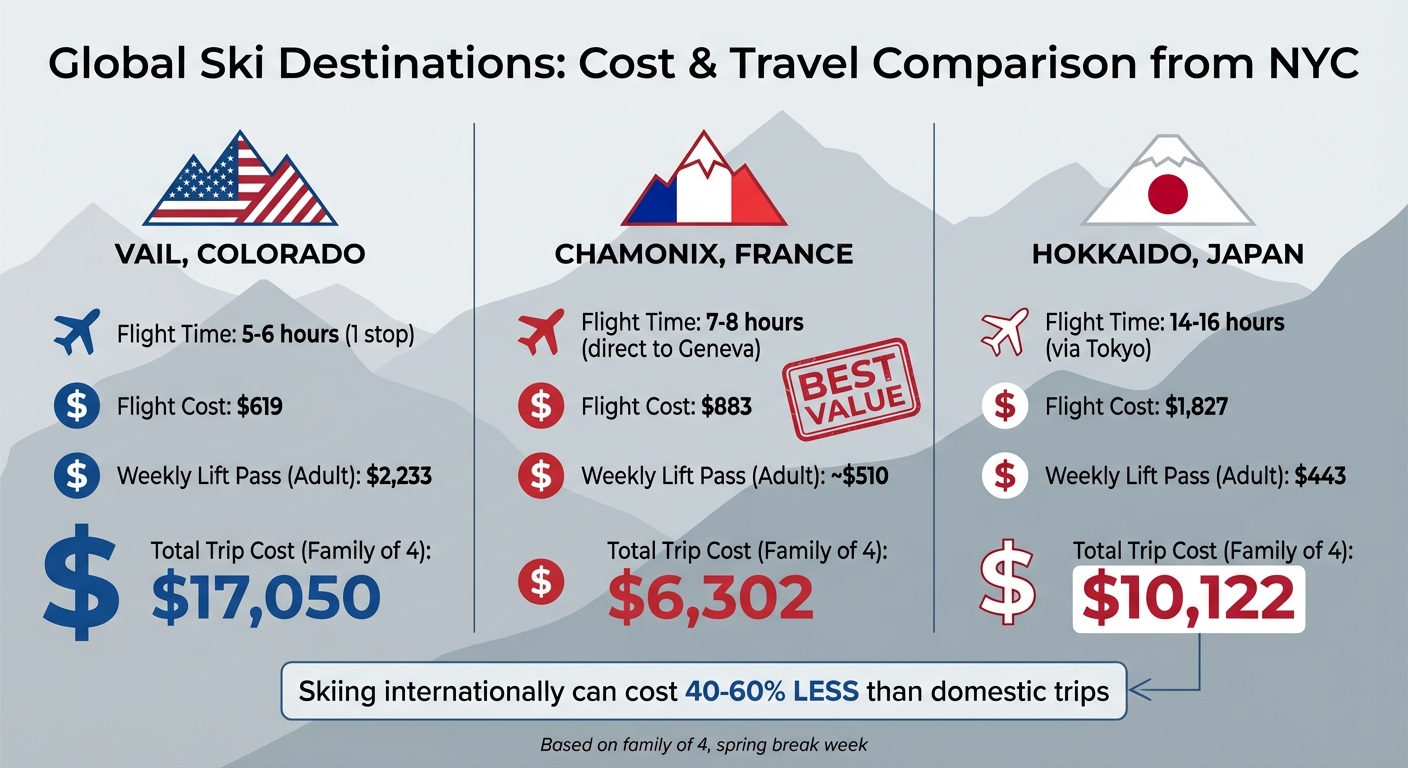
Global Ski Destination Cost Comparison from NYC
What Made It Possible
Several factors came together to make skiing a global pursuit: multi-resort passes, cheaper international flights, Instagram's influence, and the rise of remote work. The 2025–26 Ikon Pass now includes access to 70 resorts across 13 countries and five continents, while the Epic Pass covers over 80 destinations worldwide. For $1,051 to $1,329, skiers essentially get a "winter passport", making international trips surprisingly competitive with domestic ones. Writer Ryan Ariano sums it up well:
"It's cheaper to ski the rest of the world. ... You could fly to and ski for a week in Japan AND a week in Chamonix at a 4‑star ski‑in/ski‑out for less than it costs for 1 week in Vail."
The math backs this up. A round-trip flight to Geneva costs $883, while a flight to Hokkaido runs $1,827. Compare that to $619 for a flight to Colorado. Add in the fact that a day pass at Vail can hit $329, while skiing in Japan costs just $40–$70 per day, and the appeal of international skiing becomes clear. Instagram has also played a role, turning powder-filled slopes into a kind of visual currency. Skiers now track storms and dream of "Japow" or the Alpine couloirs they see online - places they might not have considered before. And with remote work, skiers have the flexibility to turn short trips into month-long adventures across continents.
This shift feeds on itself. U.S. resorts have raised day-ticket prices to $250–$299 to push skiers toward season passes. Once you have the pass, international skiing becomes even more appealing since lift tickets are already covered. As The Snow Chasers blog noted:
"The pitch shifted from 'ski anywhere' to 'book your reservation early.' ... What started as a revolution for skiers turned into consolidation for the fat, greedy shareholders."
These combined forces have made chasing storms around the globe not just a dream, but a practical option for many.
Cost and Travel Times from NYC
The numbers paint a clear picture. A family of four spending spring break in Vail can expect to pay around $17,050 for the week. In contrast, the same family could ski in Chamonix for about $6,302 or in Hokkaido for $10,122 - including flights. Here's a breakdown comparing costs and travel times from New York City:
| Destination | Flight Time | Flight Cost | Weekly Lift Pass (Adult) | Total Trip (Family of 4) |
|---|---|---|---|---|
| Vail, CO | 5–6 hours (1 stop) | $619 | $2,233 | $17,050 |
| Chamonix, France | 7–8 hours (direct to Geneva) | $883 | ~$510 | $6,302 |
| Hokkaido, Japan | 14–16 hours (via Tokyo) | $1,827 | $443 | $10,122 |
The price differences go beyond lift tickets. Lodging, food, and overall cost structures vary widely. Japan's efficient bullet trains make it easy to get from Tokyo to nearby resorts in under two hours. Meanwhile, Europe's interconnected lift systems, like Les 3 Vallées with its 370 miles of runs, eliminate the need for shuttles between mountains. Global skiing isn't just a happy accident - it’s the result of falling barriers and a growing realization that exploring the world’s slopes can be both affordable and thrilling.
The Culture of the Circuit
Ski Houses and International Friends
For migratory skiers, chasing powder is only part of the story. They're also reshaping what it means to build community, using shared living spaces to turn mountain towns into seasonal hubs of connection. Take, for instance, Matt Yao, who in January 2025 rented a five-bedroom Airbnb in Murray, Utah. His home became a melting pot of skiers from around the world, all juggling remote work with days spent carving through fresh snow. Mornings revolved around planning carpools and mapping out runs, while evenings brought everyone together by the fireplace to share stories from the slopes.
These ski houses feel like grown-up dormitories, where shared routines and spontaneous interactions spark lasting friendships. Yao describes the experience perfectly:
"It was the oscillation between hermit mode in my room with my keyboard battle station and running around the house trying to find people to hang out with that felt just right".
The concept of seasonal coliving extends beyond private rentals. Communal spaces like the Kees and Claire Memorial Hut near Whistler offer affordable lodging for up to 38 guests at just $50 per person per night, creating a setting where camaraderie thrives.
This lifestyle appeals to those who value connection over luxury. Yao explains it best:
"We convene when the snow gods start sprinkling across the mountains, and part ways when we've gotten our fill... seasonal coliving sidesteps these constraints by bringing people together into a temporary shared space, co-creating in an intense burst before dispersing back to our respective homes, pockets filled with memories".
The friendships formed in these spaces often span continents, creating a global network of skiers who share more than just a love for the mountains.
Après-Ski Reunions
Once the skis are off, the spirit of the circuit shifts seamlessly into après-ski gatherings, where the day's adventures are celebrated. Over time, après-ski has evolved into more than just a chance to grab a drink - it's a reunion culture all its own. Skiers who connect in one mountain hub often cross paths again in another. For instance, friendships forged in Chamonix might be rekindled in Whistler or Niseko just weeks later. Spots like Chambre Neuf in Chamonix act as social hubs, drawing international freeriders to share a stiff shot of génépi, swap ski stories, and dance the night away. Meanwhile, in Niseko's Hirafu Village, the après scene revolves around cozy izakayas and restorative onsens, perfect for unwinding and reliving powder-filled days.
Professional skier Chad Sayers captures the essence of this rhythm:
"I have come back and have formed a really great base of friends and community here in Whistler... Whistler has become a place where I return to regroup".
The circuit fosters a sense of inevitability about these connections. As Yao reflects:
"It didn't feel sad though, we knew that we would cross paths soon enough, and there was always next season".
Thanks to global ski passes like the Ikon Pass - which grants access to 70 resorts across 13 countries and five continents - these international reunions are not just possible, they’re practically guaranteed. Skiing, once a local pastime, has grown into a worldwide phenomenon that brings people together, season after season.
Conclusion
Skiing has transformed from a seasonal pastime tied to a single mountain into a global, year-round pursuit. Powder chasers now roam the world like surfers chasing waves, redefining the sport as a lifestyle.
Thanks to multi-resort passes, skiers can now access dozens of destinations across five continents, making this dream a reality. As Zach Suffish aptly put it, skiing has become more than just a sport - it’s akin to holding a passport.
This evolution has fostered a worldwide community of skiers who reconnect season after season. Friendships forged on one mountain carry on to the next, creating bonds that stretch across hemispheres and are strengthened by shared experiences - whether it’s tackling a storm, sharing a ski house, or enjoying après-ski traditions together.
For those who thrive on adventure, the rhythm of this circuit is irresistible. Imagine summers in Malibu, winters in Japan, springs in the Alps, and falls in Chile. The snow never stops for those who are willing to follow it.
The Malibu Ski League embodies this spirit, uniting those who refuse to pick between the beach and the mountains. To this tribe, these landscapes are two sides of the same coin, fueling a life of endless exploration. This global network of skiers isn’t just shaping the future of the sport - it’s already here, carving out a culture of connection and adventure that transcends any single season.
FAQs
How do I plan a year-round ski calendar across both hemispheres?
To enjoy skiing year-round across hemispheres, consider using multi-resort passes like Ikon Pass, which provide access to resorts in both the Northern and Southern Hemispheres. From August to October, head to the Southern Hemisphere's top skiing spots in Chile, Argentina, or New Zealand. Once their season wraps up, shift your focus to North America or Europe from December to April.
To make the most of your pass, plan your flights, accommodations, and other logistics around each region's seasonal openings. This way, you can chase the snow and keep your skiing adventure going all year long.
What should I budget for a global ski circuit beyond lift access?
When planning a ski trip, there's more to consider than just lift tickets. You'll need to account for flights, local transportation, lodging, food, and gear. Flights, particularly for international destinations, often take up the largest chunk of your budget. To cut costs, think about traveling during off-peak times or staying in areas that attract fewer tourists.
Don't forget about expenses like rental cars, shuttle services, self-catering accommodations, and any gear rentals or backcountry permits you might need. With thoughtful planning, you might find that the total cost of an international ski adventure can compete with - or even be less than - a domestic trip.
How do people find ski houses and community on the circuit?
Skiing on the global circuit is about more than just carving through fresh powder - it's about the connections formed along the way. Skiers often come together in shared accommodations like ski houses or coliving spaces in mountain towns, creating a sense of camaraderie as they chase the next big storm. The culture surrounding this lifestyle - whether it's après-ski gatherings, friendships that span continents, or the thrill of discovering untouched snow - transforms skiing into a shared adventure. It’s a worldwide community fueled by a love for the mountains, exploration, and the bonds forged on the slopes.