




The ski industry in the U.S. is now dominated by two companies - Vail Resorts and Alterra Mountain Company - controlling over 50% of ski lift capacity. Their flagship products, the Epic Pass and Ikon Pass, offer access to dozens of resorts worldwide but have drastically changed skiing. While these passes make skiing more affordable for frequent users, they come at a cost: overcrowded slopes, loss of local resort character, and rising housing costs in mountain towns. Critics argue that corporate control is eroding the individuality of skiing and harming local communities.
Key Points:
- Market Control: Vail and Alterra own or partner with most major ski resorts in the U.S.
- Pricing: Epic Pass ($1,051) and Ikon Pass ($1,329) offer multi-resort access but push skiers to commit early or face high day-ticket prices ($356 at Vail).
- Impact: Passes increase affordability for frequent skiers but lead to overcrowding, uniform resort experiences, and housing issues in ski towns.
- Cultural Shift: Corporate ownership has replaced the grassroots ski culture with standardized, profit-driven operations.
The convenience of mega-passes has reshaped skiing, but at the expense of its personality and community-driven roots.
Why Vail Resorts Is Losing Skiers in a Growing Industry | WSJ
sbb-itb-236ebff
The Rise of the Mega Pass
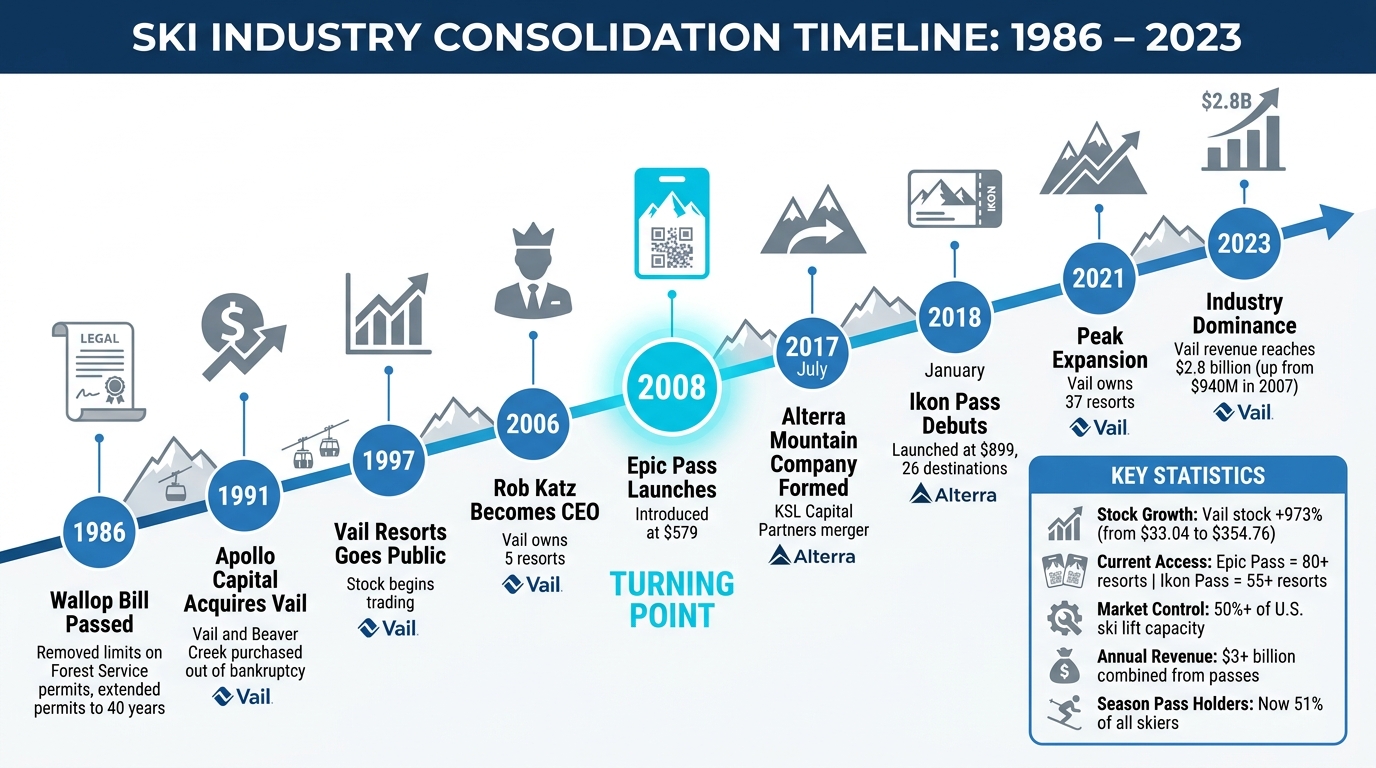
Ski Industry Consolidation Timeline: From Vail's Bankruptcy to Mega-Pass Dominance
The Expansion Timeline
The consolidation of the ski industry traces back to private equity investments. In 1991, Apollo Capital Management acquired Vail and Beaver Creek out of bankruptcy, eventually taking Vail Resorts public in 1997. Over the next decade, Vail Resorts grew steadily, but 2008 marked a turning point.
That year, under the leadership of CEO Rob Katz (who served from 2006 to 2021), Vail introduced the Epic Pass at $579. The strategy was a game-changer. Vail's stock skyrocketed by 973%, jumping from $33.04 to $354.76. Revenue tripled, climbing from $940 million in 2007 to $2.8 billion by 2023, and the company expanded its portfolio from five resorts in 2006 to 37 by 2021.
The competition heated up in July 2017 when KSL Capital Partners facilitated a massive merger to establish Alterra Mountain Company. Just six months later, in January 2018, Alterra launched the Ikon Pass, which debuted at $899 and included access to 26 destinations. Rusty Gregory, Alterra's first CEO, emphasized their approach as "a house of brands and not a branded house", allowing each resort to retain its local management and distinct character.
This rapid growth set the stage for unprecedented global influence in the ski industry.
The Scope of Their Control
The numbers highlight the sheer scale of this expansion. Vail Resorts now operates 42 ski areas and partners with additional mountains through the Epic Pass, granting access to 80 ski areas across four continents. Meanwhile, Alterra's Ikon Pass provides access to 55 ski areas worldwide. Together, these two mega-passes dominate over 50% of the U.S. ski lift capacity.
The financial stakes are massive. Combined, these passes generate more than $3 billion annually in advance revenue. Season pass holders, once a relatively small segment, now account for 51% of all skiers, surpassing day-ticket buyers for the first time. In Utah, skier visits soared from 2 million in 1981 to 7.1 million in the 2022–23 season - a 255% increase that far exceeds the state's population growth.
This transformation was made possible, in part, by the 1986 Wallop bill. The legislation removed limits on the number of Forest Service permits a single company could hold on public lands, extended permit durations to 40 years, and opened the door to unrestricted corporate expansion. What followed was more than just a consolidation of ski resorts - it was a full-scale vertical integration. Companies expanded their control to include lodging, retail, dining, and transportation, creating what some critics describe as "captive-market moneymaking machines".
The Benefits of Mega Passes
Lower Costs for Multi-Resort Skiers
With single-day lift tickets reaching as high as $356 at top resorts, it's no wonder multi-resort passes have become so popular. Take the Epic Pass, for example - it costs $1,051 for the 2025-26 season and pays for itself after just three or four days on the slopes. For those planning longer trips, the savings quickly add up.
This pricing strategy isn't just about affordability; it's also a smart business move. By encouraging skiers to commit early, companies secure revenue upfront, reducing the financial risks of unpredictable weather. To put things into perspective, a single-resort season pass in the 1990s could cost around $2,000 in today's dollars. Now, mega passes provide access to dozens of top-tier resorts for about half that price.
"For frequent skiers with upfront capital, the democratisation is real: $1,000-1,300 buys access to 40-80+ resorts globally where previous generations paid $2,000+ for single-mountain passes." - Michael Fulton, Journalist, SnowStash
Besides saving money, these passes open up an incredible range of destinations.
Access to More Mountains
A single mega pass is your ticket to an entire network of resorts spread across continents. For instance, the Epic Pass grants access to 80+ ski areas in North America, Europe, Australia, and Asia. Meanwhile, the Ikon Pass covers 55+ destinations worldwide. For skiers who used to save all year for one trip to the Rockies, these passes have completely redefined the possibilities.
The variety is staggering. With one pass, you can ski everything from small, local hills near cities like Boston or Chicago to iconic destinations like Whistler and Park City. Companies have strategically acquired nearby resorts, giving passholders options for midweek skiing close to home and dream vacations at world-renowned mountains. It's like having a global ski passport, eliminating the hassle of buying separate lift tickets for each trip.
Easier Trip Planning
Mega passes don't just save money - they simplify the entire ski experience. Instead of juggling different ticketing systems, prices, and policies at every mountain, passholders use a single RFID card or digital pass across the whole network. Planning becomes a breeze. If the conditions at Park City aren't ideal, just head to Breckenridge - no extra fees, no refund headaches.
These passes go beyond lift access, too. Vail Resorts and Alterra have created integrated ecosystems where lodging, dining, retail, and even ski lessons can all be booked through the same platform. What used to be a logistical nightmare involving multiple vendors is now a seamless process. For skiers with limited vacation time, this convenience is a game-changer, making multi-resort trips not just possible but routine.
While the convenience is undeniable, it's also a sign of the growing consolidation within the ski industry - a trend that's shaping the future of mountain adventures.
The Downsides of Consolidation
Overcrowding at Popular Resorts
Mega-passes have made extra ski days almost free, encouraging passholders to treat mountains like their personal playgrounds. This has led to a surge in storm chasing and frequent day trips. As a result, visitor traffic now clusters around a handful of popular mountains known for reliable snowmaking and impressive vertical drops. Add in better weather forecasting and social media buzz, and you’ve got thousands of skiers flocking to the same slopes during narrow timeframes. The numbers back this up - skier visits hit a record 65.4 million days during the 2022–2023 season, leaving many resorts overwhelmed by the crowds. What were once peaceful getaways now feel more like packed amusement parks. And with this physical overcrowding, the unique charm of these resorts is starting to vanish.
The Loss of Resort Character
Corporate ownership has transformed many ski resorts into standardized, corporate-controlled spaces. Critics argue that companies like Vail Resorts and Alterra have turned these mountains into "twenty-first-century company towns", where nearly every aspect of the experience is dictated by a single entity. As operations become more uniform, some say the experience now feels like a "soulless, pre-packaged, mass commercial experience". The quirks that once defined these mountains are disappearing - slope-side barbecues, impromptu après-ski gatherings, and even certain employee grooming styles have been banned under corporate policies. Independent shops have been replaced by chains, and long-standing traditions are fading fast. It begs the question: are we skiing at Breckenridge, or just another corporate outpost?
What Happens to Local Communities
The effects of consolidation extend far beyond the slopes, rippling into nearby communities. In Colorado, where two major companies control 86% of skiing and riding capacity, rising property values have driven housing costs through the roof. In Avon - a town where many resort employees live - the median home price tripled between 2015 and 2023. Long-time residents are being forced out, while farmland is being converted into vacation homes, erasing community identities that took generations to build. Meanwhile, Vail Resorts reported a $280 million net income for the 2025 fiscal year. Former Colorado Assistant Attorney General Tony Accetta voiced his concern:
"A corporate monopoly will punish people who dare to speak against it by withholding favorable season pass privileges".
When one company controls the mountain, the lodging, and the local economy, standing up against it becomes a risk few are willing to take.
What Skiing Loses in the Process
Regional Identity Disappears
Mega passes might make skiing more accessible and affordable for some, but they come at a cost: the loss of regional uniqueness. Resorts that once had their own distinct charm now feel increasingly similar. Sam Weintraub, founder of PeakRankings, summed it up perfectly:
"Resort personality is being replaced by standardized operations".
Take the food, for instance - whether you're hitting the slopes in Vermont or Colorado, you're likely to encounter the same $25 burger. Local shops that once showcased the area's character are being replaced by upscale chain stores. And it’s not just about appearances. The centralization of operations - finance, HR, and marketing - means decisions are often made far from the mountains themselves. This shift leaves resorts feeling disconnected from their roots, with leadership that may have little to no firsthand experience of the unique culture and terrain they’re supposed to represent. The result? A cookie-cutter experience that could be anywhere, stripping away the individuality that once made each mountain special.
Community vs. Corporation
Skiing wasn’t born out of boardrooms and corporate strategies. Its roots lie in tight-knit communities - ski bums in vans, parents teaching their kids to ski, and locals running humble lodges where everyone knew your name. The culture was one of camaraderie and spontaneity, filled with parking lot barbecues, secret meetups, and impromptu après-ski celebrations. It was, as some have described, built on "playful irreverence and fellowship".
But corporate ownership has largely dismantled this grassroots spirit. Resorts that once thrived on local charm now cater to a wealthier, jet-setting clientele. Norman Bowles, a former Vail instructor, didn’t mince words:
"No company has shown such blatant disregard for employees, nor such open exploitation of its human capital to maximize profits".
When the focus shifts from people to profits, the heart of skiing - the community, the culture, the shared love of the sport - gets lost. Instead of being a gathering place for enthusiasts, skiing risks becoming just another commercialized, impersonal industry.
Conclusion
The ski pass wars have tackled the issue of access, but they've introduced a fresh set of challenges.
Mega-passes have made it possible to explore a wide range of mountains at a fraction of what individual day tickets would cost. For avid skiers, this shift brings undeniable perks. However, it’s not without its downsides: overcrowded lifts, the erosion of local mountain culture, and the gradual disappearance of the free-spirited ski bum lifestyle.
The strategy has undeniably reshaped the industry. Today, season pass holders make up the majority of skier traffic. Yet, this shift has left casual skiers and middle-class families on the sidelines, often unable to justify the cost or commitment required for a full pass.
These changes mark a turning point for the skiing world. The question isn’t whether mega-passes have transformed skiing - they clearly have. The real concern is whether they’ve stripped away its individuality. When resorts begin to feel interchangeable, when corporate decisions overshadow mountain traditions, and when local communities face skyrocketing housing costs, what remains of skiing’s distinct character? While access may no longer be the problem, the challenge of preserving skiing’s soul is only just beginning.
The convenience brought by mega-passes may have come at the expense of skiing’s once-unique identity.
FAQs
Are Epic and Ikon basically a cartel?
Epic and Ikon hold significant sway over the ski industry in North America. Together, they control a large number of resorts, with Epic operated by Vail Resorts and Ikon under Alterra Mountain Company. This dominance has sparked criticism and legal scrutiny.
Accusations against these companies include inflating prices, stifling competition, and encouraging higher spending through bundled season passes. These practices have led some to compare their influence to that of a cartel, as their control over the market raises concerns about fair competition and affordability for skiers.
Why are day tickets so expensive now?
Day tickets for skiing have skyrocketed in price, with many now exceeding $300. This trend is largely driven by major resort corporations that dominate the ski industry. Their strategy? Push skiers toward purchasing season passes instead of single-day lift tickets. However, the rise of mega passes has brought its own set of challenges, including overcrowded lifts and packed parking lots. These factors not only increase costs but also make skiing harder to enjoy for many people.
How can locals fight back against consolidation?
Locals have the power to resist the growing trend of ski resort consolidation by pushing for policies that prioritize public access and reduce corporate dominance. This can include backing laws aimed at protecting independent resorts and rallying community efforts to keep regional ski traditions alive. Supporting community-operated ski areas and collaborating with local governments to protect public lands are also effective ways to preserve the distinct character of local ski destinations.