




When snow falls, it’s not just a weather event - it’s an economic driver. A single powder day can inject millions into local economies, from flights and hotels to rentals and restaurants. Resorts like Vail have adapted by using season passes to stabilize revenue despite unpredictable snowfall. Powder operates like a perishable commodity, with demand spiking after storms. Skiers chase storms like traders, using data and tools to maximize their experience, while resorts and towns capitalize on the influx of visitors. However, the ski industry remains at the mercy of nature, and warming trends threaten to shorten seasons, making every inch of snow more impactful.
Why “Big Ski” Economics is Hard to Shake Off
sbb-itb-236ebff
How Powder Works Like a Commodity
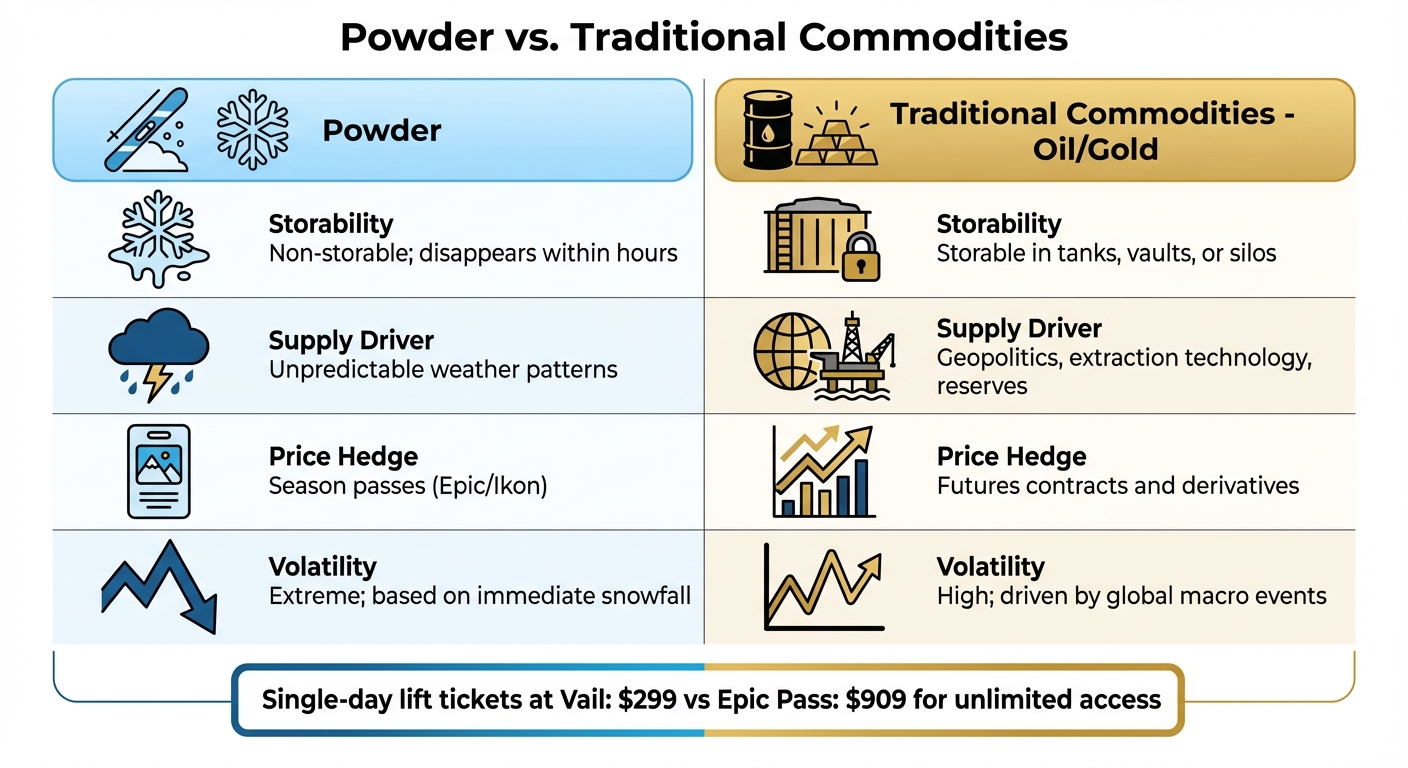
Powder vs Traditional Commodities: Key Differences in Storage, Supply, and Pricing
Supply, Demand, and Price Swings
Powder operates like a classic commodity, with snowfall acting as supply, skiers driving demand, and storms introducing volatility. However, its unique perishability sets it apart. For instance, Vail experienced no snowfall during a record-priced New Year's weekend in 2024, while Jackson Hole saw an incredible 593 inches of snow during the 2016–17 season. When snowfall surges, demand skyrockets. Conversely, when snow is scarce, resorts turn to artificial snowmaking, which has grown from covering 25% of trails in the 1970s to 80% today.
To manage the unpredictability of weather, ski resorts have shifted to a subscription-based model. Season passes now make up about 73% of Vail Resorts' total lift-ticket revenue.
"The upfront money [from passes] is a hedge for seasons with lower snowfall and bad weather."
- Kirsten Lynch, CEO of Vail Resorts
This approach allows resorts to secure revenue before the first snowflake hits the ground, transforming weather risks into a reliable income stream. Unlike traditional commodities, powder's extreme volatility and perishability make it a distinct player in the market.
Powder vs. Other Commodities
Powder shares some traits with commodities like oil, gold, and even concert tickets - particularly its volatility. However, unlike these, powder is fleeting; it vanishes within hours as skiers carve through it. While oil can be stored in tanks and gold in vaults, powder's value diminishes almost immediately after a storm.
Here’s how powder stacks up against traditional commodities:
| Feature | Powder | Traditional Commodities (Oil/Gold) |
|---|---|---|
| Storability | Non-storable; disappears within hours | Storable in tanks, vaults, or silos |
| Supply Driver | Unpredictable weather patterns | Geopolitics, extraction technology, reserves |
| Price Hedge | Season passes (Epic/Ikon) | Futures contracts and derivatives |
| Volatility | Extreme; based on immediate snowfall | High; driven by global macro events |
This perishability fuels massive price swings. For example, single-day lift tickets at Vail reached $299 during the 2023–24 season. On the other hand, skiers with Epic Passes, priced at $909, locked in unlimited access, offering a more stable and economical option. The pricing strategy mirrors the airline industry: book early for savings or pay a premium to chase the perfect conditions.
The Powder Arbitrage
Storm Chasers as Traders
The best powder skiers operate like commodities traders - tracking storm patterns, booking last-minute flights, and staying ready to move at a moment’s notice.
Since 2013, Park City financial planner Mike Ruzek has built a following of over 60,000 on his social media accounts, collectively known as The Powder Buoy. His method revolves around tracking NOAA buoy 51101, situated 186 nautical miles northwest of Kauai. When this buoy’s wave heights spike from 5 to over 15 feet, Utah’s Wasatch Range often sees a heavy snowfall 12 to 14 days later. This approach boasts an 80% accuracy rate.
"About two weeks after a spike in the buoy's wave height, Utah gets a dump of snow."
- Mike Ruzek, Founder, The Powder Buoy
Meanwhile, Andrew Winters, an Assistant Professor at the University of Colorado, has pinpointed another reliable indicator. When the jet stream "retracts" over the North Pacific instead of extending eastward, it frequently dips into the southwestern U.S., leading to major snowfall in Colorado about a week later. These individuals are true opportunists, capitalizing on weather patterns like traders exploiting market inefficiencies.
This fast-paced strategy is supported by advanced tools that make such precision possible.
The Tools They Use
Powder chasers rely on platforms like Powderchasers, created by Steve Conney, which provide detailed analyses of snow density, wind speeds, and potential lift closures. Forecasting packages range from $149 per trip to $699 for eight custom forecasts per season.
To verify conditions in real time, they turn to USDA SNOTEL sites, which deliver automated data on snow depth and water content from remote, high-altitude sensors. But they don’t stop there - chasers also call local sources like hotel night auditors, snowplow operators, and bakery workers in mountain towns to gather on-the-ground insights that official resort updates might miss.
"The deepest snow is not always your best chase. We look at winds, potential closures, snow density, and other factors."
- Steve Conney, Founder, Powderchasers
Some skiers take an even more strategic approach by positioning themselves in "buffer towns" like Pocatello or Idaho Falls. These locations keep them within striking distance of multiple resorts, allowing them to decide on the morning of a storm where to head, based on the latest overnight snowfall totals. In this high-stakes game, seconds and accurate data can make all the difference. The system operates much like high-frequency trading, where speed, data, and positioning determine who gets the best runs before the powder is gone.
Equipped with cutting-edge tools and quick decision-making, these powder chasers embody the energy and precision of the storm economy.
How Resorts Make Money from Powder
Where Resorts Make Their Money
Ski resorts rake in revenue from a variety of sources: lift tickets, equipment rentals, dining, lodging, and retail. Big players like Vail Resorts and Alterra have an edge here - they own rental shops, upscale restaurants, hotels, condos, and retail stores, ensuring they capture nearly every dollar skiers spend on the mountain.
During Utah's 2024–2025 season, the average skier shelled out $306 per day. This broke down to $62 for lodging, $61 for dining, and $59 for lift passes, with the remaining $124 going toward rentals, shopping, and other services. For smaller, independent resorts like Pats Peak, lift tickets only make up about 40% of total revenue, while food, beverages, and ski schools each contribute 15–20%.
This revenue model shifts the financial risk of poor weather from the resort to the consumer. Even in bad snow years, resorts are already paid. For example, in 2023, Vail Resorts sold 2.4 million season passes, generating an impressive $900 million in upfront sales.
"Passes made up ~73% of the company's overall lift-ticket revenue, giving the business more stability. The upfront money is a hedge for seasons with lower snowfall."
- Kirsten Lynch, CEO, Vail Resorts
Still, all these revenue streams rely on one unpredictable factor: snowfall.
Mother Nature as CEO
No matter how much resorts invest in infrastructure or refine their pricing strategies, they remain at the mercy of snowfall. Mother Nature dictates the length of the season, the quality of the skiing, and whether the slopes are bustling with powder enthusiasts or eerily quiet.
In the past, ski resorts were seen as risky investments because their success was tied so closely to the snowpack. To reduce this uncertainty, resorts have invested heavily in snowmaking technology. Leading operators now aim to cover 80% of trails with artificial snow early in the season. However, even the most advanced systems are powerless when temperatures rise above freezing.
The season pass model has become the industry's best defense against nature's unpredictability. By securing revenue before the snow season even begins, resorts protect themselves from the financial fallout of a lackluster winter. But when a powder day delivers 18 inches of fresh snow overnight, it's nature - not the resort - that decides whether skiers flock to the mountain, hotels fill up, and flights sell out.
"Most mountains were prestige assets owned by rich families, and their fortunes rose and fell with the snowpack. It didn't make much of an investment opportunity."
- Sara Olson, Vice-president of Communications, Vail Resorts
No matter how much resorts innovate or invest, they still dance to the rhythm of nature’s unpredictable schedule.
The Storm Economy
Who Profits from Powder Days
Powder days aren't just about carving fresh tracks; they ignite an entire economy. When a big snowfall blankets a ski town, every corner of the local economy feels the rush. Hotels fill up, restaurants buzz with activity, rental shops and gas stations see lines, and bars and grocery stores thrive. Even airlines see a spike in bookings, and ski guides find their schedules packed. Social media influencers jump in too, sharing jaw-dropping powder shots that fuel the hype even further.
To put it into perspective, the U.S. winter sports tourism industry contributed $11.3 billion to the economy and supported over 191,000 jobs during the 2015–2016 season. In years with heavy snowfall, the numbers climb even higher - an extra $692.9 million in economic value and 11,800 more jobs compared to average seasons. In West Virginia, the state's five-month ski season alone generates over $250 million in economic activity and sustains 5,000 jobs.
Interestingly, ski resorts often earn more from services like ski schools, dining, and equipment rentals than from lift ticket sales. But the storm economy doesn't stop at the resort gates. Local businesses brace for the rush, stocking up on supplies and bringing on extra staff, knowing that just one powder day can make a massive difference in their monthly revenue. These ripple effects set the stage for some eye-opening examples of how storms reshape economies.
Real Examples of Storm Economics
Let’s dive into real-world cases that highlight the financial impact of snowstorms. Take Utah's 2024–2025 ski season, for example. With 6.5 million skier visits, the state saw $2.51 billion flow into its economy. This spending supported over 31,000 jobs, with visitors from states like California, Florida, and New York contributing a significant share.
In February 2025, a single storm brought 7.9 inches of snow to Mount Washington Alpine Resort in Canada. That snowfall alone was valued at $1.86 million, based on POW Canada’s "The Foreca$ter" tool, which calculates the economic impact of snow in terms of GDP, spending, and tax revenue.
"If we want [politicians] to realize that outdoor recreation matters, we need to translate the stoke per face shot to a price per face shot." - Ryan Stuart, Author, Upward and Onward
But the storm economy has its vulnerabilities. In February 2017, a massive storm at Jackson Hole caused chaos when it toppled dozens of 80-foot steel utility poles, cutting power to 3,000 people and forcing the resort to shut down for five days.
"It was like having the best drug you've ever had and then it not being available." - AJ Cargill, Patroller, Jackson Hole Mountain Resort
Conclusion
For years, the ski industry has operated under the illusion that it sells lift tickets. In reality, it sells access to something far less predictable: the weather. Resorts that understand this shift will shape the future of skiing.
Vail Resorts' Epic Pass, introduced in 2008, changed the game by transforming weather uncertainty into steady income. By collecting payments long before the season begins, resorts protect themselves from the financial impact of poor snow years. This strategy doesn’t just stabilize cash flow - it redefines how skiers access the slopes.
"This pricing model acts as a form of weather insurance: Even as total skier days go up in seasons with good weather and down in bad, revenue from skiers stays a lot more stable from year to year." - Rob Katz, CEO, Vail Resorts
But this shift has created a divide. Single-day tickets now cost as much as $299, and exclusive experiences, like guided powder tours, can reach $2,500. These pricing strategies have made premium access a luxury only a few can afford. At the same time, environmental challenges are adding pressure. With warming temperatures shortening ski seasons - Canada may lose 25 days of skiing annually by 2050 - every inch of snowfall becomes an economic battleground.
The resorts that succeed in this new reality will be those that navigate weather volatility with smart pricing models, independents that carve out affordable niches, and investors who fund resilient infrastructure. Yet, with nature ultimately in charge, the ski industry must learn to adapt - or risk being left out in the cold.
FAQs
Why is powder considered a perishable commodity?
Powder is a fleeting treasure for skiers, disappearing just hours after a storm. Unlike many other resources, it can't be stored or preserved for future use. Its short-lived nature makes it a time-sensitive prize for those eager to carve through fresh snowfall.
How do season passes hedge against bad snow years?
Season passes offer a smart way to handle unpredictable snow seasons. By securing your access and costs upfront, you’re guaranteed time on the slopes regardless of how much snow falls. This not only provides peace of mind for skiers but also ensures steady opportunities to enjoy the mountain, no matter what the weather brings.
What’s the smartest way to chase powder without overpaying?
The key to snagging fresh powder without overspending is all about planning smart - kind of like a savvy investor. The first move? Buy your ski pass early. Snagging it before the snow starts falling often means locking in a much lower price.
Next, keep a close eye on storm cycles and weather updates. Timing your trips around these patterns can help you hit the slopes when the powder is fresh, without paying those sky-high peak-season rates. By combining early preparation with real-time weather tracking, you can enjoy epic ski days without draining your wallet.