




The skiing world is changing. Traditional resorts, long seen as the heart of winter sports, are facing challenges like shrinking snow seasons and rising costs. Meanwhile, skiers are taking control of their experiences, driven by new technologies, shifting lifestyles, and a desire for more freedom. Here's what's happening:
- Backcountry Growth: Participation has more than doubled since 2017, as skiers seek untouched terrain and escape crowded, pricey resorts.
- Tech Tools: Advanced weather apps, GPS mapping, and real-time avalanche forecasts make independent skiing safer and easier.
- Remote Work: Flexible jobs let skiers chase snow globally, blending work and leisure into extended trips.
- Community Models: Membership-based networks and smaller ski areas offer affordable, skier-focused alternatives to corporate resorts.
As snow declines and costs rise, the future of skiing is less about fixed destinations and more about mobility, technology, and skier-driven communities. Winter is no longer tied to the mountain - it’s wherever you choose to go.
What is Backcountry Ski Touring? Start Here!
sbb-itb-236ebff
Technology Enabling Independent Skiing
The tools that once required expert knowledge are now accessible to virtually every skier. With weather apps, GPS mapping, and real-time forecasting, planning a ski trip no longer depends solely on resort updates. These technologies transform raw data into actionable insights, helping skiers find the best snow and safest routes. Let’s dive into the key innovations making independent skiing more achievable.
Weather Tracking Apps and Storm Forecasts
Forecasting apps have come a long way from simply predicting sunny or snowy days. Take OpenSnow, for example. This platform uses advanced models tailored specifically for mountain terrain. In December 2025, OpenSnow unveiled the PEAKS model, an AI-driven system that took 18 months to develop under the guidance of Founding Meteorologist Joel Gratz. By analyzing past storm patterns across approximately 6 billion grid points, the model enhances low-resolution weather data into high-resolution 3km forecasts, making predictions far more accurate.
"PEAKS is an AI (machine learning) model that is up to 50% more accurate in mountain terrain." - Joel Gratz, Founding Meteorologist, OpenSnow
Traditional weather apps often fail to capture the complexities of mountain environments, but platforms like WinterScience go deeper. They rely on the SLF SNOWPACK model, a scientific standard used by avalanche professionals worldwide. This model tracks details such as snow grain type, density, and shear strength, giving skiers a better understanding of how snow will behave on various slopes.
Real-time verification tools add another layer of confidence. High-resolution satellite imagery allows skiers to confirm snow conditions for specific trails or backcountry zones. For instance, in February 2026, SnowRadar accurately tracked "Arctic Vortex Sigma", predicting 24–36 inches of snow and intense winds for areas like Jackson Hole, Alta, and Park City starting February 16.
Online Networks for Trip Planning
Accurate forecasts are just the beginning. Digital platforms also simplify the logistics of ski trips. Apps like OpenSnow and SnowSpot let users compare snowfall projections across multiple resorts, making it easy to choose destinations with the best conditions . SnowSpot goes a step further by pulling data from over 9,000 weather stations nationwide to estimate snow depth in even the most remote areas.
For those traveling in groups, platforms such as SnoFlow streamline coordination. They offer tools for carpooling, cost-sharing, and group messaging to keep everyone on the same page. Meanwhile, Skibum caters to mobile skiers, providing real-time maps that include snow overlays, road conditions, and even legal overnight parking spots - perfect for vanlife enthusiasts.
Backcountry skiers have their own dedicated tools. Skida has built a community of over 50,000 users who rely on its "tour catalog", avalanche bulletins, and 3D terrain maps. These maps even highlight runout zones, helping skiers plan safer routes.
GPS and Mapping Tools for Terrain Discovery
Navigating unfamiliar terrain has never been easier, thanks to advances in GPS technology. Premium GPS apps now offer offline high-resolution maps, ensuring skiers can navigate even without cell service. Platforms like Gaia GPS go beyond basic navigation, integrating pre-vetted multi-day routes complete with GPS tracks, lodging options, and fuel stops as map layers.
More advanced tools, such as SnowSignals and Rime, take things further by using AI to provide slope-specific condition reports. These apps analyze factors like elevation, sun exposure, wind, and cloud cover to pinpoint the best snow on any given day . SnowSignals Pro, priced at $64.99 per year, even offers smart ski plans that help users time their runs - whether it’s catching softened snow on southern slopes in spring or finding untouched powder stashes .
"I built Rime to be that local. Not to replace the experience of knowing a mountain, but to make that kind of knowledge accessible to anyone who shows up and wants to make the most of their day." - Founder, Rime
These tools have revolutionized forecasting by shifting from broad 15–25 mile grids to precise 1.8-mile grids, enabling skiers to predict how specific peaks and valleys will be affected by storms. The result? Skiers can now explore beyond resort boundaries with a level of confidence and terrain awareness that once required years of local experience.
The Growth of Backcountry Skiing
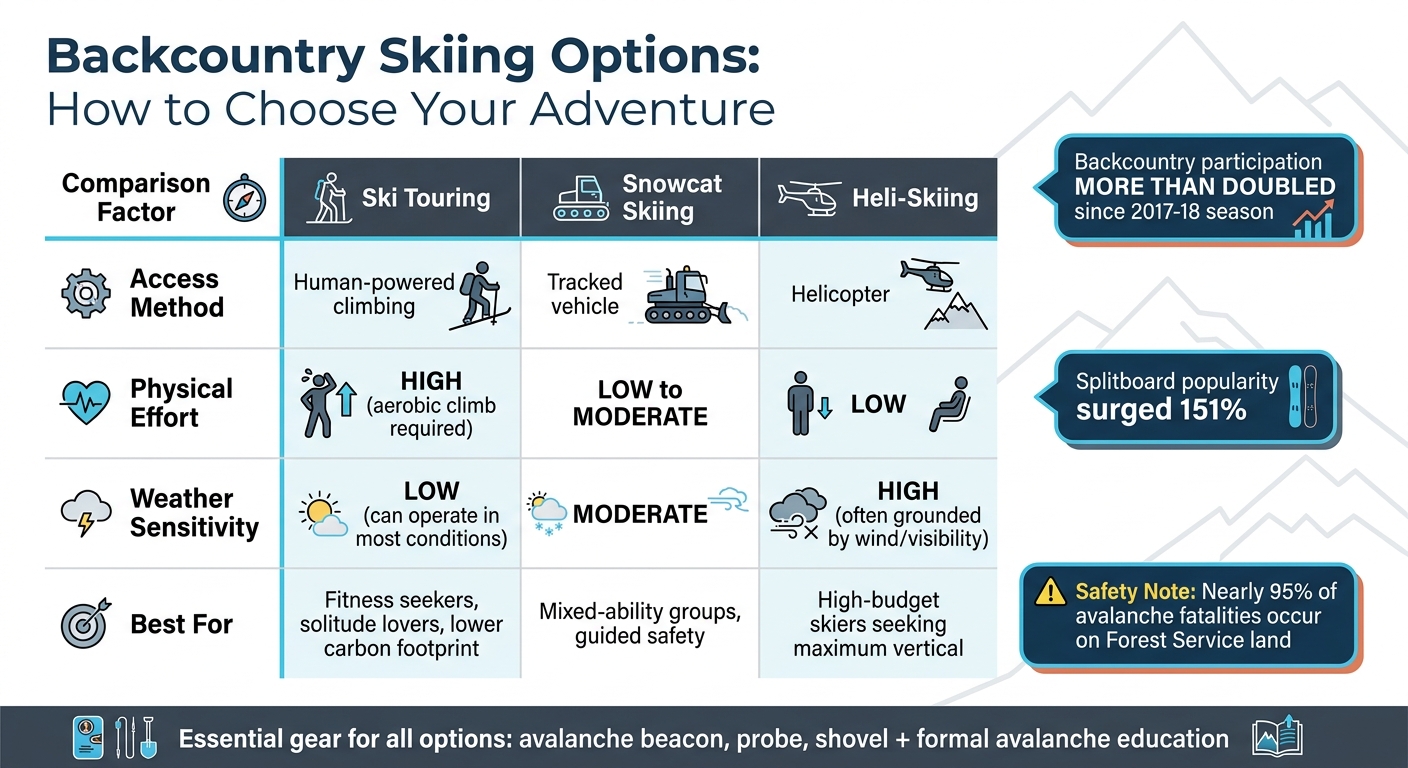
Backcountry Skiing Options Comparison: Touring vs Cat Skiing vs Heli-Skiing
Backcountry skiing has seen explosive growth, with participation during the 2023–24 winter more than doubling since the 2017–18 season. Rising costs, overcrowded slopes, and the increasing hold of corporate giants on resorts are driving skiers to explore alternatives. Today, Vail Resorts and Alterra Mountain Company dominate over half of the U.S. lift capacity, with 86% of Colorado's lift capacity under their control. This concentration has created what insiders describe as a "powder-crazed swarm" at major resorts. Adding to the frustration, single-day lift tickets have soared past $300, with Vail Mountain charging $356 and Deer Valley $349. Former Vail Resorts CEO Rob Katz explained the strategy behind these prices:
"We had to make lift tickets absolutely expensive because we wanted people to move from lift tickets to the pass."
For many skiers, the backcountry offers a compelling alternative: untouched powder and terrain that remains pristine long after a snowfall. Faced with the choice of spending around $1,000 on a season pass to fight resort crowds or investing in touring gear for solitude in the wilderness, a growing number are opting for the latter.
Ski Touring and Independent Zones
Ski touring, which involves climbing mountains under your own power using specialized gear like climbing skins and bindings, has become the heart of the backcountry movement. It provides direct access to untracked terrain without the hassle of lift lines or crowded parking lots. The popularity of splitboards - gear that allows snowboarders to tour like skiers - has surged 151% during this boom.
This shift isn't just about equipment; it's about embracing a new mindset. Jeremy Jones, CEO of Jones Snowboards, captures this sentiment:
"The mountains - you are entering a wild place."
Additionally, many skiers are moving away from fuel-intensive activities like heli-skiing in favor of the lower carbon footprint offered by human-powered travel. While touring requires significant physical effort and a willingness to climb for every descent, the payoff is immense for those seeking autonomy and untouched snow.
Cat Skiing and Heli-Skiing Expansion
For those looking for a less physically demanding way to explore the backcountry, snowcat skiing has become a popular choice. Using tracked vehicles, this method allows groups to access remote terrain without the high cost or weather sensitivity of helicopters. Snowcat skiing delivers the backcountry experience - deep powder and untracked runs - with guided safety and less exertion.
Heli-skiing, on the other hand, remains the top-tier option for accessing the most remote peaks and achieving maximum vertical. However, it is the most expensive and heavily weather-dependent, with trips often grounded by wind or poor visibility.
| Option | Access Method | Physical Effort | Weather Sensitivity | Best For |
|---|---|---|---|---|
| Ski Touring | Human-powered climbing | High (aerobic climb) | Low | Fitness seekers, solitude |
| Snowcat Skiing | Tracked vehicle | Low to moderate | Moderate | Mixed-ability groups |
| Heli-Skiing | Helicopter | Low | High | High-budget skiers, maximum vertical |
Backcountry Safety and Preparation
While the backcountry offers freedom and solitude, it also comes with serious risks. Nearly 95% of avalanche fatalities occur on Forest Service land, where most backcountry recreation takes place. Essential safety gear includes an avalanche beacon, probe, and shovel, but equipment alone isn't enough. Formal avalanche education, focusing on terrain recognition and group management, is critical. As Scott Schell, Executive Director of the Northwest Avalanche Center, emphasizes:
"Avalanche forecasts aren't produced by machines. They're done by people with high levels of expertise."
The funding for these safety measures is precarious. The U.S. Forest Service allocates just $2.5 million annually to support 14 regional avalanche centers, leaving many to rely on non-profits for over half their budgets. Budget constraints have even forced some centers to reduce their forecasting from daily to weekends.
Physical preparation is another key factor. Backcountry skiing requires a 6–8 week preseason training program focused on lower-body strength, core stability, and high-intensity cardio to handle the demands of climbing without lifts. For those venturing into the backcountry, being physically and mentally prepared is non-negotiable. This shift in skiing culture is pushing the sport beyond the confines of resorts, offering a more flexible and terrain-focused experience.
Mobile Lifestyles and Global Winter Chasing
Following Snow Across Hemispheres
For dedicated skiers, the game has changed. Instead of being tied to one season or location, they're chasing winter around the globe - from the Rockies to the Alps, and even to the Southern Hemisphere. Tools like futureflights.ai are making this lifestyle more accessible, using advanced data analysis to track historical weather closures, real-time flight prices, and baggage policies. This means powder enthusiasts can pivot their plans on a dime - rerouting from a rain-soaked French Alps to Norway based on 7–10 day forecasts.
Smaller regional airports are also opening up new opportunities. Destinations like Tromsø in Norway, Poprad-Tatry in Slovakia, and Kutaisi in Georgia are becoming accessible, letting skiers bypass crowded hubs like Geneva or Denver. However, with this convenience comes challenges - over 20% of ski travelers in 2025 faced baggage delays or reroutes due to tight connections and weather-related issues at regional airports. To avoid losing precious ski time, savvy travelers now pack essentials like boots and goggles in carry-ons and plan buffer days at the start of their trips.
"Nothing sabotages a ski trip faster than a missed connection in a snowstorm"
This global pursuit of fresh powder has naturally aligned with the rise of flexible remote work.
Remote Work and Skiing Flexibility
Remote work has reshaped what a ski trip can look like. Instead of quick weekend getaways, skiers are now blending work and leisure into 10-day workcations. By 2025, 58% of remote workers had taken workcations lasting a week or more, with mountain and ski destinations ranking just behind beaches in popularity. The average length of these trips has grown from 4.2 days in 2022 to 2.1 weeks in 2025, with 73% of companies now supporting extended remote work.
Mountain towns like Killington, Park City, and Breckenridge are stepping up to meet these needs. With gigabit fiber internet, these locations are enabling seamless remote work lifestyles. Facilities like Slope Space in Killington, founded by Greg Cash, cater specifically to this community. In February 2026 alone, Slope Space served over 1,000 remote workers, offering high-speed internet, ergonomic workstations, and even locker rooms with showers - all within walking distance of the slopes.
"If I can work from anywhere, why not work from somewhere amazing?"
Effects on Local Ski Economies
The influx of mobile skiers is reshaping mountain towns in both positive and challenging ways. In Park City, a 2024 report revealed that 52% of homes were either empty or used seasonally, highlighting the housing pressures driven by this new wave of remote workers and winter travelers. Political factors have also played a role. Jay Peak Resort in Vermont saw a 10–15% drop in business when Canadian season pass holders - typically half of its clientele - paused travel due to cross-border tensions. Steven Wright, the resort’s General Manager, expressed concern:
"Heavy snow has insulated us from the potential big downside of Canadian visitation... What happens when that snow melts?"
Still, this mobility is fostering a more global winter sports culture. During the 2025-2026 season, Altihut 3014 in Georgia’s Caucasus region hosted skiers from over 15 countries for an 8-day ski mountaineering program. Meanwhile, the formation of the Global Sustainability Ski Alliance in May 2025 - uniting resorts from Europe, Scandinavia, and New Zealand - signals a shift toward serving an international, mobile community.
Mountain towns are adapting, transitioning from seasonal economies to year-round hubs. Activities like mountain biking, indoor water parks, and conferences are helping smooth out revenue fluctuations. These changes highlight how winter is no longer confined to a single place - it's now defined by a community that’s always on the move.
Skier Networks and Community-Driven Models
Membership Communities Connecting Skiers
Skiing is entering a new era, driven by the enthusiasm and creativity of its participants. At Malibu Ski League, we’re creating a membership community that brings outdoor lovers together through shared adventures and a collective passion for the slopes. This approach shifts the focus from static locations to fostering connections, giving skiers the freedom to design their own experiences.
Digital tools are playing a big role in this transformation. Features like real-time rosters, in-app scheduling, and gamified rewards are helping to build tight-knit communities. These innovations aren’t random - they’re shaped by research and feedback from the skiing community, resulting in affordable memberships that encourage trust and camaraderie, all powered by technology.
This evolving model challenges the traditional resort experience and opens up new possibilities for winter sports enthusiasts.
Resorts vs. Skier Networks
For decades, traditional ski resorts have been defined by their physical infrastructure - think chairlifts, trails, and fixed facilities. But this model often comes with hefty price tags, with single-day passes sometimes exceeding $200. Skier networks, on the other hand, focus on fostering social bonds, collaborative trip planning, and cost-sharing through carpooling and group lodging.
| Aspect | Resorts | Community Networks |
|---|---|---|
| Primary Focus | Infrastructure, lift access, physical terrain | Social connection, shared trips, value-based groups |
| Trip Planning | Individual or family-based, fixed lodging | Collaborative, group-driven decision-making |
| Social Interaction | Casual encounters on lifts or in lodges | Skill-based and availability-based matching |
| Cost Structure | High-cost day passes, commercial services | Shared expenses, affordable memberships |
| Safety/Support | Professional patrols, resort staff | Peer mentorship, workshops, vetted systems |
The numbers tell the story. In the U.S., around 50% of skier visits now come from season-pass holders, up from about 38% a decade ago. The Epic Pass, for instance, has grown from 200,000 early adopters to over 2 million holders today. This shift reflects a move away from one-off purchases toward systems that encourage commitment and engagement.
What Comes Next for Winter Sports
This isn’t about replacing resorts - it’s about rethinking winter sports as dynamic, community-driven experiences rather than being tied to specific locations. One major hurdle is combating inactivity. As brands work to make skiing more accessible through lifestyle, fashion, and digital platforms, keeping people engaged and active is critical.
"The real threat isn't competitors, it's inactivity. Fewer people moving, participating, or even showing up at all." - Ariana Ferwerda, Founder, Halfdays
The idea of community-driven skiing isn’t new. Take Camp Fortune Ski Club near Ottawa, which has been running since 1910. Its success proves that a shared passion and genuine connections can support local economies better than centralized, high-tech solutions. Similarly, the Milan–Cortina 2026 Winter Olympics, which will span multiple locations and feature a 12,000-kilometer torch relay across 110 provinces, highlights the growing trend of decentralized, networked events.
"The future of the Winter Olympic Games will not be defined by scale, but by intelligence, strategic clarity, technical precision, and deep respect for place." - Giacomo Angeletti, Venue Technical Lead, Gensler Europe
The future of skiing lies in mobility and connection. As winter sports move away from fixed venues, the focus will be on empowering skiers to create their own adventures. Platforms like Malibu Ski League are leading the charge, connecting people who share a love for snow, whether they’re beach enthusiasts or mountain regulars. The industry is shifting to prioritize personal experiences and meaningful connections over traditional infrastructure, opening up exciting new possibilities for the future of winter sports.
Conclusion
The shifts in technology and weather patterns have reshaped how we experience winter. For example, in 2026, snowpack levels in the Western U.S. plummeted to just 15% to 65% of historical averages, pushing skiers to abandon fixed destinations and instead chase storms across regions.
From 2000 to 2019, U.S. ski areas faced losses exceeding $5 billion due to shorter seasons and declining visitor numbers. In response, many traditional resorts are pivoting toward year-round operations. But the real transformation is happening among skiers themselves. With tools like high-resolution weather forecasts and real-time updates on social media, skiers can now track the best conditions across entire regions. Thanks to multi-resort season passes, hopping to another mountain often comes at little to no extra cost - unlike the steep prices of single-day tickets at major resorts.
This kind of flexibility is no longer just a luxury - it’s becoming a necessity. By mid-century, even if climate goals are achieved, ski seasons in Western Canada could shrink by 14% to 18%. For lower-elevation resorts, unreliable snowfall may leave lifts idle and slopes abandoned. In this changing landscape, successful skiers will adapt by viewing winter as a network of opportunities rather than being tied to one destination.
Skiing has evolved beyond the boundaries of individual resorts. It now thrives on movement, adaptability, and the ability to navigate a fluid, ever-changing network of possibilities. The future of skiing doesn’t belong to the mountains - it belongs to those who move between them.
FAQs
How do I start skiing outside resorts safely?
To ski beyond resort boundaries safely, it's essential to understand avalanche risks and safety protocols. Equip yourself with critical tools such as an avalanche transceiver, probe, and shovel - and make sure you know how to use them effectively. Stick to terrain that matches your skill level, rely on sound judgment, and always ski with experienced partners. For extra preparation, consider enrolling in an avalanche safety course or seeking advice from local guides familiar with the area.
What gear do I actually need for backcountry touring?
When heading into the backcountry, you'll need gear that prioritizes both safety and functionality. Essentials include skis, a snowboard, or a splitboard, along with boots, poles, goggles, and a helmet. For uphill travel, pack climbing skins and consider crampons or ski crampons for icy conditions. Keep ski wax and tools handy for maintenance on the go.
Avalanche safety equipment is non-negotiable: bring a transceiver, probe, and shovel. You'll also need a sturdy pack to carry your gear, plus additional tools like a route guide, whistle, and a snow analysis kit to help assess conditions. These items are crucial for navigating backcountry terrain while staying prepared for potential risks.
How can remote work make ski trips longer and cheaper?
Remote work has transformed ski trips, making them longer and more budget-friendly. By working remotely, skiers can extend their stays without burning through vacation days. Flexible schedules also mean they can travel during off-peak times, which often translates to lower prices on lodging and lift tickets. For even more savings, many opt for smaller resorts or backcountry skiing, which tend to be easier on the wallet. This shift not only helps avoid peak-season crowds but also makes skiing more accessible and enjoyable.