




The summer ski bum lifestyle is all about chasing snow when everyone else is chasing the sun. It’s not about luxury, content creation, or balancing work with mountain life - it’s about living for the thrill, freedom, and raw experiences that come with following the snow year-round. This way of life defies routine, rejects modern pressures, and prioritizes adventure over stability.
Here’s what makes the summer ski bum unique:
- Purpose: They live for the mountains, driven by an obsession with snow and the joy of skiing.
- Lifestyle: From parking lot camping at Mt. Hood to glacier skiing in Chile, their life revolves around unpredictability and movement.
- Challenges: Rising costs of living and commercialization of ski culture have made this lifestyle harder to sustain.
- Contrast: Unlike remote work nomads balancing careers, ski bums fully immerse themselves in the pursuit of snow and community.
This lifestyle isn’t about running away - it’s about choosing a life that feels alive, even if it’s unconventional. It’s sweaty airport trips in July, shared meals in parking lots, and planning life around storm cycles instead of calendars. For those who embrace it, the reward isn’t just the snow, but the freedom to live on their own terms.
Where the Summer Ski Bum Came From
The Original Ski Wanderer
The ski bum lifestyle can trace its roots back to the 1920s, when Ernest Hemingway and his wife Hadley hiked up Austrian mountains with skis in tow. Back then, there were no chairlifts or groomed slopes - just the raw effort of climbing up, the thrill of descending, and the reward of a cozy hütte at the end. It wasn’t about competition or performance; it was about the sheer joy of the experience.
After World War II, many American soldiers who had trained in the Alps returned home with a deep love for the mountains. Rather than settle into traditional careers, they sought out life on the slopes. This post-war passion helped establish iconic resorts like Vail and Aspen. Alongside these resorts emerged a new type of person: someone who worked the lift lines in the morning and skied them in the afternoon.
By the 1970s, the ski bum had a face - and a name. Gary Bigham moved to Chamonix in 1975 and never really left. Now, at 73, he still skis nearly every day from his chalet in Argentière. He captured the era on a 16mm Bolex camera, documenting neon-clad monoskiers, daring runs, and a carefree culture that rejected convention. In Bigham’s own words:
"I'm just useless at paperwork or this office stuff, or making money, really. I cook. I clean. I go skiing."
This raw connection to the mountains laid the groundwork for a lifestyle that would eventually blur the lines between winter and summer.
How Summer Became a Second Winter
Over time, the ski bum culture evolved, challenging the idea that skiing was only a winter activity. For these enthusiasts, snow wasn’t bound by seasons. Bigham and POWDER Magazine co-founder David Moe even created a fictional character, Captain Powder, to embody this mindset. Captain Powder was “the defender of winter, fighting the forces of summer.” The concept started as a joke, but it reflected a real determination to keep the season alive.
In 1982, Bigham and photographer Ace Kvale pushed this idea further. They traveled to Durban, South Africa, to perform a freestyle ski demo at a military parade. Funded by the local tourism board, the trip became a wild adventure. That story - turning a summer detour into a skiing opportunity - captures the essence of the summer ski bum lifestyle.
Meanwhile, Club Med was institutionalizing a similar spirit. Starting with its Alpine village in Leysin, Switzerland, in 1956, the company introduced the "Gentil Organisateur" (GO) program. This system rotated staff between resorts every 6 to 12 months, allowing employees to chase winter across hemispheres - from the Alps to Hokkaido to the Maldives. Hemisphere-hopping became more than a dream; it became a job.
This relentless pursuit of snow has shaped a lifestyle where movement is constant, and the calendar is just a suggestion.
Why Skiing Produces Drifters
Unlike many outdoor sports, skiing doesn’t fit neatly into a weekend schedule. The season is short, conditions are unpredictable, and the best powder days don’t wait for your workweek to end. That urgency draws certain people away from routine and into a lifestyle defined by movement.
For these individuals, low pay and tight living quarters are minor inconveniences. Skiing offers something far more meaningful than a paycheck. As Aman Narain, founder of A2Z Advisors, explained about the GO lifestyle:
"For a specific personality type, adventurous, warm, extroverted, experience-over-accumulation, this is a package that beats the market."
This isn’t a personality shaped by skiing - it’s one that skiing naturally attracts. The sport’s seasonal rhythms, communal living, and obsession with snow create a culture that thrives on motion. Skiing calls to those who can’t sit still, shaping lives where every storm becomes an invitation to chase the next adventure.
sbb-itb-236ebff
How Ski Culture Got Polished
From Grit to Glitz: The Rise of Luxury Skiing
Skiing has come a long way from its gritty, free-spirited roots. What used to be a lifestyle centered around passion and community has morphed into a polished, high-end experience. If you compare the raw, grainy 16mm footage of early ski bums to today's Instagram-perfect powder shots, the transformation is undeniable. Skiing has become a commodity - packaged, marketed, and sold to a wealthier audience.
This shift didn’t happen overnight. It was a gradual climb, fueled by corporate consolidation and the rise of mega-passes like Ikon and Epic. These passes bundled multiple resorts under single ownership, turning once-independent mountain communities into a streamlined, commercialized network. Alongside this came a steep rise in costs. Take Jackson Hole Mountain Resort, for example: over the past two decades, lift ticket prices soared from about $70 to more than $200. Lodging costs followed the same trajectory, reflecting the growing commercialization of mountain life.
The mountains themselves haven’t changed, but the price of admission has. For the old-school ski bum - the one who worked odd jobs, lived on ramen, and skied every possible run - this new reality is almost unrecognizable. They haven’t disappeared; they’ve just been priced out.
How Social Media Changed Skiing
The cultural shift is just as striking as the economic one. Where skiing once celebrated the raw chaos of the mountains, today’s version is curated and glossy. Social media has turned the slopes into a stage for drone footage, perfectly styled gear shots, and TikToks edited during "Content Strategy Hour" - the modern après-ski ritual. Instead of swapping stories over cheap wine in a hostel, skiers now swap hashtags and engagement metrics.
This change has reshaped how people experience the mountains. The focus has shifted from being fully present to creating content. As writer Lucas Freeman put it:
"The vibe is: 'Yes, I hit a double black. No, I haven’t answered my client email. Let me upload this drone footage first.'"
But not everyone is on board with this polished aesthetic. A counter-movement is gaining traction among younger skiers. Dubbed "thriftcore" or "anti-corporate snow drip", this trend embraces vintage one-pieces, upcycled Patagonia gear, and secondhand finds from platforms like GearTrade. It’s more than just a style choice - it’s a statement. These skiers are rejecting the luxury branding of the slopes, carving out a new identity that’s equal parts practical and rebellious.
Remote Work Nomad vs. Summer Ski Bum
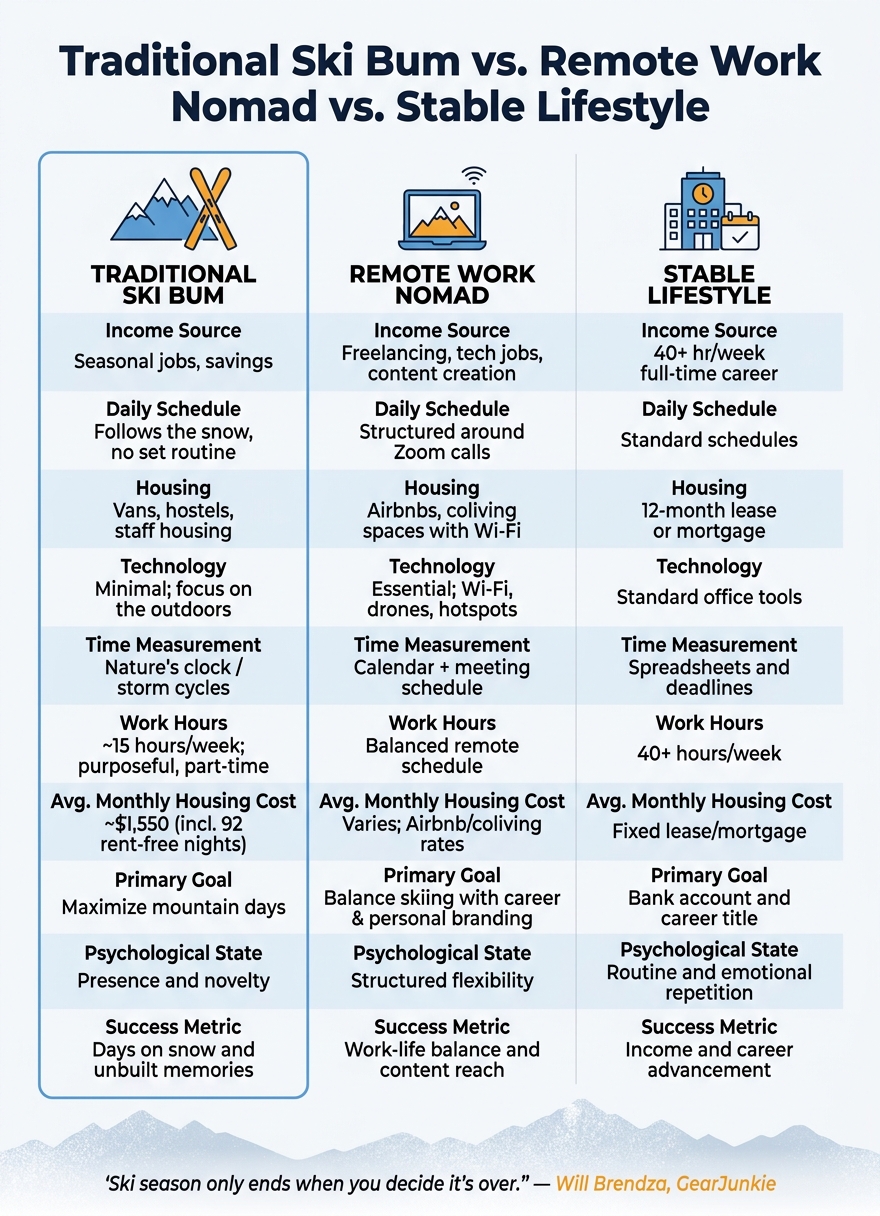
The digital age has also given rise to a new kind of skier: the remote work nomad. This is someone who balances skiing with a full-time job, hopping between Zoom calls and ski runs while staying in Airbnbs or coliving spaces. It’s a stark contrast to the traditional ski bum, whose life revolved around chasing snow and living frugally.
In January 2025, writer Matt Yao joined a group of remote workers from cities like San Francisco, Los Angeles, and New York to rent a five-bedroom house in Murray, Utah. Their goal? To ski six nearby resorts while keeping up with their professional lives. While this setup might look similar to the ski bum lifestyle from the outside, the differences are clear:
| Feature | Traditional Ski Bum | Remote Work Nomad |
|---|---|---|
| Income Source | Seasonal jobs, savings | Freelancing, tech jobs, content creation |
| Daily Schedule | Follows the snow, no set routine | Structured around Zoom calls |
| Housing | Vans, hostels, staff housing | Airbnbs, coliving spaces with Wi-Fi |
| Technology | Minimal; focus on the outdoors | Essential; Wi-Fi, drones, hotspots |
| Primary Goal | Maximize mountain days | Balance skiing with career and personal branding |
Yao himself reflected on this shift, saying:
"I was transitioning from nomadic ski bum with an unquenchable thirst for snow to perhaps a wiser version of myself who recognizes that just because you love something, doesn't mean you have to be immersed in it 24/7."
It’s a practical perspective, but it also marks the end of the traditional ski bum era. What follows is a new chapter - one shaped by balance, technology, and a different kind of freedom.
Life of a Ski Bum Documentary
What Summer Ski Bumming Actually Looks Like
Summer ski bumming is a far cry from the glossy image of luxury resorts or remote work setups. It’s a gritty, unconventional lifestyle that thrives on unpredictability and passion for snow, even in the heat of summer.
Airports in July
Picture this: it’s July, and the airport is packed with families hauling beach bags and flip-flops. Meanwhile, you’re dragging a massive ski bag stuffed with avalanche beacons, shovels, probes, and goggles. It’s sweaty, awkward, and completely intentional. This is the reality of summer ski bumming - a deliberate choice to chase snow when everyone else is chasing the sun.
Glacier Camps and Parking Lot Living
At Mt. Hood's Timberline, the parking lot becomes much more than a place to park - it’s a hub of camaraderie and creativity. In 2025, photographer Alex Zimmerman captured this unique scene, where professional riders like Miles Fallon and Scotty James trained alongside locals. People shared everything from salmon rice balls to gummy bears during jump sessions, and even Honey Bear, an Australian Shepherd, had her own sun tent in the lot.
"A sense of community feels like an understatement. After months of riding, eating, and laughing together, it becomes something else entirely. Something closer to family." - Alex Zimmerman, Photographer, The Snowboarder's Journal
Days on the mountain follow a strict rhythm. You start early to catch the fresh, firm snow before the sun softens it too much. By mid-morning, it’s back to the parking lot to refuel and soak in the slower pace as the snow melts under the summer sun.
Chasing Winter to Chile
When North America’s glaciers can’t keep up, the most dedicated ski bums head south - literally. They board red-eye flights from cities like Los Angeles or Miami and land in Santiago, Chile, ski bags in tow. From there, it’s a nerve-wracking drive up a winding mountain road with 39 switchbacks, en route to the Tres Valles resorts: La Parva, El Colorado, and Valle Nevado.
Before hitting the slopes, a pit stop for tire chains is crucial - prices climb as you get closer to the mountain. But the effort is worth it. Portillo, Chile’s oldest ski resort, boasts sunny skies on about 80% of its ski days. Hostel kitchens buzz with activity, from weather maps pinned to walls to the sound of cheap wine glasses clinking. It’s a raw, unfiltered kind of freedom. As writer Lexi Dowdall of Wild Rye puts it:
"In Chile, the prices are lower, the lifts are slower, the food is far better, and the wine…OH, THE WINE!"
Portillo’s mandatory multi-night stays - three or four nights minimum - force visitors to settle in and fully embrace the experience.
Where Skiing Meets Surfing
Not every ski bum heads abroad. Some stay stateside, blending two passions: skiing and surfing. These adventurers keep wetsuits and ski boots side by side in their truck beds, chasing waves at dawn and snow by afternoon. The truck becomes a rolling shrine to the outdoors, carrying the unmistakable scent of saltwater, sunscreen, and old ski wax. This mix of surf and snow captures the essence of a life that refuses to fit into neat seasonal boxes.
Disappearing for a Whole Summer
For some, summer ski bumming isn’t just a phase - it’s a way of life. These die-hards disappear into the mountains for months, chasing snow wherever it lingers. One Colorado skier kept a streak going for three years straight, relying on high-altitude glaciers and rugged snowfields to keep the dream alive. Their gear takes a beating - specialized “rock skis” endure the sun-rotted, debris-filled slopes - but the passion never fades.
Will Brendza, Ski Section Editor at GearJunkie, captures the mindset perfectly:
"Ski season only ends when you decide it's over."
For those who live this way, it’s not about escaping reality - it’s about redefining it. The constant pursuit of snow becomes a way of life, proving that sometimes, instability feels like true freedom.
Why Instability Can Feel Like Freedom
Traditional Ski Bum vs. Remote Work Nomad vs. Stable Lifestyle
Living a life dictated by snow and uncertainty is more than just a lifestyle; for some, it's an art form. These wanderers embrace instability, finding freedom in its unpredictable rhythm.
Who Chases Seasons and Why
The people who choose this path aren’t reckless. They simply see the world differently, thriving on unpredictability rather than fearing it. For them, certainty feels more like a cage than a comfort.
Interestingly, it’s not always about skiing itself. As Matt Yao, author of More Human Possible, explains, it’s about the profound connection between place and identity:
"Where you live shapes what you do and who you're with which by extension permeates into who you become."
These individuals defy being boxed into a single identity. They’re the ski bum who also codes, the patroller who paints, or the person who feels equally at home in a Manhattan sublet in October and a tent near Mammoth in April. For them, movement isn’t an escape - it’s an expression. This way of life even changes their perception of time itself.
Measuring Time by Storm Cycles
Ask one of these wanderers what month it is, and they might hesitate. But ask them about the next storm cycle in the Sierra Nevada, and the answer comes instantly. Their internal clock doesn’t tick to the rhythm of spreadsheets or deadlines - it’s synced with snowfall and weather patterns.
This isn’t chaos; it’s a different kind of structure. Blake Boles, author of Dirtbag Rich, captures this philosophy perfectly:
"To me, being a dirtbag simply means that you're too busy following your bliss to worry about a little dirt under your nails. It means you're doing something right."
For dedicated season chasers, life revolves around the mountain. Some manage to clock over 60 ski days a season by living close to resorts and aligning remote work schedules with first chair. The storm cycle becomes their alarm clock, and the powder report takes the place of the morning news. It’s not about rejecting priorities; it’s about creating their own.
Behind what might seem irrational lies a deliberate choice - a way to reclaim time and live on their terms.
The Logic Behind an Irrational Choice
From an outsider’s perspective, summer ski bumming might look financially reckless. But for those living it, it’s a carefully calculated lifestyle. One wanderer in 2022 reported spending an average of $1,550 per month on rent by combining short-term stays with 92 rent-free nights at family homes or camping. It works if you’re willing to let go of the traditional 12-month lease mindset.
The contrast with a conventional lifestyle is striking:
| Feature | Stable Lifestyle | Summer Ski Bum |
|---|---|---|
| Time Measurement | Standard schedules | Nature's clock |
| Housing | 12-month lease or mortgage | Sublets, vans, tents, or seasonal coliving |
| Work View | 40+ hours/week; full-time career | ~15 hours/week; purposeful, part-time |
| Psychological State | Routine and "emotional repetition" | Presence and novelty |
| Success Metric | Bank account and career title | Days on snow and unbuilt memories |
David Ocamb, author of Say the Quiet Part, sums it up: "What people are really chasing is escape velocity. Not necessarily escape from responsibility or adulthood, but escape from emotional repetition." A single week of immersive experiences can feel more fulfilling than months of routine because it forces the brain to engage, creating fresh memories instead of running on autopilot.
What You Wear When You Wander
For these wanderers, gear isn’t just practical - it’s part of their identity. A Patagonia shell that’s traveled from Chile to Hood to a New Zealand hostel isn’t a fashion statement; it’s a record of adventures. Every scuff on a ski boot or patch on a jacket tells a story that can’t be captured on a LinkedIn profile.
For those who bridge skiing and surfing - wetsuits and ski boots sharing space in the same truck bed - clothing becomes a kind of uniform. It’s a signal to others in their tribe, a group bound not by headquarters or dress codes but by a shared instinct to chase nature’s next offering. As Yao puts it, "Permanence, the quality of something lasting, isn't the same thing as immobility." The gear moves, the identity remains. In rejecting routine, these well-worn items become symbols of freedom in a world obsessed with efficiency.
Conclusion: Restless, Romantic, and a Little Jealous
Why the Freedom Still Pulls
In a world dominated by routines and obligations, the summer ski bum stands as a reminder of what true freedom looks like - choosing the extraordinary over the expected. Even as the costs climb higher, the appeal of this lifestyle remains unwavering. The culture endures, not because it's about skiing per se, but because it's about rejecting the idea that the calendar or the clock should dictate your life.
It’s about making a deliberate choice: the mountain over the meeting, the wild over the predictable. As Joseph Campbell once said:
"We're so engaged in doing things to achieve purposes of outer value that we forget the inner value, the rapture that is associated with being alive, is what it is all about."
For the ski bum, this clarity arrives early. In a world that seems to build endless mazes of distractions and demands, their perspective feels almost revolutionary. Max Mogren captures this sentiment perfectly:
"Maybe we know that 'living the dream' is one of the few healthy, sane responses to finding oneself immersed in an American Nightmare."
This isn’t about running away. It’s a conscious decision - one made with worn gear, a truck that smells of adventure, and a heart ready for whatever comes next. It’s a longing for moments that go beyond what can be measured or monetized. Choosing this path isn't escape; it’s a bold embrace of life’s unpredictability.
One Last Image
Imagine a quiet treeline, where a small group of friends prepares for a run. There’s no app telling them this is the right spot, no sponsorships to make it look perfect. The storm came through overnight, the lot filled before dawn, and now they’re climbing in silence - leaving behind inboxes, leases, and rigid schedules.
"Meanwhile, on some secluded mountain far from the fray a small group of friends step into their skis and start ascending above the absurdity."
This moment isn’t shared on social media because its worth lies in being lived, not posted. They’re here because the window for such wild, fleeting experiences is open right now. And they know - like only those who’ve chosen this life can - that it won’t always be. As Bill Perkins wisely points out:
"The teenager in you dies, the college student in you dies, the single unattached you dies... Once each of these mini-deaths occurs, there's no going back."
So they go. And somewhere, as you read this, you might feel that subtle, nagging pull toward the mountain. That pull? That’s the point.
FAQs
How do summer ski bums afford it?
Summer ski enthusiasts sustain their lifestyle through creativity, seasonal jobs, and a willingness to trade comfort for their passion. Many cut costs by sleeping in their trucks, bunking in hostels, or hiking to isolated snowfields. They make their budgets go further with affordable passes, minimal spending on gear, and prioritizing unforgettable experiences over possessions. At the heart of it all is a deep love for skiing and a deliberate choice to step away from traditional routines.
Where can you actually ski in summer?
In North America, Mount Hood in Oregon stands out as the go-to spot for summer skiing. Its Palmer snowfield remains skiable from late spring through August, offering a consistent option for skiers. With over 2,000 feet of vertical descent at high elevation, mornings typically bring firm snow, while afternoons offer softer conditions. While other options exist - like glaciers in Colorado, Alaska, or Canada - they often demand more effort and preparation, with terrain that can be more challenging.
Is summer ski bumming still possible today?
Summer ski bumming is still alive, though it exists on the fringes of mainstream ski culture. For the truly dedicated, it’s all about chasing snow wherever it lingers - on glaciers, high-altitude snowfields, or secluded mountain passes. The conditions are often icy and unpredictable, but that’s part of the appeal.
For those who dive into this offbeat pursuit, it’s more than just skiing. It’s an act of defiance against the polished, commercialized world of ski tourism. Picture dragging ski gear through airports in the heat of July, sleeping in the back of a truck, and crisscrossing the globe in search of the next patch of snow. It’s about freedom, adventure, and finding meaning in the raw, untamed side of the sport.