




When ski towns shed their winter layers, they reveal a quieter, more grounded side. Gone are the bustling lift lines, après-ski crowds, and high-end gear displays. What remains is a slower rhythm, where locals reclaim their space, trails transform for summer adventures, and the focus shifts from performance to community.
Here’s what happens when the snow melts:
- Winter’s Show Ends: The flashy ski culture fades, leaving quieter streets and shuttered shops.
- Summer Activities Take Over: Ski slopes become mountain bike trails; rivers and lakes buzz with kayakers, paddleboarders, and fly fishers.
- Local Life Comes Alive: Farmers markets, dive bars, and trailhead parking lots become the heart of the town.
- Authenticity Over Status: Summer highlights experience and connection over appearances, with weathered gear and local knowledge taking center stage.
- Shared Outdoor Spirit: Ski, bike, and surf cultures overlap, united by a respect for nature and a love for the outdoors.
Summer isn’t just an off-season - it’s a chance to see who and what truly defines these mountain towns.
This Ski Town Looks Completely Different in Summer
sbb-itb-236ebff
Winter Theater vs. Summer Reality
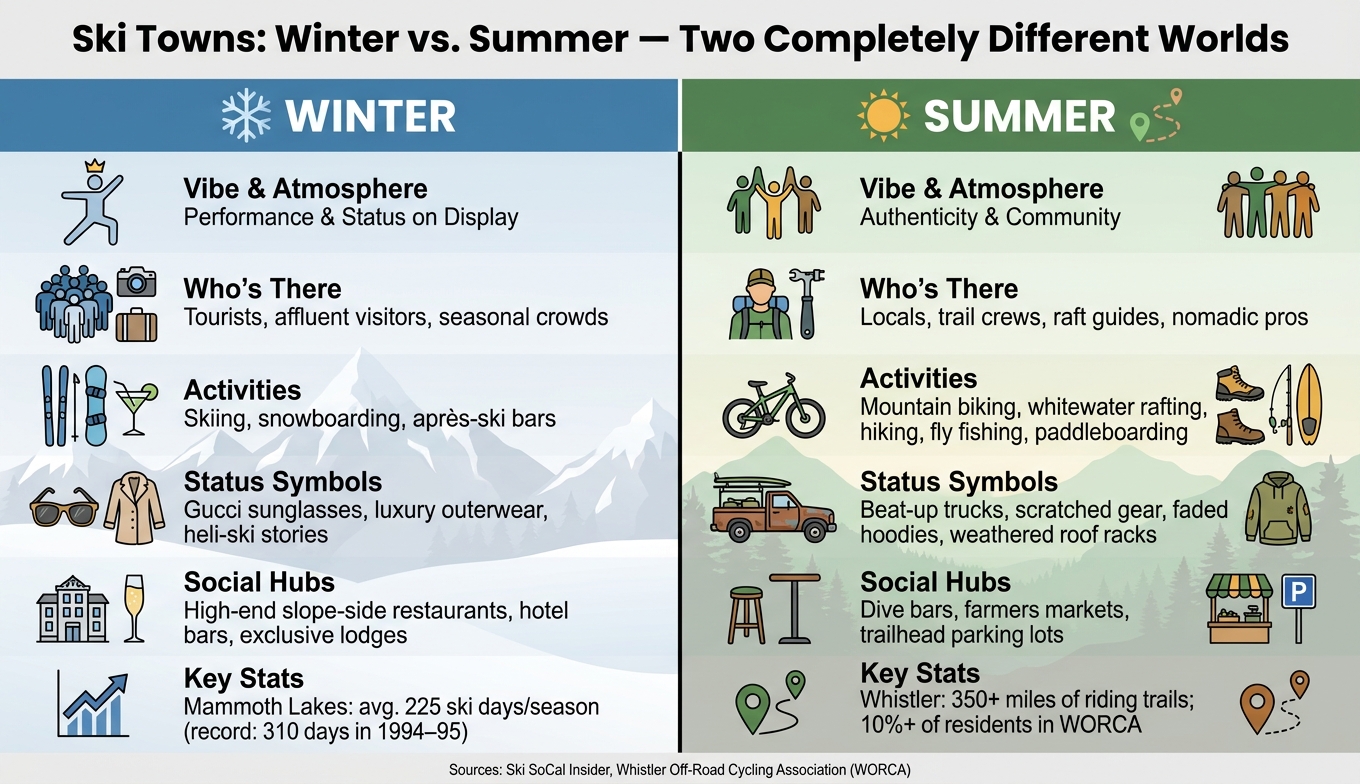
Ski Towns: Winter vs. Summer - Two Completely Different Worlds
Winter in Ski Towns: Performance and Status on Display
Take a stroll through a ski town in February, and it’s like stepping onto a stage. The “actors” are dressed for the part - furs, Gucci sunglasses, and high-end outerwear all signaling a certain level of affluence. By mid-afternoon, après-ski bars are packed, brimming with cocktails and a sense of exclusivity. The air is thick with an unspoken competition: who tackled the steepest run, who’s staying in the most luxurious lodge, and who’s rocking the latest gear. Tristan Kennedy, Editor of SNOW Magazine, captures this perfectly:
"Stereotypes are two-a-penny on the slopes here, from women in fur coats and Gucci sunglasses, to the best-dressed snowboarders you'll see anywhere in Europe."
During the winter months, these towns operate in a predictable rhythm, with surges of visitors during holidays creating a bustling, almost theatrical atmosphere. Meanwhile, locals work behind the scenes, running the lifts and serving drinks, blending into the background as the show unfolds. But when the snow melts and the crowds leave, a very different scene emerges.
What Disappears When the Snow Melts
As winter fades, so does the performance. The shops that buzzed with activity close their doors, and the once-full parking lots sit empty. The lively energy of midwinter gives way to something quieter and more subdued. The spectacle of winter tourism vanishes, leaving behind a town stripped of its seasonal façade. Marian Lyman Kirst, writing for High Country News, described Aspen in the off-season as a place where "half the town's stores were shuttered and dark - closed until November."
In summer, the rhythm of these towns slows dramatically. The constant stream of visitors is replaced by occasional bursts of activity during festival weeks. Streets that were once crowded with tourists become home to morning dog walkers and locals enjoying the calm. Without the performance of winter, the town’s genuine character comes into focus, offering a glimpse into its quieter, more authentic side.
Summer Scenes from Ski Towns
Mammoth Lakes: From Snow to Summer Adventures
By July, Mammoth Lakes undergoes a striking transformation. The gondola still hums along, but instead of skiers, it's ferrying mountain bikes to the trails. Lake Mary glistens with paddleboarders, and the shared houses that once housed ski instructors now shelter trail workers and bike guides, often seen enjoying breakfast burritos on porches surrounded by duffel bags.
What sets Mammoth apart is how its seasons overlap. The resort once recorded an impressive 310-day ski season (1994–95) and typically averages 225 days. Even as summer activities thrive on the lower slopes, skiing can linger on the upper mountain. Sasha Everett, Ski SoCal Insider, captures this duality: "Mammoth remains active - but in a new guise". Late-season lifts operate from 7:30 AM to 1:00 PM, catering to spring skiers chasing the perfect corn snow, while mountain bikers take to the trails below. This seasonal dance is echoed in Jackson, where summer brings its own unique rhythm.
Jackson: A Blend of Rapids, Trails, and Cowboy Spirit
In Jackson, summer smells like sunscreen and river water. The Snake River becomes the town's heartbeat, with daily whitewater rafting trips powered by snowmelt, while fly fishers seek quiet corners of the river. Over at Grand Teton National Park, trailheads fill early, and latecomers often face a long walk to the parking lot.
Jackson's summer vibe is a mix of outdoor adventure and ranching heritage. Cowboys and outdoor enthusiasts share the same diners, dusty parking lots, and even bar stools. Jackson Hole Mountain Resort brings locals together with "Friday Night Bikes", offering discounted lift tickets and rentals from July 4th to Labor Day. It's a small gesture that reminds everyone the mountain belongs to the community, even if only briefly. While Jackson leans into its rugged roots, Whistler takes a different approach, embracing its summer identity with fervor.
Whistler: From Prestige to Pedals
By August, Whistler trades its winter glamour for a summer scene dominated by dirt-covered mountain bikers. The village buzzes during Crankworx, the world’s largest mountain bike festival, which attracts riders from all over. Once the festival ends, the trails settle into a quieter rhythm, with locals reclaiming their space.
Whistler’s summer stats are impressive: over 350 miles of riding trails and a community where more than 10% of residents belong to the Whistler Off-Road Cycling Association (WORCA). One cherished tradition is the Thursday "Toonie Rides", casual races that bring together riders of all ages. As local racer Jesse Melamed puts it:
"There's no hype or fanfare, just people riding and lapping out because they want to be on their bike."
When the snow melts, what’s left is a community united by their love for the trails.
Northeast Mountains: A Quiet Seasonal Shift
In the Northeast, the change from winter to summer feels more subdued. Resorts like Killington in Vermont and Whiteface in New York swap ski runs for hiking trails, while base lodges host weekend farmers markets. Bike parks open their doors to families eager for summer fun, and places like Stowe come alive with its Sunday farmers market and the popular 5.5-mile Recreation Path, bustling with joggers, cyclists, and dog walkers.
Here, the summer season doesn’t just repurpose the landscape - it redefines it, showcasing a quieter, more inclusive side of these mountain towns.
European Alps: Timeless Summers in the High Peaks
In the Alps, the shift from winter to summer feels natural, not forced. As the luxury ski crowd departs, the mountains return to their roots. Farmers guide livestock to high pastures, and hut-to-hut hikers set out on multi-day treks. Paragliders soar from ridgelines, and places like the Restaurant Refuge du Plan de l'Aiguille in Chamonix offer meals to those who’ve truly earned them.
The Alps embrace summer with authenticity. In the Dolomites, "Peaks of Gastronomy" events celebrate local ingredients and outdoor dining, while Zermatt's Annual Folklore Festival highlights traditions untouched by ski culture. When the winter crowd fades, what remains is the Alps at their core - unchanged and enduring.
The Social World of Summer Mountain Towns
Who Stays When the Tourists Leave
When the chairlifts stop spinning and the rental shops close their doors, mountain towns take on a different rhythm. The frenzy of the tourist season gives way to a quieter, steadier pace, revealing the core community that remains. These are the locals, seasonal workers who’ve decided to stick around, and nomadic pros who shift their focus from snow-covered slopes to rugged trails. Among them are raft guides, trail crews, mountain bikers doubling as mechanics, and bartenders who know exactly how their regulars take their coffee - and when to give them space.
What keeps these people rooted isn’t the allure of the resort but the untamed beauty of the mountains, the slower pace of life, and the tight-knit community that emerges once the crowds are gone. Researcher Martha Gärber from the Free University of Bozen-Bolzano explains that small mountain communities "maintain an economic circuit and a community-based life style in remote and peripheral regions". These towns have a pull of their own, creating a gravitational force that keeps certain individuals grounded. As the tourists leave, the social dynamics shift, and local values take center stage.
Status Looks Different in Summer
Winter in a mountain town is all about appearances. Status is flaunted through shiny new ski gear, expensive jackets, and casual mentions of exclusive trips like heli-skiing in Alaska. You can size someone up from across the lodge by their gear alone.
But summer rewrites the script. Here, it’s not about brand-new equipment or flashy displays. Instead, a beat-up truck, scratched gear, and a hoodie worn thin at the cuffs tell a story of experience and time spent outdoors. That faded hoodie? It’s not just clothing - it’s a badge of honor earned by someone who knows every inch of the local trails. A weathered roof rack loaded with bikes and kayak paddles speaks volumes about a life lived in sync with the wild. In summer, the currency shifts to something deeper: the knowledge of hidden swimming holes, secret trailheads, and the kind of authenticity that can’t be bought.
Where Locals Actually Hang Out: Bars, Markets, and Parking Lots
As the seasons change, so do the spaces where people gather. The high-end slope-side restaurants and hotel bars with curated cocktails fade into the background. Instead, the heartbeat of the town moves to more unassuming places - spaces that thrive on connection rather than consumption.
You’ll find it in the dive bar with sticky floors and a jukebox playing Tom Petty, where no one cares what you’re wearing. It’s in the farmers market on Saturday mornings, where locals come not just to buy produce but to catch up with familiar faces. And it’s in the parking lot at the trailhead, where tailgates drop, thermoses of coffee are passed around, and conversations flow before anyone even laces up their boots.
These spaces reflect the deeper values of the community. The farmers market isn’t a tourist trap in the off-season - it’s a weekly ritual. The dive bar doesn’t have a dress code or a reservations list because it’s there for the people who call this place home. As Martha Gärber notes, mountain communities maintain their social fabric through "multifunctional recreational purposes" that serve the year-round residents rather than seasonal visitors. When the performance-driven energy of winter fades, the town finally gets to be itself, creating spaces that are as authentic as the people who gather there.
The Ski-Surf-Saddle Lifestyle: Where These Cultures Overlap
When summer rolls around, a certain type of adventurer emerges - one who doesn’t fit neatly into a single category. These are the people who seamlessly blend ski, surf, and outdoor cultures into their lives. Picture this: last winter, they were ski instructors carving down snowy slopes. Now, they’re leading kayak tours or building trails, their trucks loaded with a surfboard, bike frame, and a sense of adventure. This lifestyle isn’t just about switching sports with the seasons - it’s a mindset, a way of living that thrives no matter the weather.
Gear and Style That Work Year-Round
You can spot the overlap in these cultures by looking at the gear and style. Gone are the days of neon-colored, puffy ski jackets dominating mountain fashion. Today, technical gear is sleek, functional, and adaptable. Brands like Stio (from Jackson Hole), Flylow (based in Denver), and Strafe (born in Aspen) design clothing that fits just as well on a summer trail as it does on a winter slope. Essentials like moisture-wicking base layers and packable rain jackets are staples for both powder chasers and mountain bikers seeking that perfect "hero dirt" - the ideal trail condition that bikers rave about during shoulder seasons.
There’s also a certain effortless style, or steeze, that flows across these sports. The same person who takes care to avoid the dreaded "gaper gap" (that awkward space between helmet and goggles) on the slopes is the one rocking a perfectly coordinated bike kit in the summer. Even the humble toque (or beanie) makes the seasonal jump, keeping heads warm during those brisk, early morning trail rides when the thermometer hovers around 45°F.
But the connection between these sports goes deeper than just the gear.
What Ski, Surf, and Outdoor Cultures Actually Share
At their core, these cultures share a rhythm and philosophy that transcend the sports themselves. It starts with a shared approach to gear: keep it versatile, functional, and low-key. But even without the equipment, the parallels are undeniable. All of these pursuits revolve around chasing the perfect moment. Surfers wait for the right swell. Skiers obsess over powder days. Mountain bikers anticipate trails with just the right amount of tackiness. The patience, the weather-watching, and the ability to drop everything when conditions align all come from the same place - a deep connection to the natural world.
What truly ties these communities together is their respect for the environment. Take Whistler, for example, where over 10% of the permanent population belongs to the Whistler Off-Road Cycling Association (WORCA). These locals don’t just ride the trails - they help maintain them, showing up for trail work nights in exchange for bike park tickets. It’s not about being a tourist; it’s about stewardship. The same ethos drives Leave No Trace camping and avalanche education in winter. Whether it’s the saddle, the slope, or the wave, these sports demand care for the landscapes that make them possible. And that sense of responsibility - that commitment to giving back - is the essence of what summer reveals when the snow melts away.
Conclusion: Summer Shows Who Actually Belongs
Winter in a ski town feels like a grand production. There's a cast of characters, a wardrobe of ski gear, and a script everyone seems to follow. But when the snow melts, the lifts stop turning, and the tourists head home, the town sheds its winter persona, revealing its true self.
Not every town thrives during this quieter time. Some businesses shutter until the next snowfall, and the silence can feel heavy. It raises a tough question:
"Is a town really a town if it's economically, socially and mentally closed half the year?"
The places that endure - the ones that feel alive even in summer - owe their spirit to the people who stick around. The long-time teacher, the local plumber ensuring pipes don’t freeze, or the raft guide who grew up on the river. These are the folks who keep the heartbeat of the town going, even when the crowds disappear. Their presence brings life to the quiet trails, the laid-back farmers markets, and the dive bars where no one's putting on a show. They create a sense of place that no ski pass can replicate.
Summer has a way of sorting things out. The seasonal show-offs and status-seekers leave, taking their theatrics with them. What’s left is slower, simpler, and, if you take the time to notice, far more compelling. Morning coffee on a porch at 8,000 feet. A farmers market where everyone greets each other by name. A dive bar where conversations linger long after the snow has melted. These moments capture the essence of mountain life in summer - unhurried, genuine, and deeply rooted.
This shift challenges the idea of a "ski town" entirely. The term itself feels limiting:
"In calling a place a 'ski town', we deny it the beauty, fun, and warmth it offers the entire rest of the year."
Ultimately, belonging isn’t about the season or the spectacle. It’s about the connection that endures when the crowds are gone. The people who stay in July aren’t just waiting for winter to return. They’re living in the moment, embracing the slower rhythm of mountain life. For them, the mountains are more than a backdrop for a seasonal script - they’re home.
FAQs
Why do ski towns feel so different in summer?
In the summer months, ski towns undergo a transformation, shedding their winter persona of luxury lodges, high-end gear, and meticulously planned events. With the snow melted, the spotlight turns to simpler pleasures like outdoor adventures, farmers markets, casual dive bars, and lazy days floating down rivers. Some towns buzz with life, thanks to tight-knit communities and hardworking seasonal locals, while others feel eerily quiet, revealing how much their character is tied to the grandeur of winter activities.
What do locals do when winter tourists leave?
When the winter crowds head home, locals settle into the calmer, slower pace of summer in the mountains. The focus shifts from the adrenaline of ski slopes to more laid-back activities like mountain biking, floating down rivers, and wandering scenic trails. It’s less about chasing thrills and more about soaking in the surroundings.
Places like Jackson and Aspen transform during this time, buzzing not with tourists but with local charm. Farmers markets, dive bars, and community festivals take center stage, offering residents and visitors alike a chance to enjoy the area’s unpolished, genuine character. It’s a season for reflection, connection, and embracing the quieter joys of mountain life.
Which summer activities define ski towns after the snow melts?
When the snow disappears, ski towns take on a whole new personality, becoming hotspots for outdoor activities like mountain biking, hiking, rafting, and swimming in alpine lakes. The atmosphere softens into a laid-back, community-focused rhythm, with farmers markets, casual hangouts at dive bars, and lively seasonal festivals. These warm-weather experiences peel back the flashy side of winter tourism, exposing a deeper connection to local traditions and a slower-paced, outdoor-centered way of life.