




Snow sports are more than just skiing and snowboarding - they’re a $100 billion global industry fueled by passion, identity, and lifestyle. Here’s the breakdown:
- Global Impact: Snow sports generate over $100 billion annually. In the U.S. alone, winter travelers spent $85 billion on overnight trips during the 2024–2025 season.
- Spending Habits: Advanced athletes spend an average of $3,060 per trip and take four trips a year, with 67% opting for luxury accommodations.
- Key Drivers: Revenue streams include resort operations ($11.3 billion), gear and apparel ($19.58 billion), and real estate, which grew 15% in 2023.
- Lifestyle Focus: Snow sports are deeply tied to identity. 80% of advanced athletes consider the sport a core part of who they are, driving spending on apparel, luxury brands, and social experiences.
- Opportunities: Despite its size, the industry lacks a unified digital platform to connect enthusiasts, resorts, and brands, leaving room for growth in community-driven solutions.
Snow sports aren’t just about the slopes - they’re about belonging, shared experiences, and a lifestyle that keeps people coming back year after year.
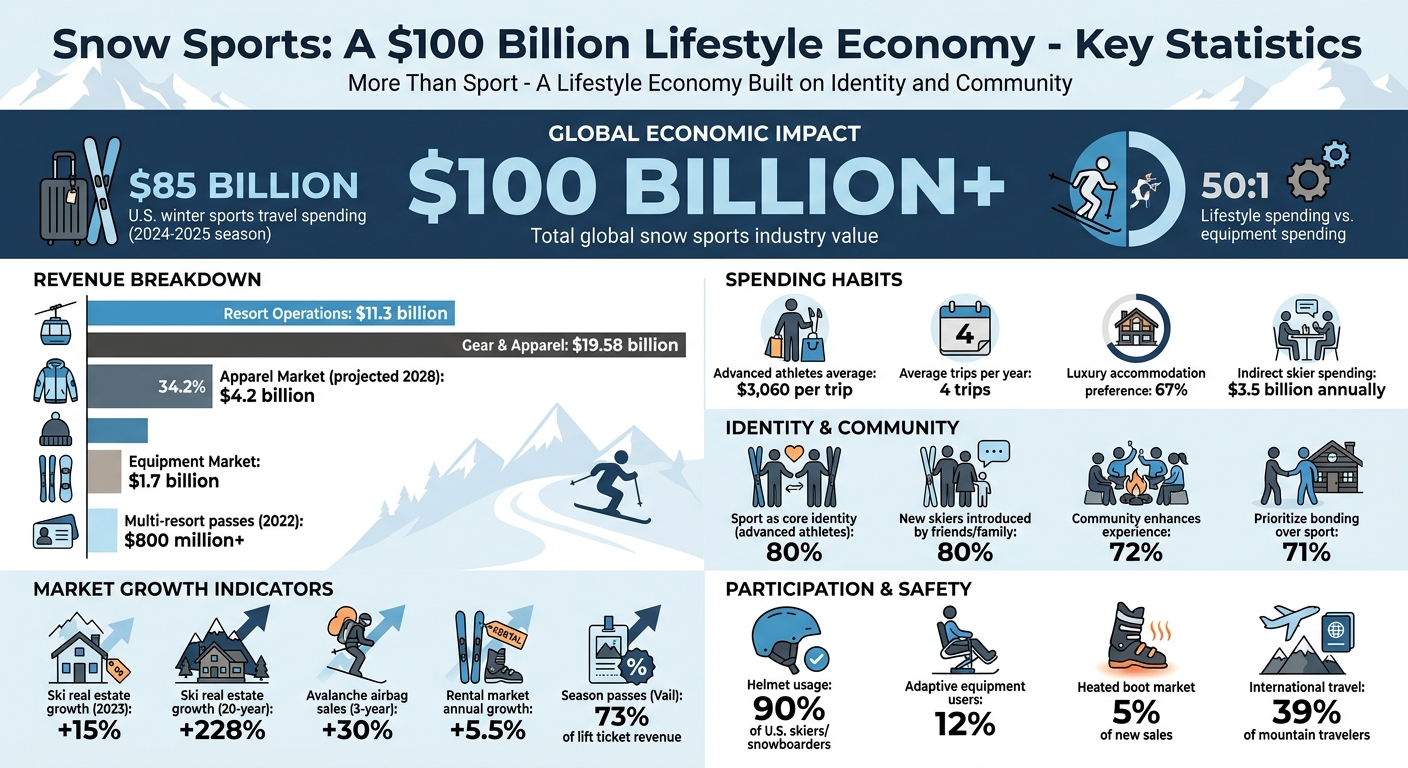
Snow Sports Industry: $100 Billion Economy Breakdown and Key Statistics
Is Ski Culture Dead? The Truth Nobody's Saying
sbb-itb-236ebff
The Hidden Economy of Snow Sports
The $100 billion snow sports economy extends far beyond lift tickets and ski rentals. It’s a vast web of industries, all tied to the vibrant culture and lifestyle of mountain communities.
Resorts and Real Estate
Ski resorts are the backbone of this economy. They’re not just about slopes - they’re hubs for dining, lodging, ski schools, and more.
Real estate in ski destinations is thriving. In 2023, property values in these areas soared by 15%, and over the last two decades, U.S. ski real estate has grown by an eye-popping 228%, far outpacing traditional markets. Take Aspen, for instance, where ultra-prime properties now average €68,900 per square meter. Jeremy Rollason, Head of Savills Ski, notes:
Today, wealthy buyers value lifestyle, comfort and exclusivity and are willing to pay for it.
Consolidation is another big trend. Multi-resort passes, like the Epic Pass, generated over $800 million in 2022 alone. Resorts are also investing heavily in infrastructure, with $812 million earmarked for capital improvements that same year. To tackle shorter winters, many are expanding into summer activities like hiking and cycling.
While resorts anchor this economy, advancements in gear and apparel are driving growth in parallel.
Gear, Apparel, and Accessories
The snow sports apparel market is projected to hit $4.2 billion by 2028. Clothing takes the largest share at 32.7% in 2023, but headgear is the fastest-growing segment.
Lifestyle trends and technology are reshaping the industry. Smart goggles with heads-up displays have carved out a $350 million market. Heated ski boots now account for 5% of new boot sales, and avalanche airbag sales have climbed 30% over the last three years, fueled by the rise in backcountry skiing. Safety is also a priority, with nearly 90% of U.S. skiers and snowboarders wearing helmets. Adaptive equipment is gaining traction, with 12% of participants using it. Meanwhile, rentals are growing at a steady 5.5% annual rate, with 15% of North American skiers relying solely on rented gear.
These advancements make the experience on and off the slopes even more appealing, seamlessly connecting to travel, tourism, and nightlife.
Travel, Tourism, and Nightlife
Travel is a cornerstone of the snow sports economy, tying into the community-driven nature of the sport. A sense of camaraderie plays a huge role, with 72% of travelers saying it enhances their experience. Many enthusiasts opt for upscale options - 67% of advanced skiers and snowboarders choose luxury accommodations. Local economies benefit, too, with indirect skier spending adding $3.5 billion annually. Food and beverage operations alone make up 14% of resort revenue.
The demographic landscape is also shifting. Older millennials (ages 35–44) now make up the largest group of winter sports travelers. International travel is on the rise, with 39% of mountain travelers exploring destinations outside the U.S. in the past year. Domestically, hotspots like Colorado, California, and New York remain popular, while international favorites include Canada, France, Germany, and Italy. And it’s not just people hitting the slopes - 31% of luxury travelers now bring their pets along for the ride.
Culture Drives Spending
Snow sports are more than just gear and activities - they're a way of life. In the U.S. alone, winter sports travelers spent over $85 billion on overnight trips during the 2024–2025 season. Compare that to the global snow sports equipment market, valued at just $1.7 billion. This massive 50-to-1 spending ratio highlights a clear trend: people aren’t just buying products - they’re investing in a lifestyle.
Buying Identity and Lifestyle
For many enthusiasts, snow sports are deeply tied to their sense of self. Among advanced athletes, 80% consider these activities a core part of their identity. This connection is reflected in their spending habits. Expert-level participants shell out an average of $3,060 per trip, with 67% opting for upscale accommodations - a clear sign that their investments go far beyond the slopes.
Luxury and fashion brands have tapped into this identity-driven spending. Labels like Louis Vuitton, Balenciaga, and Loro Piana have released alpine-inspired collections that emphasize lifestyle over performance. As Ariana Ferwerda, founder of Halfdays, puts it:
Fashion and luxury brands are exceptionally good at turning activities into identity. They don't lead with technical mastery or insider language. They lead with imagery, emotion, and lifestyle.
This shift is mirrored in the snow sports apparel market, which is projected to grow to $4.2 billion by 2028 - more than double the size of the equipment market. Much of that spending goes toward creating a distinct style both on and off the slopes, reinforcing the idea that snow sports are as much about personal expression as they are about athleticism.
The Social Side of Snow Sports
The lifestyle spending doesn’t stop at personal identity - it extends to social experiences. Eighty percent of new skiers are introduced to the sport by family or friends, not through ads or solo exploration. Once on the mountain, the social aspect becomes even more central: 72% of travelers say the sense of community enhances their trip, and 71% prioritize bonding with companions over the sport itself.
This social element fuels a cycle of recurring trips and spending. As Melanie Fish, VP of Public Relations at Expedia Group, explains:
Winter sports travelers are not only passionate – their sport is a big part of their lifestyle, and they're willing to splurge on these types of trips.
Ultimately, snow sports culture thrives on more than just skiing or snowboarding. It’s about the friendships, the après-ski gatherings, and the sense of belonging to a unique world - one that keeps people coming back year after year.
Why Lifestyle Beats Sport
Snow Sports vs. Surfing, Golf, and Cycling
When it comes to snow sports, the real value lies in selling a lifestyle, not just equipment. Think about it - Nike didn’t dominate the running world by simply selling shoes. They created the Nike Run Club, transforming running into a global community experience. Snow sports are following a similar path. The culture surrounding these sports has become a far bigger revenue driver than the gear itself.
Golf figured this out a long time ago. Country clubs don’t just offer tee times; they sell an entire lifestyle - status, networking opportunities, and a sense of belonging. Surfing brands? They’ve built entire coastal cultures, making the beach a way of life. Cycling, too, has shifted its focus. It’s no longer just about high-performance bikes; it’s about fostering community and shared experiences. Across all these activities, it’s clear: culture is where the real money is.
This shift highlights a key trend - brands that focus on selling identity, not just equipment, are the ones that thrive.
Culture-Driven Brands Win
Take Vail Resorts as an example. In December 2023, they revealed that season passes made up 73% of their lift-ticket revenue. With 2.4 million passes sold, they brought in about $900 million. But here’s the kicker - they didn’t achieve this by building better chairlifts. Instead, they priced single-day tickets close to $300, making their $1,000 Epic Pass seem like a steal. What they’re really selling is membership in a lifestyle that justifies spending more.
Fashion brands have also jumped on this trend. Louis Vuitton, Balenciaga, and Loro Piana have all introduced alpine-inspired collections that focus more on aesthetic and lifestyle than technical performance. Ariana Ferwerda, the founder of Halfdays, is a perfect example of this shift. Her brand raised $10 million in a Series A funding round in October 2025 by focusing on making skiing approachable and fun rather than overly technical. This approach works because it resonates with people who want to feel part of a community, not just own the best gear.
The numbers back this up. By 2028, the snow sports apparel market is expected to hit $4.2 billion - more than twice the size of the equipment market. Why? Because people aren’t just buying jackets; they’re buying into a lifestyle. For 80% of advanced athletes, snow sports are a core part of their identity. Brands that succeed are the ones asking, “Can you see yourself here?” rather than focusing solely on performance. Community and identity are the ultimate profit drivers.
The Missing Layer: A Central Community Network
Why the Industry Is Fragmented
The snow sports industry is stuck in silos. Resorts, brands, and athletes often operate independently, with no shared digital space to unite them. This isolation is deepened by the dominance of Vail Resorts and Alterra Mountain Company, whose Epic and Ikon passes split the community into two major, competing ecosystems . These passes don't just offer access - they lock skiers into specific resort networks, limiting broader connections across the skiing culture.
Even though 1 in 4 active skiers uses tracking apps, these tools are typically tied to individual resort groups. Their focus is on personal performance metrics rather than fostering a sense of community. On top of that, the industry is heavily skewed: just 13% of global resorts account for nearly 75% of skiing activity, leaving smaller, local hills struggling to stay afloat.
Interestingly, the offline world tells a different story. About 80% of new skiers are introduced to the sport through friends or family, showing the strength of personal connections. However, this organic network hasn't been scaled digitally. Instead of leveraging technology to amplify these relationships, the industry continues to rely on fragmented, in-person connections. All of this points to a massive missed opportunity for a unified digital solution.
The Opportunity for a Central Platform
What if there were a way to bridge these gaps? A central community platform could transform the snow sports world, turning fragmented networks into a cohesive digital hub. To see the potential, look no further than the running industry. Nike didn't just sell shoes - they built the Nike Run Club, creating a global community that fuels participation and, in turn, product sales. Snow sports could follow a similar path, formalizing the social networks that already drive new participation and making it easier for beginners to find their place.
Ariana Ferwerda, founder of Halfdays, captures the challenge perfectly:
The real threat isn't competitors, it's inactivity. Fewer people moving, participating, or even showing up at all.
A unified platform could address this by expanding the sense of belonging in the snow sports community. It's not just about keeping the core group of dedicated skiers - it’s about inviting more people in. With 72% of winter sports travelers saying that community enhances their experience, there’s a clear appetite for better tools to connect. The passion, participation, and spending power are already there. What’s missing is the digital thread to tie it all together.
Conclusion: Snow Sports as a $100 Billion Lifestyle
Snow sports have grown into much more than a weekend pastime. They’ve shifted from recreation to a lifestyle that powers a $100 billion industry. For 80% of advanced athletes, this isn’t just an activity - it’s a fundamental part of who they are. That connection is what drives the economic engine behind the sport.
The numbers tell the story. From multi-billion-dollar resort revenues to thriving retail and apparel markets, snow sports have become a lifestyle economy. In the 2024-2025 season alone, U.S. winter sports travelers spent over $85 billion on overnight trips. For expert athletes, the average spend of $3,060 per trip reflects more than just the cost of participation - it’s an investment in an experience that defines them. Similarly, the snow sports apparel market is expected to reach $4.2 billion by 2028, showing how identity and self-expression are woven into this culture.
But this isn’t just about spending. The real value lies in the community. For 72% of winter sports travelers, meeting new people adds to the magic of the experience, while 71% say bonding with their companions is a priority. Snow sports sell more than performance - they sell connection, shared memories, and the sense of being part of something bigger.
At Malibu Ski League, we’re tackling the fragmented nature of this industry by creating a membership community that ties together gear, trips, and shared experiences. Our mission is to unite skiers, snowboarders, and surfers on a single platform. Our apparel isn’t just functional - it’s a way to carry the culture with you, whether you’re carving down a mountain or dreaming of your next adventure from the beach. By bringing together passionate enthusiasts, we’re creating a central hub for this lifestyle.
Snow sports have transcended their niche, becoming a $100 billion lifestyle economy built on identity, community, and unforgettable experiences. The passion is there, the spending power is clear - now it’s about providing the platform to bring it all together.
FAQs
What’s included in the $100B snow sports economy?
The snow sports economy is a powerhouse, valued at $100 billion. It encompasses a wide range of industries, including resorts, apparel, travel, real estate, gear, media, nightlife, and tourism. These sectors work together to form a thriving ecosystem driven by the culture and lifestyle choices of snow sports enthusiasts.
Why do snow sports travelers spend so much beyond gear?
Snow sports enthusiasts don’t just splurge on gear - they invest in a whole lifestyle. Their trips are about more than hitting the slopes; they’re tied to identity and unforgettable experiences. On average, they shell out $3,060 per trip, with the biggest expenses coming from travel, lodging, and dining. Many of these travelers journey over 350 miles to reach their destination, and their spending doesn’t stop there. Nightlife, events, and social gatherings often round out the experience, turning these trips into something much bigger than just a winter getaway. This deep connection to the culture of snow sports makes it a powerful engine for economic activity.
What would a unified snow sports community platform actually do?
A single platform for the snow sports community could bring together resorts, athletes, brands, and enthusiasts, acting as a central hub for everything snow sports. Features like social networking, tailored content, and event participation could help build stronger connections within the community. By encouraging shared experiences and deeper engagement, this platform could not only enhance the emotional connection to snow sports but also boost spending on travel, gear, and other lifestyle-related products tied to the industry.