




By 2040, skiing and snowboarding will be reshaped by climate change and cutting-edge advancements. Resorts are relying heavily on artificial snowmaking, AI tools, and renewable energy to keep slopes operational. Membership models are replacing traditional day passes, while urban indoor facilities make the sport accessible year-round. Despite these changes, the essence of snow sports - connection to nature, camaraderie, and outdoor adventure - remains intact.
Here’s what’s changing:
- Snowmaking Tech: Modern systems can produce snow in warmer conditions, reducing costs and emissions.
- AI in Training and Safety: Wearables and analysis tools improve skills and reduce risks.
- Climate Challenges: Natural snow cover is declining, with some regions projected to lose up to 78% by 2100.
- Sustainability Efforts: Resorts are moving toward carbon neutrality with solar-powered lifts and electric equipment.
- Urban Growth: Indoor ski facilities in cities are making snow sports more accessible.
The future blends innovation with tradition, ensuring the mountains continue to inspire.
The Digital Mountain: How AI is Transforming Your Skiing
sbb-itb-236ebff
How Technology Will Change Skiing and Snowboarding by 2040
Technology is reshaping snow sports in ways we couldn’t have imagined just a decade ago. From advanced training tools to innovative snow production methods, the future of skiing and snowboarding looks increasingly high-tech. Take, for example, the collaboration between U.S. Ski & Snowboard and Google Cloud in February 2026. Together, they introduced an AI video-analysis tool that transforms basic smartphone footage into 3D skeletal models. This tool, tested by Olympians Maddie Mastro and Alex Hall, dives deep into the physics of movement, analyzing factors like angular velocity and landing torque - all without relying on cumbersome sensor suits. Oliver Parker, Vice President of Global Generative AI at Google Cloud, summed it up best:
By using our full-stack AI, we're helping democratize elite coaching - proving that if we can solve for the world's best athletes in the most extreme conditions, we can help anyone... improve their games.
Here’s a closer look at some of the innovations driving this transformation.
AI Wearables and Real-Time Training
AI coaching tools are no longer reserved for elite athletes - they’re becoming accessible to everyday skiers and snowboarders. In November 2024, Motion Metrics introduced Carv 2, a boot-mounted device that delivers real-time audio coaching through headphones. Powered by data from over 500 million turns, it automatically adjusts its feedback based on snow conditions. The system even rates your turns on a 1-to-10 scale, where 1 represents a basic snowplow and 10 signifies flawless carving, using a scoring system developed by Salzburg Research.
But it’s not just about improving performance. AI is also stepping up as a safety tool. Advanced models can now predict avalanche risks and detect fatigue patterns that could lead to injuries, providing crucial safety insights. As Anouk Patty, Chief of Sport at U.S. Ski & Snowboard, put it:
This isn't just about winning medals; it's about providing our athletes with the safest and most advanced training environment in the world.
Advanced Snowmaking and Indoor Ski Facilities
Snowmaking has quietly transformed into a highly efficient and tech-driven process. Modern systems can now be controlled remotely - just a tap on a tablet activates them when temperatures drop below 28°F. This shift has drastically reduced labor requirements, cutting the time needed to maintain a trail from 100 man-hours to just 20-30. At Bromley Mountain in Vermont, President Bill Cairns managed to slash annual snowmaking costs from $800,000 to around $400,000 by upgrading to high-efficiency snow guns. These guns use only 10 cubic feet per minute of compressed air, compared to the 800 cubic feet older models required. To top it off, the resort installed a solar farm that now powers over half of its snowmaking operations.
The air is where the little dollar bills fly out.
Even more impressive, new "all-weather" snow guns can produce snow at temperatures as high as 68°F. While this comes with higher energy costs, it’s a game-changer for resorts aiming to stay operational during warmer winters. These innovations not only save money but also align with broader goals of reducing environmental impact.
Climate-Responsive Gear and Apparel
As snow conditions become less predictable, gear manufacturers are pivoting to meet new challenges. Equipment traditionally designed for dry, powdery snow must now handle frequent rain and freeze-thaw cycles, which leave behind icy, uneven surfaces. Safety gear is also adapting to cope with heavier, wetter avalanches, even as AI advances make avalanche forecasting more accurate.
Another pressing issue is sustainability. Most skis, bindings, and boots currently end up in landfills due to recycling challenges and a lack of second-hand market infrastructure. By 2040, the industry is expected to shift toward gear designed for "circular economies", meaning equipment that can be refurbished, resold, or broken down into reusable parts. Resorts are also expanding their offerings to include alternatives like fatbikes with oversized tires, which are better suited for low-snow conditions.
The future of snow sports is clearly one of innovation, with technology paving the way for safer, more efficient, and environmentally conscious practices.
Climate Change and the Push for Sustainable Ski Resorts
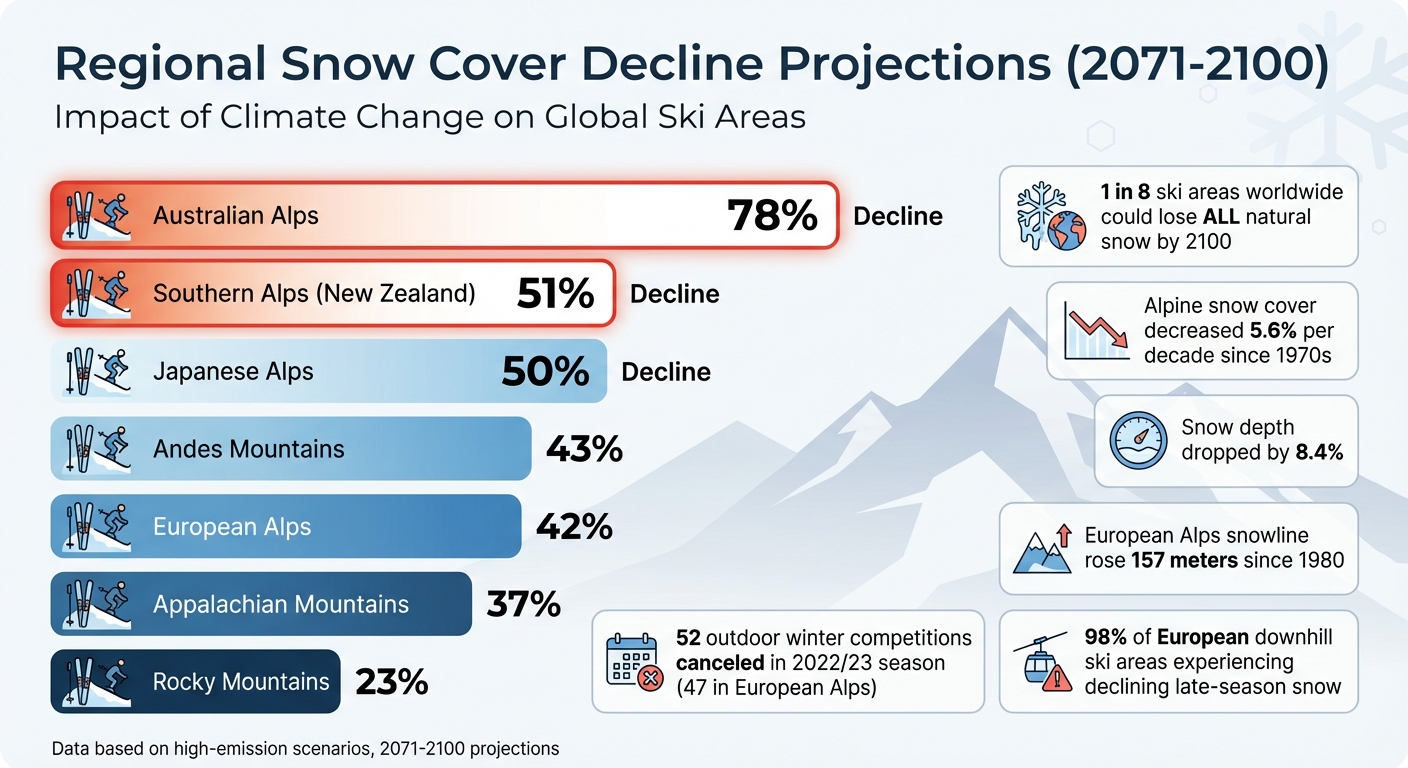
Projected Snow Cover Decline by Region Through 2100
The skiing industry is facing a stark reality: natural snow is becoming less reliable. Since the 1970s, alpine snow cover has decreased by 5.6% per decade, and snow depth has dropped by over 8.4%. In the European Alps, the snowline elevation has risen by 157 meters since 1980. For skiers and snowboarders, this translates to fewer days with natural snow, especially during the early (November–December) and late (March–April) parts of the season.
Snow Cover Decline: What the Data Shows
The numbers paint a challenging picture. Under high-emission scenarios, 1 in 8 ski areas worldwide could lose all natural snow by 2100. The extent of this loss varies by region. For example, the Australian Alps could see a 78% decline in annual snow cover days by the late 21st century, while the Rocky Mountains might face a 23% reduction. In the European Alps, nearly 98% of downhill ski areas are already experiencing declining snow trends during the late season.
| Region | Projected Decline in Snow Days (2071–2100) |
|---|---|
| Australian Alps | 78% |
| Southern Alps (New Zealand) | 51% |
| Japanese Alps | 50% |
| Andes Mountains | 43% |
| European Alps | 42% |
| Appalachian Mountains | 37% |
| Rocky Mountains | 23% |
The Alps, in particular, are warming at a rate of 0.5°C per decade since 1980. Dr. Diego Clara of Dolomiti Superski highlighted the stakes:
Almost everyone in our valleys depends on snow tourism... and the cold days of autumn are becoming fewer in number and also come later.
Shorter and less predictable seasons are reshaping the industry. Smaller, low-altitude resorts are shutting down, while larger, high-altitude operations are consolidating their market share. For example, during the 2022/23 season, 52 outdoor winter competitions were canceled due to insufficient snow - 47 of them in the European Alps alone.
In response to these challenges, ski resorts are stepping up efforts to cut emissions and adopt renewable energy solutions.
Carbon-Neutral Resorts and Renewable Energy
Some of the biggest players in the industry, like Vail Resorts and Boyne Resorts, are aiming for net-zero Scope 1 and 2 emissions by 2030. Meanwhile, France's 238 ski resorts have pledged to achieve carbon neutrality by 2037. These initiatives focus heavily on electrification and renewable energy, replacing diesel-powered systems with solar and wind-powered alternatives.
Aspen One made headlines in early 2026 by opening the Limelight Mammoth in California, a fully electric hotel equipped with heat pumps for climate control. Chris Miller, Senior Vice President of Sustainability at Aspen One, explained their approach:
Snowmaking isn't the core issue; the energy being used is. We're focused on tackling the root causes of climate change, not just adapting within resort boundaries.
Boyne Resorts has also taken bold steps. In February 2025, the company announced that all new buildings at its Big Sky resort in Montana - such as a ski school and employee housing - would be fully electric. Similarly, Bolton Valley in Vermont installed a 121-foot-tall wind turbine to power its operations. Vail Resorts has invested over $10 million in nearly 100 energy efficiency projects since 2017.
Trail grooming equipment, a major contributor to emissions, is also being addressed. These machines can account for up to 60% of a resort's total emissions. Many resorts are transitioning to hydrotreated vegetable oil (HVO), which significantly lowers carbon output without requiring entirely new machinery. Snowmaking, another energy-intensive activity, accounts for around 25% of a resort's emissions and requires an estimated 706–839 gigawatt-hours of electricity annually across the Alps.
These efforts aim to preserve the skiing experience for future generations while addressing the environmental challenges that threaten the sport.
How Malibu Ski League Supports Eco-Conscious Skiing

Beyond the resorts, communities like Malibu Ski League are fostering a more eco-friendly approach to skiing. Their membership-based model encourages skiers to plan trips thoughtfully, reducing the environmental toll of frequent, last-minute travel. This approach also strengthens connections among members and with the natural environment.
Daniel Scott, a sustainable tourism expert at the University of Waterloo, offers a hopeful perspective:
The entire industry is not doomed. But it will be reshaped.
Who Will Be Skiing and Snowboarding in 2040
By 2040, skiing and snowboarding will be part of a broader outdoor lifestyle that blends multiple activities. Gen Alpha and younger millennials are already driving this shift, treating these snow sports as just one part of an adventure that might also include surfing, mountain biking, or even yoga. In Asia, the growing popularity of skiing is a prime example of this evolution. The number of skiers in China skyrocketed from just 10,000 in the mid-1990s to 12.5 million by 2015, positioning the region as a major player in reshaping global snow sports.
Younger, More Diverse Participants
The younger generation craves variety, and resorts are stepping up by integrating multi-sport facilities to cater to this demand. Women are increasingly becoming key decision-makers for ski-related travel, while niche groups like LGBT "Gay Ski Weeks" and organizations such as the National Brotherhood of Skiers are expanding the sport's reach. About 16% of participants now switch between skiing and snowboarding, but the rising cost of access - daily lift tickets at major resorts often exceed $200 - remains a significant challenge.
These trends are complemented by urban innovations that are redefining how and where people experience snow sports.
Urban Growth and Year-Round Access
Cities are becoming hubs for skiing and snowboarding, making the sports more accessible than ever. Over 1,000 dry slopes are now operating in 50 countries, bringing the slopes to urban populations. One standout example is L+Snow in Shanghai, which opened in September 2024. Spanning nine square hectares, it’s the largest indoor ski resort in the world, equipped with 72 cooling machines to maintain temperatures between 23°F and 26°F - even during sweltering 86°F weather outside. Similarly, Copenhagen’s CopenHill facility, built on a waste-to-energy plant, draws around 10,000 visitors annually to its 400-meter synthetic slope.
Urban facilities are transforming skiing into a year-round activity. Tremblant, for instance, invested $1.4 million in a dry slope to provide summer options, while cities host freestyle rail jams on synthetic surfaces to engage youth who may not have easy access to mountain resorts. By 2040, many first-time skiers may find their footing at indoor facilities in their own cities, making the sport more inclusive and accessible. This urban growth reflects the industry's push toward inventive and sustainable solutions.
How Ski Culture Will Evolve by 2040
From Day Tickets to Membership Communities
Since 2021, ski pass prices have jumped by about 40%. This surge is nudging skiing away from traditional day tickets toward membership communities that cultivate deeper connections among skiers.
Take multi-resort passes like the Epic Pass, for example. Vail Resorts describes it as "the ultimate guest loyalty programme". For roughly $1,000 a year, skiers gain access to a global network of resorts, creating a sense of belonging that stretches across borders. Independent resorts, however, are carving their own path. In 2017, Red Mountain Resort in British Columbia launched a bold crowdfunding campaign called "Fight the Man. Own the Mountain", spearheaded by CEO Howard Katkov. The campaign raised over $12.2 million, offering investors perks like private clubhouse access and lift tickets in exchange for their support.
"Fight the Man. Own the Mountain." – Howard Katkov, CEO, Red Mountain
Meanwhile, Summit Powder Mountain in Utah took a unique route back in 2013. By crowdsourcing the funds to buy the resort, they capped daily passes at 1,500 and season passes at 3,000. This move created an unusually low skier density of just three skiers per acre, ensuring a more serene mountain experience. The resort is also building what it describes as a "next-generation Alpine town" focused on social entrepreneurship and collaboration. These shifts highlight a growing trend: prioritizing quality and community over sheer volume.
Membership models are transforming ski resorts into year-round hubs of activity. Beyond winter sports, resorts now offer snow yoga, farm-to-table dining, backcountry clinics, and even media labs to keep members engaged throughout the year. Technology is also stepping in - AI-driven platforms are personalizing experiences, while digital carpooling initiatives aim to cut emissions, tackling the fact that travel can account for up to 80% of a ski trip's carbon footprint. The Malibu Ski League takes this community-first approach even further, connecting skiers and snowboarders through gear swaps and group trips, creating bonds that go well beyond the slopes. While business models evolve, the essence of snow sports remains intact.
What Stays the Same: Friendship, Nature, and Getting Outside
Even as membership communities reshape the skiing world, the mountains' timeless charm remains. At its heart, skiing and snowboarding are about gathering with friends, breathing in crisp mountain air, and soaking in nature's beauty - values that will hold strong through 2040.
Rather than replacing these core elements, the shift toward membership models amplifies them. Auden Shendler, Aspen Skiing Company's VP of Sustainability, puts it perfectly:
"We need to find ways to wield the power of the outdoor community to drive change at scale".
These advancements - whether in technology or sustainability - are tools to protect what truly matters. The joy of a powder day, the thrill of a challenging run, and the simple pleasure of sharing a hot drink at the lodge are experiences that transcend innovation. By 2040, while the gear may be smarter and snow management more advanced, the magic of the mountains will remain the same. This blend of progress and tradition will continue to shape the future of snow sports.
Conclusion
The skiing and snowboarding experience in 2040 still holds onto its timeless appeal - gliding through fresh powder and breathing in the crisp mountain air. But the landscape is shifting in response to technological advancements and environmental challenges. AI-driven wearables, carbon-neutral resorts, and membership-based models are no longer just enhancements; they’ve become necessary changes for a sport grappling with the reality of climate change. In some areas, natural snow cover could shrink by as much as 78% by the century's end. Resorts powered by solar energy and advanced water recycling systems are setting a new benchmark, ensuring that mountain adventures remain possible even under mounting environmental strain.
Yet, it’s not just about technology or sustainability - there’s a deeper transformation happening. As Auden Schendler, VP of Sustainability at Aspen Skiing Company, explains:
What ski resorts do on the ground around cutting their carbon footprint... is admirable but inadequate. We need to find ways to wield the power of the outdoor community to drive change at scale.
This shift highlights a growing emphasis on community and responsibility. Skiers are moving away from corporate mega-passes toward models that prioritize local ownership and connection. This change reflects a desire for more than just access to the slopes - it’s about fostering a sense of belonging. What truly matters is preserved: the exhilaration of untouched powder, the camaraderie of sharing a drink in the lodge, and the freedom to explore unspoiled terrain. Even as the industry evolves, these simple joys remain at the heart of the sport.
FAQs
Will ski seasons be shorter by 2040?
By 2040, ski seasons are expected to shrink as a result of climate change. Higher temperatures and decreased snowfall are already taking a toll on ski resorts, particularly those located at lower elevations. To cope, many resorts are turning to snowmaking technology and offering alternative activities to attract visitors. However, shorter seasons and fewer ski days are likely to become standard. In some regions, natural snowfall could decline significantly, potentially reshaping the industry over time.
Will skiing get too expensive for beginners?
Skiing might soon become pricier for beginners, thanks to a mix of climate change and rising operational expenses. Resorts are spending more on things like artificial snow production and adapting to changing weather patterns, which drives up costs. Many are also leaning toward membership models and building community-focused amenities - an approach that tends to cater to seasoned skiers rather than casual newcomers.
On the bright side, developments like indoor skiing domes and AI-driven training tools could make the sport more accessible in certain ways. However, the overall trend points to higher costs and added hurdles for those just starting out.
Are indoor ski domes actually worth it?
Indoor ski domes provide a reliable way to enjoy skiing and snowboarding regardless of the season or local weather conditions. This consistency is especially valuable in regions where natural snowfall has become unpredictable due to climate change. These facilities make winter sports more accessible to a broader audience and can effectively extend the skiing season.
However, there are valid concerns regarding their energy consumption and overall environmental impact. That said, when these domes are powered by renewable energy sources and incorporate eco-friendly practices, they have the potential to become an important part of the future for winter sports enthusiasts.