




Mentorship strengthens ski-surf communities by addressing seasonal disconnection, social challenges, and barriers to participation. It helps maintain year-round connections, supports mental health, and promotes inclusion. Programs like SOS Outreach and Malibu Ski League show how mentorship builds confidence, accelerates skill development, and fosters long-lasting relationships. Key strategies include setting clear goals, providing consistent support, and integrating emotional resilience training. For organizations, mentorship is a practical way to unite members, improve retention, and create a sense of belonging across seasons.
Chef. Monoskier. Mentor. | Justin Hirshfield’s Adaptive Skiing Story
Challenges Facing Ski-Surf Communities
Creating a strong ski-surf community comes with its fair share of hurdles. These challenges go beyond just organizing events or coordinating schedules. They touch on deeper issues like social dynamics, personal struggles, and financial limitations, all of which can make it harder for people to feel connected or fully participate. Let’s take a closer look at some of these obstacles.
Social and Cultural Fragmentation
One of the biggest challenges is blending the distinct cultures of skiing and surfing. Each activity has its own traditions and values, and bringing these two worlds together can sometimes create tension. For instance, generational divides often play a role. Older members of the community might emphasize experience and tradition, while younger participants may push for new ideas and change. This clash can make shared spaces feel less inviting.
Seasonal shifts add to the difficulty. Once the season ends, many of the social routines that help build connections disappear. As Lauren Zane, a surfer and writer, noted:
"I wish I had known that the window to make new friends closed after Labor Day."
This seasonal ebb and flow can leave people feeling disconnected and make it harder to maintain a cohesive community.
Mental Health and Isolation in Adventure Sports
Adventure sports like skiing and surfing are often solitary by nature, which can lead to feelings of isolation. While there are moments for connection - like chatting on a chairlift or waiting for the next wave - these interactions are usually brief. Building deeper relationships can be tough, especially in physically demanding or competitive settings.
Localism and sexism can make matters worse. A study by the UNSW Beach Safety Research Group involving nearly 800 surfers found that aggressive behavior and discrimination are real issues in these spaces. Such experiences can discourage people from participating, undermining their confidence and sense of belonging.
Seasonal Affective Disorder (SAD) also plays a role. The shorter days and off-season downtime can limit opportunities for engagement, leaving some individuals feeling even more isolated.
Barriers to Access and Inclusion
Cost is a major obstacle for many people. From high-quality wetsuits and technical ski gear to lift tickets, the price of participation can quickly add up. For beginners or those with limited resources, this financial barrier can feel insurmountable.
Geography presents another challenge. In remote areas, access to equipment and training is often limited to short seasonal programs. Once these programs end, the momentum can fade. An example of tackling this issue comes from Holy Cross, Alaska, where nonprofit Skiku trained 21-year-old Justin River Lechton as a permanent ski coach for four Yukon River villages. This initiative aimed to keep skiing active year-round. As Tyler Henegan, Skiku’s Executive Director, explained:
"In my mind, I have, like, a Jedi Padawan situation where we can kind of have that person mentor folks out there and really kind of hope to make something a little more sustainable."
Representation also remains a pressing issue. Women and athletes of color often face unwelcoming environments. The same UNSW study revealed that female surfers were sometimes told to "go home" or even experienced physical harassment in the water. Without intentional efforts to address these issues, ski-surf communities risk staying small, exclusive, and disconnected. These barriers not only limit participation but also weaken the sense of mentorship and connection that these communities strive to build.
How Mentorship Addresses These Challenges
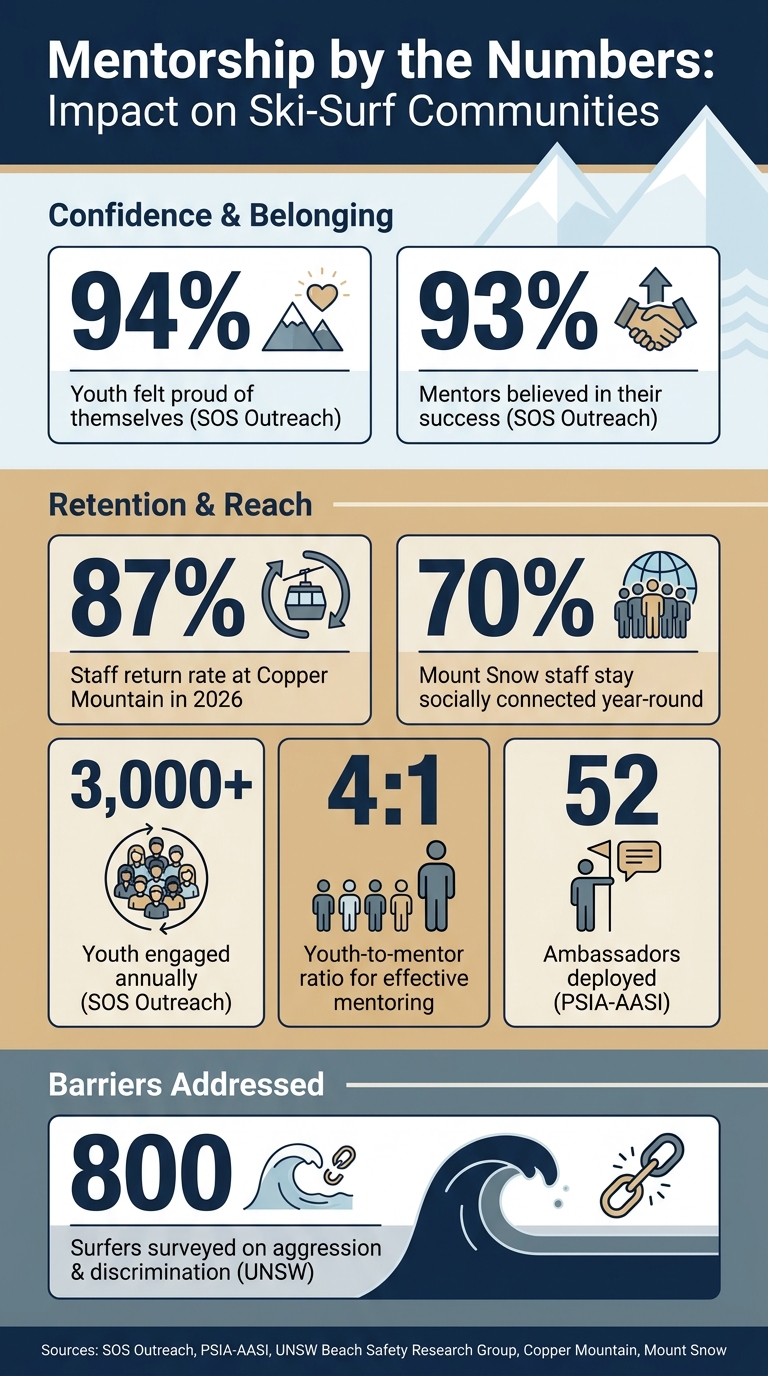
Mentorship by the Numbers: Impact on Ski-Surf Communities
Mentorship tackles the challenges of fragmentation, isolation, and exclusion head-on, creating meaningful relationships that go beyond just events or equipment.
Building Confidence and Psychological Safety
Fear is a natural part of adventure sports. Whether someone is facing their first black diamond ski run or paddling into overhead waves, the mental demands can be just as intense as the physical ones. Mentors play a key role in addressing this by acknowledging those fears and helping mentees navigate them.
"Mentorship is a feeling, not a role. It's a gentle reminder that kneeling again or pausing for a moment is just part of the learning process on the water." - AlishaSUP, Aqueous SUP
With support, mentees often feel more confident, perform better, and make safer decisions. Mentors also model smart decision-making, such as checking wind conditions before heading out or adjusting plans when weather changes unexpectedly. These real-time lessons are invaluable. For example, 94% of youth participants in SOS Outreach's mountain mentorship program said their mentors helped them feel proud of themselves, and 93% felt their mentors believed in their success.
This confidence becomes the glue that keeps people connected to their communities throughout the year.
Keeping Members Connected Year-Round
Ski and surf communities often face a seasonal rhythm - when the snow melts or waves go flat, connections can easily fade. Mentorship helps bridge these gaps by fostering relationships that last beyond the peak seasons.
At Copper Mountain, a focus on mentorship and training led to an 87% staff return rate in 2026, thanks to year-round communication and off-season meetups. Similarly, at Mount Snow in Vermont, around 70% of staff stay socially connected throughout the year, even though many live hours apart. As Keith Rodney, a PSIA Telemark Team Member at Mount Snow, explained:
"The thing I've noticed is that the stronger the culture is, the lower the turnover... I would say that the culture is key to keeping the interest alive."
For ski-surf communities, this means creating consistent engagement to ensure relationships endure through the off-season.
Supporting Inclusion and Skill Growth
Mentorship not only builds confidence and connection but also promotes inclusion and faster skill development. By breaking down barriers to entry, mentorship offers a welcoming hand to newcomers while helping them develop skills more efficiently. Pairing experienced members with beginners creates a personalized experience that no online guide can replicate.
SOS Outreach exemplifies this approach. Operating at 24 mountain resorts in 9 states and engaging over 3,000 youth annually, the program focuses on youth from low-income and minority backgrounds. With a 4:1 youth-to-mentor ratio, their curriculum emphasizes social-emotional learning, earning them U.S. Ski & Snowboard's Diversity, Equity and Inclusion Champion Award. Similarly, the PSIA-AASI Western Region Ambassador Program deployed 52 ambassadors across 23 member schools during the 2025–2026 season, volunteering 500 hours to onboard nearly 100 new members through peer support. As Pat Medau, an ambassador at Heavenly Mountain Resort, shared:
"I've had the privilege to work with many of our new instructors... see them become PSIA members and then mentor them through our training process to become certified Level One instructors. It's been rewarding!"
For beginners, mentorship accelerates learning in ways group lessons often can't. Tom Corliss, founder of Malibu Makos Surf Club, summed it up well: "When you have a strong foundation, you will be able to progress at a much faster speed - without having to try the ol' trial and error method." This guided approach not only builds skills quickly but also keeps new members engaged and excited to continue.
sbb-itb-236ebff
How to Design a Mentorship Program for Ski-Surf Communities
Core Elements of a Mentorship Program
A well-designed mentorship program begins with a solid structure. The first step? Goal-setting. At the start of each season, mentors and mentees should sit down together to define what they hope to achieve. This shared vision not only sets a clear direction but also keeps both parties accountable.
"Mentorship is a structured relationship that has two people be together in a specific way to achieve and fulfill a co-created vision." - Mountain Mentors
This structured approach directly tackles issues like fragmentation and isolation by promoting accountability and growth. But beyond setting goals, consistency beats intensity. Mountain Mentors suggests at least one in-field session per month, along with 2–6 hours of planning and knowledge sharing. These planning sessions aren't just about logistics - they're key to building trust, which is essential when engaging in high-risk sports.
Another cornerstone of a strong program is allowing mentees to choose their mentors. Research from the PSIA-AASI Women's Council pilot program, led by Carol Levine, revealed that mentor choice - along with encouraging mentees to seek multiple mentors for different needs - boosted confidence and created a pipeline of resilient leaders.
With this foundation in place, mentorship programs can take the next step: integrating mental skills training.
Adding Mental Skills Training to Mentorship
Adventure sports like skiing and surfing require more than just physical skills; mental resilience is just as important. Incorporating social-emotional learning (SEL) into mentorship sessions helps participants manage fear, handle setbacks, and develop emotional strength.
For example, SOS Outreach has built their entire curriculum around SEL. By combining it with structured group mentoring, they’ve seen measurable improvements in participants’ sense of belonging, teamwork, and self-confidence across 24 mountain resorts in 9 states. Vanessa Chavarriaga of Melanin Base Camp highlights the value of this approach on a personal level:
"My best ways to combat feelings of deficiency or impostor syndrome are to set intentional goals and surround myself with friends and mentors who can help me remember them."
Even simple practices, like short emotional check-ins before sessions, can make a big difference. These check-ins normalize conversations around fear and self-doubt, showing newer participants that mental struggles are a natural part of the learning process - not a sign they don’t belong.
Tracking Results and Refining the Program
To keep a mentorship program effective, you need to measure its impact. Start with pre- and post-season surveys to track changes in participants’ sense of belonging, confidence, and skill perception. SOS Outreach uses this method and has earned a gold badge rating from the National Quality Mentoring System (NQMS), which evaluates programs based on evidence-based benchmarks.
Retention rates are another key metric. For example, Copper Mountain’s snowsports school saw instructor return rates jump to 87% in 2026 after introducing structured mentorship and off-season meetups. Combining quantitative data with exit questionnaires can give you a deeper understanding of relationship quality and areas for improvement.
"Mentorship doesn't need to be complicated to be impactful. Because sometimes, a little bit of support truly beats a whole lot of nothing." - Carol Levine, Former PSIA-AASI National Team Member
Finally, community coordinators play a vital role in ensuring consistency. They monitor pairings and track progress between seasons, acting as the glue that holds the program together. These evaluation methods create a strong foundation for scaling mentorship efforts, setting the stage for broader community implementation.
Bringing Mentorship into Malibu Ski League
Using Trips and Events as Mentorship Opportunities
Malibu Ski League's trips - including Mountain Tour stops at Park City, Mammoth, and Jackson Hole, along with the Forever Summer Retreats - naturally set the stage for mentorship. These shared adventures foster connections through moments like chairlift rides, surf sessions, and après gatherings.
By intentionally pairing new and seasoned members based on shared interests, MSL can create lasting relationships. This approach aligns with insights from Brenton Reagan, Lead Guide at Exum Mountain Guides, who led the Arc'teryx Backcountry Mentors program in Jackson, WY:
"Season-long learning takes the pressure off the teacher to share all the information at once, and it also takes the pressure off the student to immediately understand complex topics in one or two days." - Brenton Reagan, IFMGA and Lead Exum Guide
Rather than trying to pack everything into a single trip, MSL can treat each event as a chapter in an ongoing mentorship journey. These connections not only build knowledge but also strengthen the community's sense of unity across seasons.
Reinforcing a Shared Ski-Surf Identity
Mentorship moments during trips and events also help foster a shared identity that ties the community together year-round. MSL thrives on its "Always Winter. Forever Summer" philosophy, appealing to those who share a passion for both the ocean and the mountains. Mentorship here doesn't just reflect this identity - it actively shapes it.
Community rituals play a big role. Events like "Shellback SZN", "Topanga Turns", and "Aprés Army" meetups give members regular opportunities to connect and feel part of something bigger. Even gear contributes to this shared identity. Wearing recognizable MSL items - like the Gravity Unit hoodie ($94.38) or the Coastal Cords hat ($42.35) - creates a visible bond that bridges snow and surf seasons. As MSL puts it:
"We're not building a brand - we're building a culture. And culture lives through moments and being outside." - Malibu Ski League
When mentors and mentees come together at events, donning the same gear and participating in shared rituals, the community identity becomes something they experience, not just read about.
Building a Scalable Mentorship Structure
To start, MSL could test a pilot program during one winter season. Pairing five to ten mentor-mentee duos at a Mountain Tour stop would provide a manageable way to refine the process before expanding. This method echoes the Arc'teryx Backcountry Mentors program, which began with five participants in December 2025 and grew as members invited others to join.
A group mentoring model - one mentor for every four members - offers a balanced approach that avoids overwhelming experienced participants while still being effective. MSL’s existing network of NCAA athletes and athlete meetups provides a strong foundation for recruiting the first wave of mentors.
A straightforward structure could include:
- A Mentor Kickoff event at the start of each winter and summer season to set expectations and goals
- Monthly check-ins between trips to maintain momentum
- An end-of-season survey to evaluate progress and gather feedback
Conclusion: Growing Ski-Surf Communities Through Mentorship
Ski-surf communities face challenges like social isolation, mental health struggles, and uneven access to resources. Yet, mentorship offers a way to tackle these issues head-on by fostering supportive, meaningful relationships. In fact, studies reveal that over 90% of young participants in mountain mentorship programs report greater success and confidence thanks to their mentors' guidance and encouragement.
What makes mentorship so effective is its flexibility - it doesn’t rely on rigid structures or formal curriculums. Instead, it grows naturally through shared experiences, whether on a chairlift or during a surf session. It’s about building genuine connections rooted in shared passions.
"Mentorship plays a critical role in shaping careers, confidence, and community within the snowsports industry." - Laurel Walker, Author, The Snow Pros
For organizations like Malibu Ski League, the foundation for impactful mentorship is already in place. Their events and strong network create the perfect environment to expand these efforts. The "Always Winter. Forever Summer" mantra isn’t just a slogan - it’s a way to foster year-round connections through mentorship, one season at a time.
The formula is simple: start small, be consistent, and focus on creating a sense of belonging rather than prioritizing skill level. When everyone - whether seasoned pros or complete beginners - feels welcome, the community becomes something much bigger. This vision perfectly aligns with Malibu Ski League’s mission: bringing winter and summer enthusiasts together through authentic, lasting mentorship.
FAQs
How do you match mentors and mentees?
Matching mentors and mentees can happen through organized programs or natural connections. The strongest partnerships often stem from common interests or experiences, such as a shared love for skiing or surfing. Some programs allow mentees to select their mentors, ensuring a better fit, while others promote connections that form more naturally. No matter the approach, the foundation of a successful mentorship lies in honesty, mutual respect, and a give-and-take relationship where both sides actively contribute.
How do you keep members connected in the off-season?
Malibu Ski League keeps its members engaged all year with a range of exclusive perks. One standout is the Trips List, which grants early access to trip launches and special events. Beyond that, members can participate in group travel meetups, weekend pop-ups, collaborative drops, and winter opening-day gatherings. These activities are designed to build real-life connections, ensuring that even if you show up alone, you’ll leave with a new group chat buzzing.
What metrics show a mentorship program is working?
Metrics focus on pre- and post-program self-assessments that measure outcomes like sense of belonging, community connection, teamwork, and prosocial behavior. Additionally, end-of-program data points - such as the percentage of participants who felt supported, encouraged, and proud - play a crucial role. By using validated surveys at both the beginning and end of the season, progress can be effectively tracked over time.