




A chairlift works as a social space because it gives you 3 things most apps and public spaces don’t: a shared setting, a short time limit, and a clean exit. In about 8 to 12 minutes, strangers can talk without pressure, stay quiet without tension, and part ways without any awkward wrap-up. There’s no feed, no record, and no need to impress anyone.
Here’s the core idea in simple terms:
- The mountain starts the conversation for you.
- The ride has a built-in end, so talk feels low-pressure.
- Silence is fine, which makes the space calmer.
- People mix by chance, not by filters or status.
- What happens on the chair usually stays on the chair.
I’d sum it up like this: the chairlift shows how good social settings work. You get a shared problem, a short window, and an easy way out. That’s why a small talk moment on a cold ride can feel more human than hours spent online.
A few details stand out:
- Most lift chats fall into 6 common types: snow reports, route tips, gear talk, life stories, jokes, and quiet company.
- A chair ride often lasts under 10 minutes, which keeps the stakes low.
- Riders often share one view, one weather pattern, and one goal at the same time: getting up the mountain.
| What makes it work | What it does |
|---|---|
| Shared cold, snow, and terrain | Gives people something plain to talk about |
| Short ride time | Cuts social pressure |
| No audience or archive | Lowers self-consciousness |
| Random seatmates | Mixes people who may never meet elsewhere |
| Built-in ending at unload | Ends contact cleanly |
My take: the article isn’t just about skiing. It’s about how good social design can make talking easier. The chairlift does that with almost no effort at all.
Why Chairlift Talk Feels Easy, Honest, and Low-Stakes
Shared conditions do the icebreaking
You don’t need some polished opener on a chairlift. The mountain does that job for you.
Snow, cold, and terrain hand both people something concrete to talk about right away. You’re looking at the same run, feeling the same wind, and dealing with the same conditions. So the conversation starts with something real, not small talk for the sake of it.
Maybe the person next to you just came down the trail you’re eyeing. They can tell you what’s soft, what’s scraped off, and what’s better left alone. That shared setting is a big reason even a brief chat feels grounded.
A ten-minute ride removes social pressure
A chairlift ride comes with its own time limit, and that changes everything.
Nobody has to figure out how to leave the conversation. Nobody has to fake an excuse. You can make a joke, say you’re nervous about a black diamond, or ask for trail advice from a stranger without stressing about how to wrap things up. The unload ramp takes care of that for you.
That’s a rare social break. Most places don’t give you such a clean exit. It’s part of why people tend to open up faster on a lift than they might at a dinner party that could, in theory, drag on for four hours. That built-in deadline also helps explain why lift etiquette works so well.
No archive, no audience, no personal brand
This is what sets a chairlift apart from almost every other social space right now: nothing is being recorded.
There’s no archive, no audience, and no personal brand in the background. Online, even casual posts can feel like a performance. On a chairlift, you’re just talking.
The point isn’t to push away screens. It’s to keep a small pocket of time where nobody feels on display. That shift makes conversation feel lighter, simpler, and more direct. And when a conversation disappears as soon as the ride ends, the unspoken rules start to matter more.
sbb-itb-236ebff
The Unspoken Rules of Sharing a Chair
Loading, spacing, and the safety-bar script
The chairlift runs on a simple routine, and almost everyone falls into it without a word. In the loading zone, there’s no room to overthink it. You load fast, settle into your spot, and let the lift carry you uphill. Once the chair swings into motion, the unspoken rules start to show.
How people read the room on a lift
A chair can bring together builders, designers, locals, visitors, skiers, and snowboarders of every age. Whatever someone does Monday through Friday tends to fade for a few minutes, and that’s part of what makes lift talk feel so natural. The conversation depends as much on the person next to you as it does on the snow below.
The best opener is usually simple recognition. The person beside you might know the run you’re looking for, the snow you just came off, or the route that saves your knees late in the day. If they’re quiet, stay quiet. If they want to talk, go with it.
Why silence does not feel awkward here
Silence works on a lift because the mountain already did the hard part. You don’t need to fill every pause. You just need to share the ride. From there, the real story is who ends up beside you and what they decide to say.
Who Ends Up on the Same Chair and What They Talk About
A moving cross-section of mountain life
Nobody chooses their chairlift neighbor. Timing and gravity do the job.
With a helmet, goggles, and a puffy jacket on, it’s hard to tell who someone is from 9 to 5. A person who runs a company, a high school student, a retiree, and a local who skis three days a week can look more or less the same once they slide into the chair.
After the silence settles in, that’s often what stands out next: who happens to be sitting beside you. As Lichota Seidewand of Malibu Ski League puts it, the mountain makes weekday roles disappear for a few minutes. A retiree, a teenager, a local, and a weekend visitor can all end up on the same chair simply because they reached the loading zone at the same moment. No algorithm sorted them. No one planned it.
Shared terrain and risk create fast trust
Cold weather and a little risk have a funny effect on people. They tend to make strangers more useful to each other, fast.
One person points out where the snow is still soft. Someone else gives a quick tip about a better line. Another rider laughs with you - not at you - about a wipeout they just watched. It’s a small thing, but it matters. That kind of practical, watchful goodwill feels rare because nobody is trying too hard. It just happens.
The main categories of chairlift conversation
Most chairlift talk lands in a few familiar lanes:
- Snow conditions and route tips
- Life stories
- Gear talk
- Jokes
- Brief lift friendships
- Quiet companionship
That short, low-pressure exchange is the kind of thing digital platforms keep trying to imitate.
The Chairlift: Bringing Skiers Together in Ways Nothing Else Can | Salomon Freeski
What Digital Social Platforms Could Learn From the Chairlift
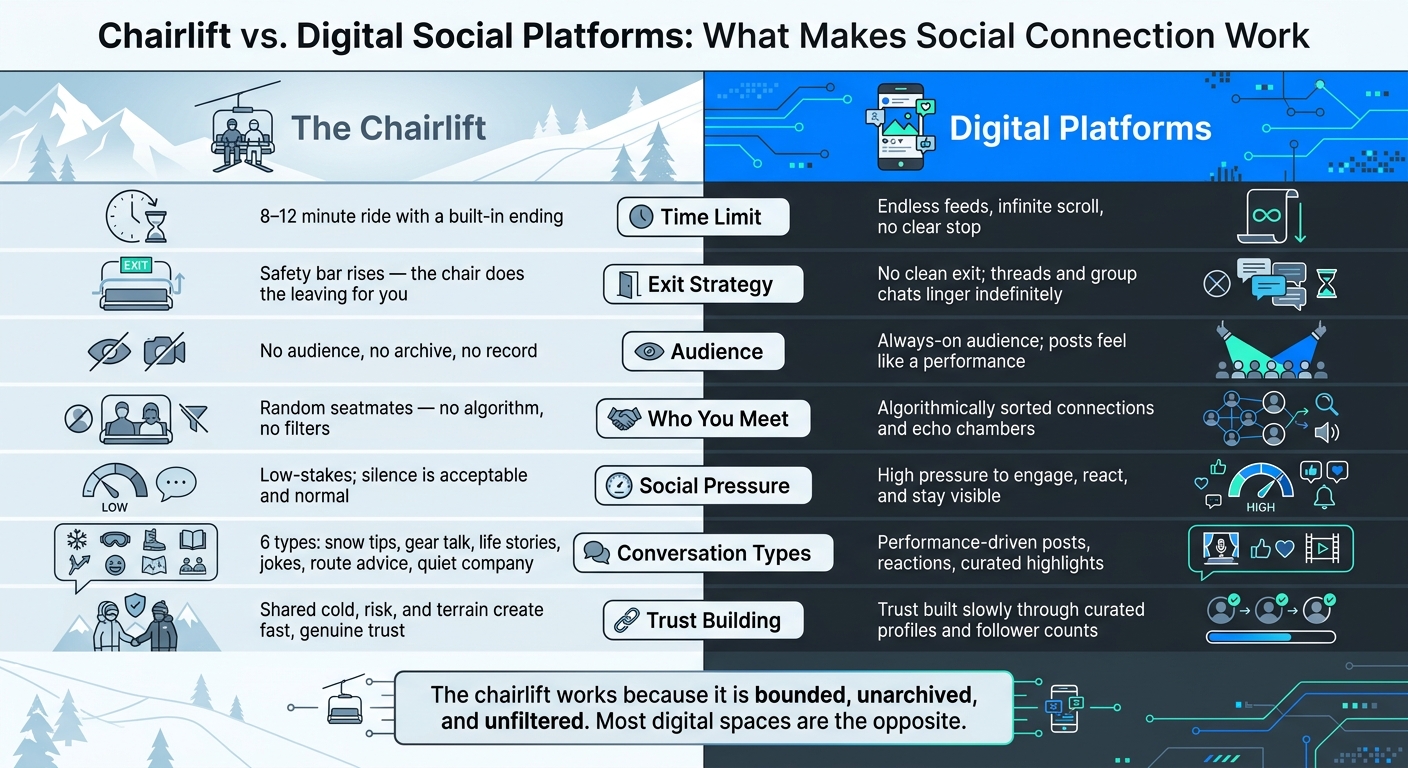
Chairlift vs. Digital Social Platforms: What Makes Social Connection Work
Shorter windows, clearer endings, less performance
That built-in time limit changes the feel of the ride.
A chairlift works in part because it ends. You get ten minutes, give or take, and then it's done. That clear boundary makes the conversation feel safe. You're not signing up for an endless thread, a group chat that won't die, or a feed that keeps asking for one more reaction.
Digital platforms tend to do the opposite. They stretch the moment, keep it going, and reward performance. They ask people to present, polish, and stay visible. The chairlift doesn't ask for any of that.
Scarcity sharpens attention.
Why skiing offers more than the run itself
The run is the part everyone sees first. But a lot of what makes a day on the mountain stick with you happens in between: on the lift, in the base lodge, or in the parking lot while everyone peels off boots.
That's a big part of the mountain's appeal. Its value is social as much as athletic.
Those brief, unforced moments of connection matter. They don't need a perfect photo, a saved chat, or an audience. And that's exactly the part most platforms can't copy.
The bar rises and the moment ends cleanly
Here's what the chairlift gets right that most digital spaces don't: the ending is built in. The safety bar rises, everyone shuffles to the edge, and you go your separate ways down different runs. The chair does the leaving for you.
That kind of temporary closeness is getting harder to find. It's bounded, low-stakes, and unarchived. It happens with whoever ends up on the same chair, and then it passes.
Not because people don't want that sort of contact. More often, it's because most of the spaces we've built don't make room for it. The mountain still does.
FAQs
Why do chairlift conversations feel more natural than online interactions?
Chairlift conversations feel natural for a simple reason: they happen in a brief, low-pressure space where two people are sharing the same moment.
There’s no long setup. No need to impress anyone. You get on, ride together for a few minutes, and then get off. That clear start and finish takes a lot of pressure out of the exchange.
The setting does some of the work too. You’re looking at the same terrain, feeling the same weather, and dealing with the same level of risk. That shared experience creates common ground right away.
As a result, face-to-face conversation often feels easier, more honest, and more open to everyone.
What makes silence on a chairlift feel comfortable instead of awkward?
Silence feels easy on a chairlift because the ride already gives both people a shared frame. You’re moving together, hearing the same sounds, and looking at the same view, so there’s less pressure to fill the gap with talk.
The closeness is brief and low-pressure, which lowers the social stakes. If the moment feels a little awkward, it usually doesn’t matter much. On top of that, resort etiquette tends to lean calm and respectful, so staying quiet reads as normal - not as rejection.
What can digital platforms learn from how chairlifts create connection?
They can spark low-stakes, meaningful conversations built around shared experience, not transactional interaction. Like chairlift rides, the best exchanges feel easy, brief, and open to people from all kinds of backgrounds.
When digital spaces put shared interests ahead of personal branding, they can build trust, deepen belonging, and strengthen community.