




If I’m booking a ski trip, I’d pick a hotel for a short weekend and a rental for a longer group stay. That’s the short answer.
Here’s why:
- Hotels usually work better for 2–3 night trips, especially for couples or anyone who wants to stay close to the lifts.
- Rentals often work better for 5+ night stays, especially for families and bigger groups splitting fixed fees.
- The nightly rate can fool you. I’d compare cleaning fees, taxes, parking, food, shuttle costs, and checkout rules before paying.
- A place that looks cheaper can cost more if it’s far from the mountain or if the group is too small to split fees.
- If I’m going car-free, I’d check the exact lift distance, not just the area name.
A ski stay is not just about the room. It’s about total cost, time to the lifts, gear storage, meal setup, and how much work I want on the first and last day.
One simple rule helps:
The shorter the trip, the more a hotel tends to make sense.
The longer the trip, the more a rental can pay off.
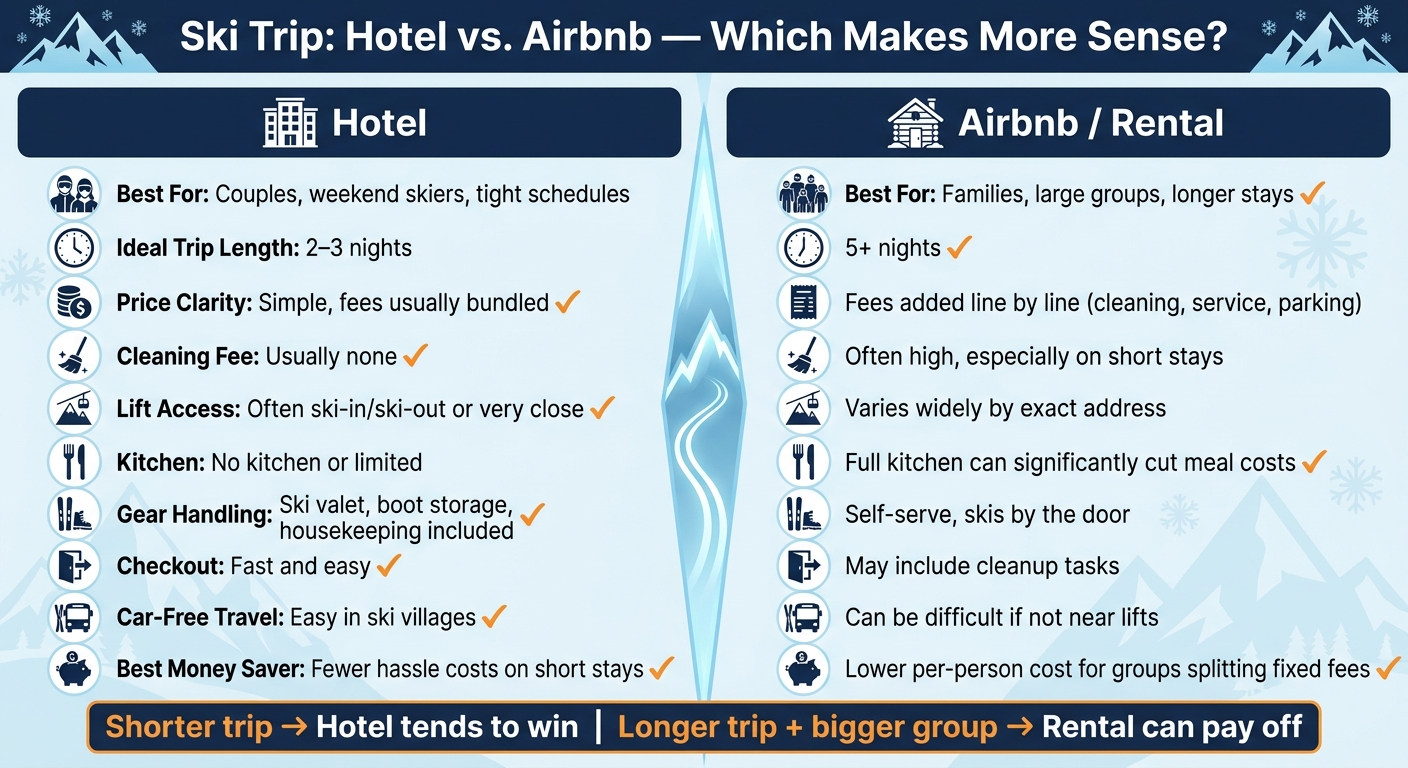
Ski Trip Hotel vs. Airbnb: Full Cost & Convenience Comparison
Quick Comparison
| Factor | Hotel | Airbnb / Rental |
|---|---|---|
| Best trip length | 2–3 nights | 5+ nights |
| Best for | Couples, weekend skiers, tight schedules | Families, big groups, longer stays |
| Upfront price clarity | Usually simpler | Often more fees added later |
| Cleaning fee | Usually none | Often added, and can be high on short stays |
| Lift access | Often closer or ski-in/ski-out | Varies a lot by exact address |
| Food setup | No kitchen or limited | Full kitchen can cut meal costs |
| Gear handling | Ski valet, boot storage, housekeeping often included | More self-serve |
| Checkout | Usually fast | May include cleanup tasks |
| Car-free travel | Often easier in ski villages | Can be hard if not near lifts |
| Best money saver | Fewer hassle costs on short stays | Lower per-person cost for groups |
If I wanted one checklist before booking, it would be this:
- Final price in U.S. dollars
- Distance to lifts
- Parking cost
- Kitchen use vs. restaurant spend
- Shuttle or rideshare need
- Ski storage
- Checkout chores
- Cancellation terms
That’s the core tradeoff: hotels cut down the work; rentals give more room and can lower the cost per person when the setup fits the trip.
sbb-itb-236ebff
Total cost: What you actually pay for a ski hotel vs. a rental
The nightly rate is just the opening number. Both hotels and rentals come with extra costs, but rentals often pile them on one by one: cleaning fees, service fees, parking, food, and transportation. So the main issue isn’t the sticker price. It’s which option stays cheaper once you add fees, meals, parking, and getting to the mountain. In many cases, hotels fold more of those costs into the nightly rate, while rentals show each charge line by line. On short Friday-to-Sunday trips, those add-ons can matter just as much as the room rate itself.
When a cheaper-looking rental ends up costing more
This is where rentals can trip people up. The pain shows up most on short stays, remote places, or smaller groups, where fixed fees get split across too few people. If you also need rides to the lifts and plan to eat most meals at restaurants, the savings can disappear in a hurry.
When a rental clearly saves money for families and groups
Rentals tend to shine when the group is big enough to split the fixed costs. They also make more sense when travelers stay long enough to use the kitchen enough to make it worth it. For families and groups, that setup can cut the per-person cost and keep everyone under one roof. The edge gets bigger on longer trips, when home-cooked meals replace restaurant tabs and shared living space replaces booking extra rooms.
Convenience and comfort: Access, amenities, and daily logistics
After price, the next thing to look at is simple: how much work does each option save once you get there?
Hotels usually take care of the annoying parts of a ski trip for you. You’ll often get ski storage at the base, boot dryers in the hall, daily housekeeping, on-site parking, and a later checkout. That means less time dealing with gear and more time getting out the door.
Rentals are different. The group usually handles more of the day-to-day stuff, with skis stacked by the door, shared boot dryers if the place even has them, and a checkout routine that can turn the last morning into a cleanup session. Still, rentals have a clear upside: a full kitchen, a common living area, and enough room for everyone to spread out without booking multiple hotel rooms.
That tradeoff tends to change based on trip length. On longer stays, cooking meals and having shared space can make the extra effort worth it. On a short weekend trip, that same effort can feel like a hassle. And that lands differently depending on whether you’re traveling as a couple, with kids, or with a bigger group.
Hotels usually cut friction on short ski trips
On a two- or three-night stay, the convenience gap is hard to miss.
A hotel near the lifts usually means no shuttle, no grocery run, no six-person checkout plan, and no cleaning fee pushing up the cost of a short stay. Many resort hotels also include ski valet, boot storage, and slope-side access. Those extras take care of the biggest daily chores before your ski day even begins.
Rentals usually offer more space and flexibility on longer stays
Once the trip hits five nights or more, the kitchen starts to earn its keep.
A group that cooks breakfast and dinner most nights can cut food costs by a lot compared with eating every meal out in a resort town. The shared living space matters too. Instead of splitting up into separate rooms, everyone has one place to hang out after a day on the mountain. In practice, the rental becomes the trip’s home base. That’s tough to match when a group is spread across hotel rooms, and the nightly cost often looks better as the stay gets longer.
Car-free trips depend on exact location
If you’re not renting a car, check the exact distance instead of trusting the neighborhood name.
A hotel in a walkable ski village can wipe out the transportation issue altogether. A rental two miles from the lifts may sound close on paper, but it can mean daily rideshare costs or shuttle timing that adds both time and money to every ski day. For car-free travelers, exact location matters more than anything else when choosing between a hotel and a rental.
Which option fits your trip: Couples, families, groups, and work-from-ski stays
The best place to stay comes down to one thing: how much trip friction you can deal with.
Couples, weekend trips, and travelers on tight schedules
For couples squeezing in a ski weekend, a hotel often makes more sense than a rental. On a Friday-to-Sunday trip, convenience usually beats extra square footage. You can check in, ski, sleep, and head home without dealing with cleanup, checkout chores, or moving gear around more than needed.
For short stays, speed and simplicity tend to matter more than having extra rooms.
Once kids or more people join the trip, that balance starts to change. More people usually means more stuff, more moving parts, and more pressure to make the space work for everyone.
Families, large groups, and groups splitting costs unevenly
For families and bigger groups, rentals often end up being the more practical pick. A rental can cut down on awkward room splits and gives everyone one shared home base after the lifts close. That can make a big difference when the group wants to cook, spread out, or just stay together instead of splitting across hotel rooms.
A rental usually works best when:
- the group wants to stay under one roof
- fixed costs can be shared across more people
- the trip is long enough for the math to tilt toward more space for the money
As the group gets bigger and the stay gets longer, the per-person cost can drop.
Remote workers and groups with uncertain plans
Remote workers on ski trips, along with groups whose plans may change, usually need the option that’s easiest to adjust and manage day by day. If dates, headcount, or work plans might shift, focus less on the headline price and more on the booking terms.
In that case, the safer move is usually the stay with simple cancellation rules and the fewest house rules to deal with.
Next: the decision guide on who should book a hotel, who should book a rental, and what to check before paying.
Decision guide: Who should book a hotel, who should book a rental, and what to check before paying
Start with three things: trip length, group size, and how much hassle you want to deal with.
For short ski weekends, hotels often make more sense. For longer stays and bigger groups, rentals often win. The tradeoff is pretty simple: cost, convenience, and space. Some trips need a smooth, low-effort setup. Others need a kitchen, a living room, and enough room for everyone to spread out.
Use the checklist below to compare each option side by side. And before you book, look at the full price, access, and rules - not just the nightly rate. That’s where the deal either holds up or falls apart.
- Final price: Compare fees, taxes, parking, and transportation to the mountain.
- Exact location and access: Check distance to lifts, restaurants, nightlife, and shuttle or walk access.
- Kitchen access and grocery cost: Match the kitchen to your meal plan.
- Ski storage: Verify there is a place for skis and other gear.
- Reliability and communication: Check host responsiveness, check-in instructions, and issue support.
- Hot tub, lounge, or other common-space access: Check which amenities are actually available.
- Shared gathering space vs. separate rooms: Confirm whether the layout fits how your group wants to spend time together.
- Checkout rules and cleaning tasks: Read the checkout requirements before booking.
- Cancellation policy: Compare how flexible each option is if plans change.
A cheap nightly rate can look great at first glance. Then parking adds up, the shuttle is a pain, and checkout turns into a chore list. That’s why the small print matters so much here.
FAQs
How do I compare the true total cost?
Add up every cost, not just the nightly rate.
For rentals, that means looking beyond the base price and adding in cleaning fees, service fees, resort or parking fees, transportation to the mountain, grocery costs, ski storage, and any required add-ons.
For hotels, count the full picture too: resort or parking fees, transportation, and the meals you’ll likely buy during the stay.
Convenience matters just as much as price. Check the fine print on early arrivals and late departures, along with check-in and checkout rules and cancellation terms. A rental can seem cheaper at first glance, then end up costing more once fees, transportation, and groceries hit the total.
When does a rental beat a hotel on a ski trip?
A rental often makes more sense for a large group or family. You get shared living space, a full kitchen, and more room to spread out. And when everyone splits the cost, it can be easier on the budget.
It’s also a better fit if you want one central place to hang out after skiing. Instead of heading back to separate hotel rooms, everyone can relax together in the same space and enjoy the comfort of a private home.
What matters most if I’m not renting a car?
If you’re not renting a car, staying close to the mountain matters a lot. So does getting around without a hassle. Look for places with ski-in/ski-out access or a short walk to the lifts and shuttle stops.
Hotels often have an edge here because many offer their own slope shuttles. If you’re booking a rental instead, check that local transit or resort shuttles run often and are dependable before you lock anything in.