




If I had to sort these 7 towns fast, I’d put Taos, McCall, and Crested Butte South/Gunnison in the “go now” group; Red Lodge and Girdwood in the “watch closely” group; and Baker City plus Sandpoint in the “early-stage” group.
I’m looking at 4 things: mountain access, cost, transportation, and town feel. Across all seven, the same pattern shows up: places with solid skiing, a year-round base, and walkable downtown areas tend to draw more visitors first. Then home prices climb, second-home demand grows, and the local business mix starts to shift.
Here’s the short version:
- Best mix right now: Taos, McCall, Crested Butte South/Gunnison
- Still under less pressure: Red Lodge, Girdwood
- More of a watch list than a trip anchor: Baker City, Sandpoint
- Main risk in every town: housing costs moving up and locals getting squeezed
- Main gatekeeper: airport and road access
- Big stat to know: Taos Ski Valley and Crested Butte each offer more than 3,000 feet of vertical
If you want the simple takeaway, it’s this: the best ski towns usually change before the big travel pitch arrives. By the time a place is all over the map, part of what made it good may already be under strain.
5 More Hidden Gem Ski Areas of North America - 2025
sbb-itb-236ebff
Quick Comparison
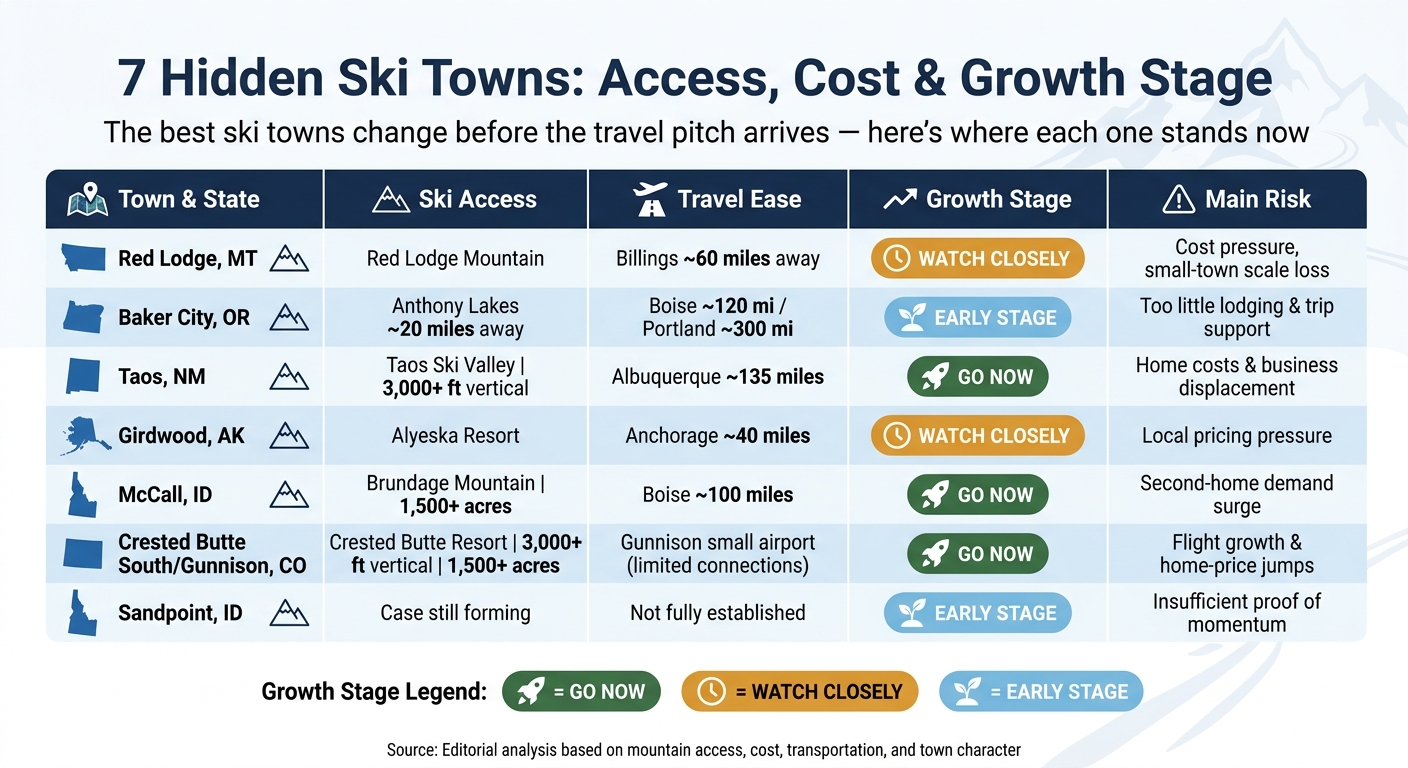
7 Hidden Ski Towns Compared: Access, Cost & Growth Stage
| Town | Ski access | Travel ease | Town feel | Stage now | Main risk |
|---|---|---|---|---|---|
| Red Lodge, MT | Close to Red Lodge Mountain | Moderate; Billings is about 60 miles away | Compact, local, low-key | Watch closely | Cost pressure, loss of small-town scale |
| Baker City, OR | Near Anthony Lakes, about 20 miles away | Harder; Boise about 120 miles, Portland about 300 miles | Working small city, light ski setup | Early-stage | Too little lodging and trip support |
| Taos, NM | Taos Ski Valley, 3,000+ ft vertical | Harder; Albuquerque about 135 miles away | Adobe town, arts, strong identity | Go now | Home costs and business displacement |
| Girdwood, AK | Alyeska access | Easier; Anchorage about 40 miles away | Small local scene | Watch closely | Local pricing pressure |
| McCall, ID | Brundage Mountain, 1,500+ acres | Fairly easy; Boise about 100 miles away | Lake town, four-season base | Go now | Second-home demand |
| Crested Butte South/Gunnison, CO | Crested Butte, 3,000+ ft vertical | Moderate; small airport limits traffic | College town + mountain town mix | Go now | Flight growth and home-price jumps |
| Sandpoint, ID | Case still forming in this draft | Not fully clear here | Still in the maybe stage | Early-stage | Not enough proof yet |
I’d read these towns less as a ranking and more as a timing guide: some are ready now, some are close, and some still need time.
1. Red Lodge, Montana
Red Lodge sits 60 miles southwest of Billings, and it still flies under the radar. A big reason is access. Billings Logan International is the closest airport, but it doesn't have the deeper direct-flight lineup you get in Bozeman. That gap helps explain why Red Lodge still feels more local than picked over.
Mountain Access
Red Lodge Mountain is the center of the ski scene, and the short drive into downtown makes the town easy to use before and after a ski day. That lower-key setup is starting to pull in more skiers who want mountain access without resort-scale crowds.
It's a good fit for travelers who want a smaller ski trip with a real downtown, not a resort village.
The ski area matters. But what gives Red Lodge its pull is how little it tries to behave like a resort.
Town Character
Unlike resort villages, Red Lodge still feels like a town first - and that's where the risk comes in. If more attention heads its way, Red Lodge will have to guard its affordability, small-business feel, and downtown scale.
Its edge is pretty simple: a compact town, an easier pace, and less resort packaging.
2. Baker City, Oregon
If Red Lodge gets its feel from Montana ranch country, Baker City comes from a different kind of remoteness: the high desert of northeastern Oregon, about 75 miles west of the Idaho border along I-84.
Mountain Access
Baker City is the closest town to Anthony Lakes Mountain Resort, a small ski area in the Elkhorn Mountains roughly 20 miles northwest. Anthony Lakes sits above 7,000 feet and gets steady cold, dry powder. That kind of snow builds the sort of loyalty you only see from skiers who’ve been around a bit. The mountain is, without question, small. Lift access is limited, terrain is limited, but the snow reputation is earned. And the lift lines? Pretty much a non-issue.
The biggest reason Baker City stays under the radar is simple: getting there takes work. Portland is about 300 miles west. Boise is around 120 miles southeast. Neither one makes for an easy drive-up ski day, and that helps keep traffic low and the town feeling like itself.
Town Character
Baker City has a well-kept Victorian downtown, a Main Street that still works like a Main Street, and a year-round outdoor base built around hiking, fishing, and access to the Elkhorn Scenic Byway. It doesn’t feel like a resort town. It feels like a working small city that just happens to sit near solid skiing.
That difference matters. Baker City isn’t selling a polished ski-trip image, and that cuts both ways. That’s part of the charm, but it also sets limits. Lodging is modest. Après-ski options are thin. And Anthony Lakes doesn’t have the lift count or terrain mix to carry a full destination trip by itself.
Who It Suits Now
Baker City works best for the skier who wants uncrowded powder, can live without resort extras, and may already be passing through this part of the West. It’s not yet a destination in the way Red Lodge is starting to look like one.
The signs of momentum are light. There’s no major new lodging push, no clear wave of second-home buyers, and no airport-access changes in sight.
So Baker City feels early - maybe too early. It makes more sense on a watch list than in a must-go-now column, unless the skiing is the whole point and everything else comes second.
3. Taos, New Mexico
Taos, New Mexico, points to a different kind of breakout story. It sits in northern New Mexico and anchors Taos Ski Valley, a mountain with more than 3,000 feet of vertical and terrain that hits far above what its name recognition might suggest in the ski market.
Part of the reason Taos stays under the radar is simple: getting there takes work. The nearest major airport is Albuquerque, about 135 miles to the south. Santa Fe Regional adds a few more flight choices, but not enough to make the trip easy. That extra distance screens out casual visitors and keeps Taos off the same mass-market map as places like Vail or Park City.
What you get instead is a town with its own identity, and it doesn't feel built from resort packaging. Taos has:
- adobe architecture
- a serious arts scene
- Pueblo culture
- a food scene shaped by the region, not by a copy-and-paste mountain-town formula
What’s shifting now is the depth of attention. Taos Ski Valley has long pulled steady winter demand from skiers who know its name for steep, technical terrain. That word-of-mouth base is starting to spread. At the same time, travel interest across the Southwest’s four-season outdoor draw - hiking, climbing, and river access - is bringing in more visitors who stay beyond ski season.
That matters because Taos has more going for it than just winter. The mix of year-round outdoor appeal and the town’s deep sense of place gives it a stronger base for growth than most ski towns its size. But the risk is the usual one. More attention can push up housing costs and squeeze the independent businesses that give Taos its texture.
Taos pulls off the ski-town-meets-adobe-town contrast better than anywhere else in the West. But that contrast lasts only if the town stays affordable enough for the people who built it. That’s the part to watch as Girdwood, Alaska, shows a version of the same pattern in a very different landscape.
4. Girdwood, Alaska
Girdwood faces the same kind of growth pressure as Taos, just in a completely different landscape. It’s easier to get to, it has strong skiing, and it’s still a town that’s trying hard not to lose its smaller feel.
About 40 miles south of Anchorage, Girdwood revolves around Alyeska Resort. It draws skiers who want serious mountain access without the polished, full-on resort-town vibe. And that’s a big part of the appeal.
More weekend skiers are making their way here, pulled in by year-round outdoor access. Skiing may get the spotlight, but that’s not the whole story. You’ve also got hiking, glacier access, and a compact local scene that still feels like it runs by its own rules.
That extra attention is pushing demand higher. But it also brings up the same hard question other mountain towns are dealing with: can Girdwood grow without pricing out locals or sanding down the small-scale character that makes it stand out?
5. McCall, Idaho
McCall sits in an in-between moment. It’s still smaller and more easygoing than Idaho’s better-known ski towns, but it’s not hidden anymore.
About 100 miles north of Boise in the Payette River Mountains, McCall is the base for Brundage Mountain, a ski area with more than 1,500 acres of terrain and a steady snow record. That mix pulls in skiers who are worn out by packed resort corridors. And Boise Airport makes McCall easier to reach than most towns at this point in the cycle, which matters more and more as word gets around.
The town itself has a compact downtown along Payette Lake. It’s a place with year-round pull: snowmobiling in winter, hiking in warmer months, and plenty of time on the water when the weather turns. Just as important, the local business scene still feels shaped by the town itself, not by a polished resort label. McCall does the four-season small-town lifestyle in a way that feels more natural than many other Idaho options, and it does it without the price tag tied to Sun Valley.
But the pressure is easy to spot. Boise’s growth has pushed second-home demand farther north, and McCall is close enough to feel it. Home prices are climbing, and the very things that make the town appealing - its scale, its laid-back lake-town feel, its distance from resort packaging - are the first things that get squeezed when demand starts to build.
McCall is worth seeing now, while that balance still holds. At the same time, it seems closer to a tipping point than many locals would like. That push and pull between access and preservation puts it on a path much like Girdwood and Taos, only with less time before the next phase shows up. And that’s where Crested Butte South and Gunnison, Colorado, offer a clear picture of what that next phase can look like.
6. Crested Butte South/Gunnison, Colorado
Crested Butte South and Gunnison sit in that interesting middle ground where a ski market feels close to taking off, but it still isn't fully priced like the big names. Gunnison is the valley town, about 28 miles south of Crested Butte, and the two work together. Gunnison-Blakely Airport is the entry point, while Crested Butte South acts as a lower-cost residential zone between the valley floor and the mountain.
Mountain Access
Crested Butte Mountain Resort sits at the top of the valley and offers serious skiing: more than 1,500 acres, over 3,000 feet of vertical, and a long-standing name for steep, expert-level runs. This is the kind of mountain that pulls in skiers who know exactly what they're looking for.
It has long been seen as one of Colorado's top spots for advanced terrain, but it has never pulled the same traffic as Vail or Telluride. A big reason is flight access. Gunnison's airport is small, and connections from major hubs are limited. That extra bit of friction helps keep crowds in check and lift lines short.
Town Character
Gunnison is a working college town, with Western Colorado University at its center, and its Main Street runs year-round instead of switching on only for ski season. That gives the town a different feel from a built-for-tourism resort village.
Crested Butte proper leans more into classic mountain-town charm: independent restaurants, a compact historic district, and an arts and festival scene that was there before ski growth took hold. Crested Butte South sits between the two in more ways than one. It gives buyers a lower price point than Crested Butte, but easier access to the mountain than Gunnison.
What Is Changing and the Risk Ahead
Second-home demand has been moving up, and the pricing gap between Crested Butte and Colorado's better-known resort towns is getting smaller. And that's the catch. The same things that make this area appealing - lower prices than Aspen or Telluride, a strong local identity, and uncrowded terrain - tend to fade first when demand picks up.
For now, the airport still acts as a brake on growth. But if flight service expands in a meaningful way, this market could move much faster than many locals want.
Crested Butte South and Gunnison still feel early enough to matter, but not so early that buyers have all the time in the world. That's a lot like Sandpoint, Idaho - a market where the line between discovery and overexposure is already starting to blur.
7. Sandpoint, Idaho
Sandpoint belongs in the conversation. But right now, the case for a full profile isn’t there yet.
And that’s useful in its own way.
Not every town is at the same stage. Some places already have the momentum, the numbers, and the story lined up. Others are still a step earlier. Sandpoint feels like one of those towns that may be getting close, but hasn’t fully made its case in this draft.
That uncertainty is part of the story here. A town doesn’t need to be fully formed to matter. Sometimes the most interesting places are the ones sitting just before the wider market starts paying attention. Sandpoint may be one of them.
How Each Town Stacks Up: Strengths, Gaps, and Growth Risks
The profiles above show towns at different points in their growth, not in one neat ranking.
That matters. These places split more clearly by stage of momentum than by simple category. Some are still early. Some are starting to pick up speed. And some are getting close to the point where the same things that make them appealing - access, lower costs, year-round use, and growth that still feels under control - can begin to clash with each other.
So the next step is pretty straightforward: separate the visit-now towns from the watch-list towns, and from the places that already seem to be feeling the strain.
Visit Now, Watch Later, or Already Too Close to Discovery
Taken together, these seven towns land in three buckets: go now, keep an eye on them, and getting close to the point where discovery starts to reshape the place.
Taos, McCall, and Crested Butte South/Gunnison still hit the mix that makes a ski town worth the trip: strong skiing, a clear local identity, and prices that are still less punishing than the big-name resort markets. But that window may not stay open forever. All three are feeling pressure from rising second-home demand and more attention from outside buyers and visitors.
Red Lodge and Girdwood are a step behind that. They’re picking up momentum, but they haven’t crossed into full overexposure.
Baker City and Sandpoint are earlier in the cycle. They’re interesting, and they’re worth watching, but they’re not quite ready to anchor a ski trip on their own.
Across all seven, the same pattern shows up again and again: access gets people in, lower costs pull more of them in, and growth pressure tests whether the town can stay itself. That’s the part that matters most. It’s not just about whether a place is still obscure. It’s about whether it can grow without losing the thing that made people care in the first place.
FAQs
How do I tell if a ski town is actually rising?
A ski town is on the way up when the growth feels real, not just dressed-up hype. You want to see momentum on the ground: steady local growth, better infrastructure, and a town that still feels like itself.
A few signs tend to stand out:
- Independent businesses opening and sticking around
- New dining spots that add life to the area
- Better airport access or easier transportation
- Growth that doesn't wipe out the town's character or walkability
That mix matters. A place can add more visitors and new investment without turning into a bland copy of somewhere else. The best rising ski towns get better while keeping their local flavor intact.
Which of these towns is best for a first visit?
The material doesn’t point to any up-and-coming or overlooked U.S. ski towns as the best pick for a first trip.
Instead, it sticks to established international spots and Malibu Ski League trips built around well-known resorts. So based on this material alone, there isn’t a list of towns to compare for first-time visitors.
What makes a ski town lose its local character?
The search results don’t directly explain why a ski town might lose its local character.
Instead, they talk about ski-surf culture, community-building through apparel and pop-up events, and general descriptions of European resort areas like Les 3 Vallées.