




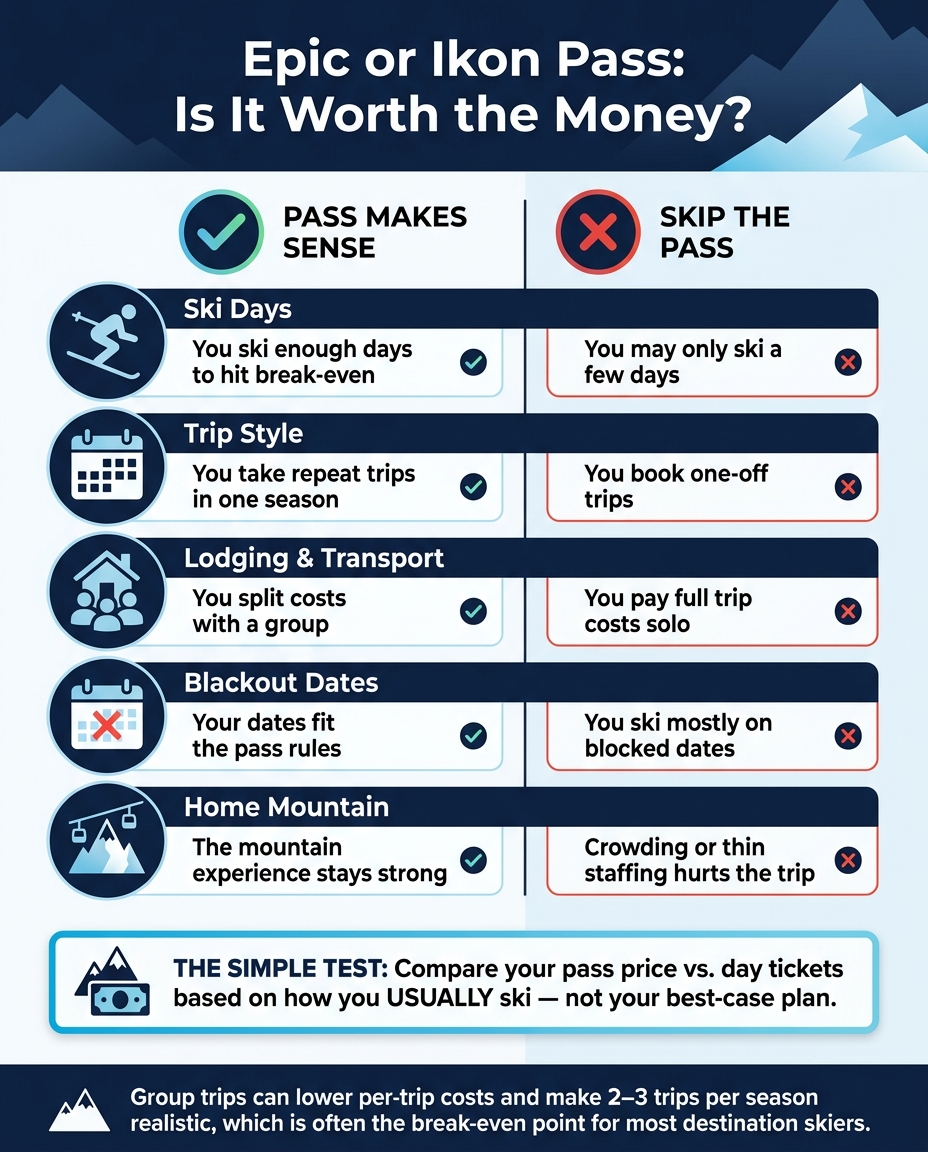
Yes - but only if you ski enough days for the pass to beat day-ticket prices. If you take just 1 trip, a full pass can be a bad deal. If you take 2 to 3 trips, split lodging, and avoid blackout-date problems, the math can swing the other way.
Here’s the short version:
- Buy a pass if you expect enough ski days to cover the upfront cost.
- Skip it if your plans are loose, your trips are short, or blackout dates will get in the way.
- Group travel matters because shared rooms and rides can cut trip costs and make extra ski days more likely.
- Your experience also depends on the town, not just the lift ticket math. When workers get priced out, service can slip and the trip can feel less worth the money.
- The best test is simple: compare your pass price against what you’d spend on day tickets based on how you usually ski, not your best-case plan.
A few things shape the answer most:
| Factor | Pass may make sense when... | Pass may not make sense when... |
|---|---|---|
| Ski days | You’ll ski enough days to hit break-even | You may only ski a few days |
| Trip style | You take repeat trips in one season | You book one-off trips |
| Lodging/transport | You split costs with a group | You pay full trip costs on your own |
| Blackout dates | Your dates fit the pass rules | You ski mostly on blocked dates |
| Home mountain/town | The mountain experience stays strong | Crowding or thin staffing hurts the trip |
Bottom line: I’d treat Epic or Ikon like a math problem first and a lifestyle buy second. If the numbers work with your normal habits, it can save you money. If not, day tickets or a smaller regional pass will often be the better pick.
That’s the lens this article uses: not hype, just whether the pass fits how you ski, travel, and spend.
Epic vs Ikon Pass: Is It Worth It? The Break-Even Cheat Sheet
Should you get an Epic Pass or an Ikon Pass for the 2025/2026 Ski Season?
sbb-itb-236ebff
What mountain culture actually is
Mountain culture comes from coming back. It grows through repeat visits, local ties, and shared norms. You see it in the shops people stop at every season, the regulars who know each other by name, the unwritten rules, and the people who return often enough to know how a place works.
That matters here because pass ownership can change all of that. It can shape how often people return, where they spend money, and whether they stay tied to a ski town over time.
The rituals that shape a town's rhythm
A ski town has its own rhythm, and repeat rituals help set it. Group trips, end-of-season meetups, and yearly events bring the same people back again and again. That steady return is part of what gives a place its feel.
You can see the same pattern outside resort-run settings too. Lichota Seidewand, founder of Malibu Ski League, organized more than 30 group ski trips over a seven-year period before formalizing the community into a brand. That's a good example of how skiing shifts from a one-time buy into a seasonal habit. People don't just visit. They build routines around the place.
Relationships, unwritten rules, and local knowledge
The unwritten rules aren't posted on a wall. People learn them by returning, watching, and listening. Over time, they build terrain judgment, storm memory, and the kind of local knowledge that helps a community ski with more care and less chaos.
That only happens with regular participation. People have to show up, spend money in town, and respect the norms that keep the place running. In ski towns, culture is learned the old-fashioned way: by returning, paying attention, and taking part.
That's the human side of the equation. The next sections look at what happens when the economics behind those habits start to strain.
Case studies: the people and places carrying it forward
A pass only works if it fits the way you actually ski. That’s the part that matters. The big question isn’t whether a pass looks good on paper. It’s whether it leads to more days on snow, lower trip costs, and fewer plans that fall apart at the last minute.
That matters because a pass saves money only when it changes what you do in real life, not what you hope you’ll do.
Group trips and the break-even math
Group trips change the math in a pretty direct way. They can lower lodging and transportation costs, and they often lead to more ski days over the course of a season. For destination skiers, trip frequency is usually the main factor.
An organized weekend ski community like Malibu Ski League shows what that looks like in practice. When a group setup makes planning easier and people split costs, skiers who might have taken one trip in a season can end up taking two or three. That shift matters. More trips mean more use from the pass, and shared lodging and food costs can make the pass easier to justify.
Local labor and what it costs to stay near a mountain
Housing and labor strain in resort towns also matter, even if not in an obvious way at first. When frontline workers can’t afford to live near the mountain, staffing gets thinner. Then service can slip. Lines get longer, operations get less steady, and the ski experience that helped justify the pass starts to weaken.
For skiers thinking about a season pass at one home mountain, that local context belongs in the same conversation as lift ticket math.
What is putting pressure on mountain culture
As demand for ski trips climbs, ski towns get pricier. And the people who keep those places running often get pushed to the edges. That matters here because the value of a pass isn't just about access to lifts. It's also about the feel of the mountain, the town around it, and whether people can still afford to come back again and again.
Housing costs, labor strain, and the loss of everyday locals
Once a ski town turns into a hot destination, housing pressure usually follows. Workers get forced farther from the mountain, and everyday locals can lose the routines and relationships that make a town feel like a community instead of just a resort.
That has a direct effect on the guest experience. When workers live farther away, towns lose people who know the mountain inside and out. Service can become less steady. You feel that pressure in longer lift lines, thinner staffing, and fewer familiar faces who know the place well.
Consolidation, standardization, and small-business fragility
Corporate investment can drive up commercial rents and put independent businesses in a tight spot. Over time, that can make mountain towns feel more generic. Many modern mountain communities now lean on weekend skiers and urban-based membership networks that keep spending tied to the mountains.
For small operators, repeat visits and word of mouth matter more than paid ads. So when the mix shifts, it's not just the look of the town that changes. The value of the destination changes too.
These pressures shape how people spend, travel, and decide to return. For visitors, the next step is thinking about how to spend in ways that help keep that mountain culture alive.
How skiers and visitors can help keep it alive
Spend and travel in ways that support local culture
Once the pass math starts to make sense, the next step is simple: look at how you actually travel. A pass only saves money if it changes how often you ski and what each trip costs. That’s the part people miss. The pass only feels like a deal if it shifts how you book trips, where you stay, and how often you go back.
Group trips show this better than almost anything else. When skiers split lodging and transportation, the cost per trip drops. And when each trip costs less, it becomes much easier to go more often. Someone who may have taken one destination trip in a season might end up taking two or three when the bill is shared across a group. More trips mean more days on snow. And more days on snow are what make a multi-resort pass pay for itself.
At the same time, owning a pass can push people in the other direction. When skiing feels prepaid, it’s easy to add trips you wouldn’t have booked otherwise. It’s also easy to spend more on lodging near a premium resort or pick a destination because the pass works there, not because the full trip cost makes sense. For buyers, the useful question isn’t whether ski culture deserves support. It’s whether the pass lines up with the number of days you’ll ski.
Conclusion: culture changes, but it does not have to disappear
A pass is worth it only if your expected ski days, travel pattern, lodging costs, and blackout dates still come out ahead of buying lift tickets one by one. If the numbers hold up against your real habits - not your best-case plans - then the pass earns its price. If not, day tickets or a smaller regional pass will almost always cost less.
FAQs
How many ski days do I need to break even?
There isn't one fixed break-even number. It depends on what your pass costs and what you'd otherwise pay per day at the resorts where you plan to ski.
Your actual break-even point can move around based on blackout dates, the mountains you visit, and whether you pick a limited pass or one with full access. In plain English: a pass only saves you money if it matches how you actually ski.
When are day tickets cheaper than a pass?
Day tickets make more sense when you only expect a handful of ski days and your total spend stays under the cost of a pass. That’s often the case for skiers taking one short trip or for anyone who won’t ski enough to reach a resort’s break-even point.
They can also be the better fit if you mostly ski smaller local mountains that aren’t part of the big pass networks. The same goes for off-peak trips, like early December or late March, when ticket prices can drop.
Which pass type best fits my ski habits?
The right pass comes down to how you ski in real life. Not the version where you hit every powder day, take three extra trips, and suddenly become the person who skis nonstop from December through spring.
It only saves you money if it lines up with your actual habits.
If you travel to destination resorts, you need enough trips for the pass to beat the cost of day tickets. If you ski only now and then, buying single-day tickets may cost less. And if you spend most weekends at one mountain, a regional or limited pass might make more sense than a big multi-resort option.
You’ll also want to look past the headline price. Blackout dates can get in the way, especially if you ski on peak holiday weekends. And there’s another trap people don’t always think about: a pass can nudge you into spending more on flights, gas, hotels, and meals just to “get your money’s worth.” At that point, the pass may save on lift access while pushing your total trip cost in the other direction.