




Most adults don’t avoid new skills because they can’t learn them. They avoid them because they don’t want to look bad while learning.
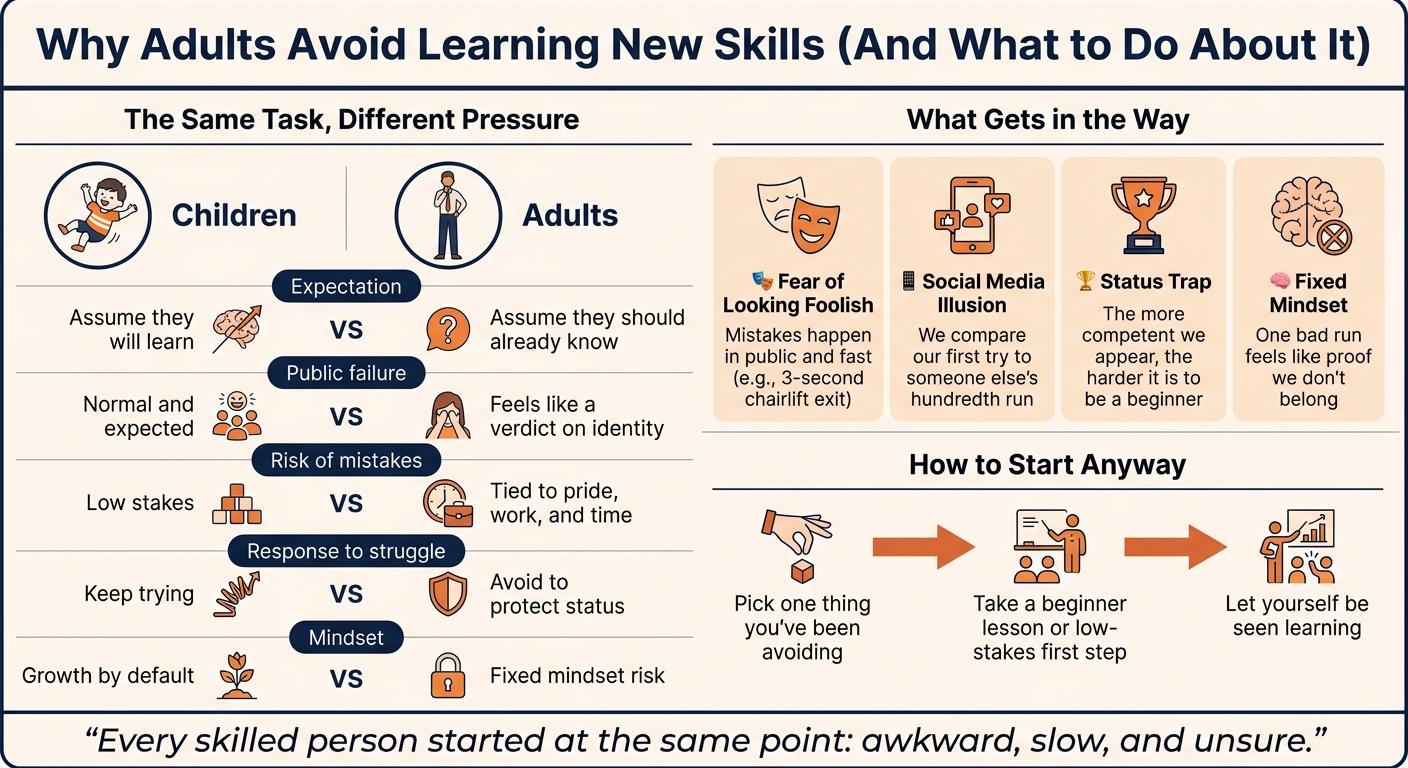
I read this piece as a simple argument: being new is not the problem - shame is. The article shows how adult life trains us to protect our image, avoid public mistakes, and stick to what we already do well. Skiing and snowboarding make that fear easy to see because falls, awkward stops, and chairlift mistakes happen in front of everyone.
Here’s the short version:
- Kids expect to learn. Adults think they should already know.
- Public failure hits adults harder because pride, work, family, and time all add pressure.
- Social media makes it worse by showing polished results instead of messy first tries.
- Status can trap us; the more I tie my identity to looking capable, the less likely I am to start from zero.
- The fix is plain: pick one thing I’ve been avoiding, take the beginner step, and let myself be seen learning.
A few facts and patterns stand out:
- Adults often compare their first try to someone else’s hundredth run
- On the slopes, you get only a few seconds to get off a chairlift and stay upright
- One public fall can feel like more than a fall; it can feel like proof that I don’t belong
- Yet every skilled person started at the same point: awkward, slow, and unsure
| Main point | What it means |
|---|---|
| Adult fear of starting | Looking unskilled feels like a hit to identity |
| Why snow sports expose it | Mistakes happen in public and fast |
| Role of social media | It hides the messy middle |
| What helps | Lessons, low-stakes starts, and practice |
| Takeaway | Start before I feel ready |
My takeaway is simple: if I only do things I can already do well, I stop growing. This article pushes one clear idea - being bad at something for a while is normal, and starting anyway is the whole point.
Why Adults Avoid Learning New Skills (And What to Do About It)
Why adults stop learning new skills
Children can fail in public; adults are expected to stay competent
Children get room to be unfinished. They fall down, ask basic questions, and try again without much baggage. Then adulthood shows up, and that room gets a lot smaller. What used to be normal confusion can start to feel like shame.
That’s the core shift: childhood learning expects failure along the way. Adult learning often treats failure like a verdict on who you are.
As author Cerith Gardiner puts it plainly:
"Children assume they will learn. Adults often assume they should already know."
It’s the same task, but the pressure changes. A kid on a ski slope looks like they’re learning. An adult on that same slope can feel like they’re being judged. That gap between childlike freedom and adult self-consciousness is hard to miss.
Fixed mindset, risk aversion, and outdated learning habits
Once failure starts to feel expensive, learning can seem like a choice instead of a normal part of life. A fixed mindset makes each mistake sting more than it should. One bad run, one awkward fall, one slow lesson - and suddenly it feels like proof that maybe you’re not cut out for it.
Adults also weigh risk in a different way. Injury doesn’t just mean a bruise. It can mean missed work, childcare issues, and time lost from an already packed schedule.
Casey Botts puts that resistance into words:
"I think it takes somebody to set aside ego and say, 'I want to get better at something.' For kids, it's just built in. For adults, there's more resistance."
That resistance tends to grow once people build status in one part of life. If you’re used to knowing what you’re doing at work or at home, it’s hard to step into a place where you look clumsy and unsure. So people protect that sense of authority by steering clear of beginner mode.
And that’s how the “someday I’ll learn to ski” list keeps growing. Not because the skill itself is out of reach, but because the first chairlift feels bigger than it is. It doesn’t just test balance. It pokes at pride and identity.
sbb-itb-236ebff
How We Can Learn As Adults | Rachel Wu | TEDxUCR
Why skiing and snowboarding make the beginner problem so clear
Skiing and snowboarding put beginner nerves out in the open. You can't hide on a mountain.
If you're learning a language, you can mess up in private. If you're learning guitar, you can practice in your living room. But on the slopes, every wobble, stop, and fall happens in front of other people. Adults usually don't stay away because they can't learn. They stay away because they don't want an audience while they do it.
Fear of looking foolish on the bunny hill
Even the gear can throw you off. Heavy boots and bindings make basic movement feel weird, almost clumsy. As one snowboard instructor put it, "Learning how to snowboard is like unlearning how to be human."
Then there's the chairlift exit. You get about three seconds to get off a moving chair and stay upright, all while people are watching. For a lot of adults, that moment doesn't just feel awkward. It feels like public proof that they don't know what they're doing. So a small fall can sting far more than the bruise itself.
Professional success does not transfer to the chairlift
On snow, job titles and life experience don't help much. The minute you clip in, everyone starts from scratch.
That can be rough for adults who are used to feeling capable. As Kiya Naka writes, "At forty-something, being new at something feels like exposure or evidence. We've spent so many years getting competent... that beginner status feels like regression."
And the body doesn't always cooperate. Many beginners lean uphill without meaning to, which leads to even more falls. The mind may know what to do, but panic takes over anyway. That's the hard part: getting better takes basic instruction, calm feedback, and repetition - the same stuff a 6-year-old needs. If you're used to being the one in charge, that can be a hard pill to swallow.
How Malibu Ski League can make starting feel less intimidating

What you wear on day one matters more than people like to admit. It can help beginners feel like they belong before they feel steady on their skis or board.
Malibu Ski League's ski-surf apparel gives new people a way to step into the scene without feeling completely out of place. And that matters, because the mountain isn't the only place where beginners feel exposed.
How social media and adult success make starting harder
Highlight reels and the shame of being seen struggling
If the mountain makes beginnerhood easy to spot, social media makes the whole thing look effortless.
It rarely shows the during. You get the polished finish line photo, the clean ski run, the big before-and-after moment. What you don’t get are the falls, the 11:00 p.m. Google searches about injury recovery, or that stiff, awkward first stretch when someone has no idea what they’re doing. And that gap matters.
It feeds a false idea that everyone else somehow skipped the messy part. So people end up comparing their first run to someone else’s tenth.
As Kiya Naka puts it:
"We watch each other from a distance and assume everyone else has already graduated from the beginner phase of things we haven't started."
That’s the trap. Everyone else looks further ahead. Everyone else looks less awkward. Watching ski clips can feel like progress for a second. But it’s not.
That effect gets even stronger when success starts to feel tied to who you are.
Success makes beginners feel exposed
The more status people build, the harder it can feel to be new at something. For adults who’ve spent years becoming the authority in a room, being a beginner can feel less like learning and more like being exposed.
Dr. Gayle MacBride, a clinical therapist and psychologist, says it plainly:
"We're rewarded for competence, polish, and the ability to make hard things look easy. It's tempting at this point to confuse usefulness with identity. We're in danger of arranging our lives around what we do well and avoiding anything that might expose a crack in the facade."
So adults steer away from anything that might dent the image they’ve built. And the fear doesn’t usually announce itself as fear. It tends to show up dressed as logic.
That’s why starting matters. It breaks the habit of performing competence.
Why choosing to be a beginner is worth it
New skills keep adults humble, curious, and mentally sharp
Once the embarrassment wears off, something lighter tends to take its place: the relief of still being someone who can learn.
There’s a shift that happens after the roughest part of the discomfort passes. On the mountain, that’s often the moment when day one stops feeling like pure humiliation and starts feeling like forward motion.
As Hilary Thorpe put it after returning to skiing in midlife:
"I didn't know this about fear - that if you keep moving through it, you might find joy on the other side."
New skills break up adult routines, ease stress, and make failure feel less fatal. They pull you into the present. Skiing, snowboarding, surfing, and biking ask adults to pay attention, stay humble, and keep going after mistakes. Comfort, on the other hand, has a way of sanding those traits down.
The goal isn’t to admire beginnerhood from the sidelines. It’s to step into it before you feel ready.
Start something that scares you because you will be bad at it
Here’s the part that matters in practice.
Choose one thing you’ve been dodging for one plain reason: you’ll be bad at it in front of other people. Not the thing you’re still secretly rehearsing. The thing you could begin now, with no polished version of yourself in sight.
That might mean booking a ski or snowboard lesson. Or it might mean starting with one person you trust. Smaller, lower-stakes settings can make the first step easier. A beginner lesson removes the pressure to look good and replaces it with something far more useful: feedback.
As Feifei put it:
"Being a beginner isn't failure. It's just the first part and everybody who's ever been good at anything had to go through it."
A lot of adults stop starting because competence becomes part of who they are. The gap between people who begin and people who stay stuck usually isn’t talent. It’s the choice to be seen trying before skill shows up.
Find the thing you avoid because you know you’ll be bad at it. Then start anyway.
FAQs
Why do adults feel so ashamed of being beginners?
Adults often feel shame about being beginners because they worry other people will judge them. In a culture that links a person’s worth to output, being new at something can feel less like learning and more like falling behind.
That’s part of what makes starting over so hard. After years of building skill and confidence, going back to square one can feel humiliating instead of normal. And social media doesn’t help. It puts the gap between beginner and expert on display all day long, which can make early mistakes feel way bigger than they are.
So a lot of adults back away from the whole thing. Not because they can’t learn, but because being bad at something for a while feels too exposed.
How can I start learning a new skill without feeling embarrassed?
Start on your own, or with just one other person. That can take some of the pressure off and make the whole thing feel less intimidating.
It also helps to pick beginner-friendly classes or groups. You don't need to jump into the deep end right away. Set small, realistic goals so each step feels doable.
Most of all, be kind to yourself. Give yourself permission to be bad at it for a while. That's not failure. That's what learning looks like.
Being a beginner means you'll fumble, miss a step, or feel awkward now and then. That's part of the process, not a sign that you should stop.
Why do skiing and snowboarding make beginner fears feel stronger?
Skiing and snowboarding can make beginner nerves hit harder because the struggle happens out in the open. Adults may feel awkward in lift lines, wipe out in front of strangers, and stress about being judged.
For adults who are used to doing things well, starting from scratch can feel like a hit to their identity. Then you add the physical uncertainty of the mountain, and the whole thing can feel humiliating instead of freeing.