




A season pass solves access. It does not solve the trip. If I want to ski more often, the main problem after buying a pass is still planning: who I go with, where I stay, how I get there, and how I stay connected to skiing between trips.
Here’s the short version:
- Passes fixed one part: lift access
- They did not fix: lodging, travel, group planning, rentals, and local tips
- The best membership idea: help me ski more often by cutting planning work
- What it should include: year-round community, trip tools, local business ties, and support across many mountains
- What matters most: whether people renew because it keeps helping, not because it offers a few discounts
A strong ski membership is not just a perk bundle. It should help with the reasons trips stall in the first place, especially for people who live hours away from the mountains.
Join a Ski Community Without Paying Premium Prices
sbb-itb-236ebff
Quick comparison
| Model | Main focus | What it helps with | Main limit |
|---|---|---|---|
| Season pass | Mountain access | Skiing more often at covered resorts | Does not handle the rest of the trip |
| Resort-tied membership | One resort | On-site perks and repeat visits | Stops being useful off that mountain |
| Member club | People and group trips | Community, events, shared trips | Needs active member use to work well |
| Concierge model | Trip setup | Lodging, timing, and planning help | Can cost more to run |
| Local business network | Town-level support | Shops, food, rentals, and services | Value depends on partner quality |
| Mountain-agnostic membership | Many places | Guidance and support across trips | Harder to keep useful in every market |
One stat stands out: Malibu Ski League’s founder says he organized 30+ group ski trips in 7 years. That says a lot. People want more than access. They want a simpler way to make ski trips happen.
If I boil the article down to one point, it’s this: the next step in skiing is not more access, but better participation.
What Season Passes Solved - and What They Left Open
How Passes Changed Skiing Economics and Habits
Before multi-mountain passes, skiing was mostly a day-ticket decision. Every visit came with the full cost, so skiing often felt pricey if you went a lot, and easy to skip if you didn’t. Resorts also leaned on pre-season pass sales for more cash certainty before winter.
That shift changed behavior. Skiing became easier to do again and again. Once you already had the pass, another day on the mountain felt like a much simpler call. But there was still a catch: buying access did not make the trip itself any easier to put together.
What Still Feels Broken After You Buy the Pass
Lift access fixes one part of the puzzle: getting on the mountain. It does not fix lodging, transportation, après plans, or the headache of lining things up with friends. That’s where skiing still feels scattered. The pass covers the mountain, but not the trip.
Season passes made skiing easier to buy and easier to repeat. They did not organize the rest of the trip, build community, or add value between ski days.
That isn’t a knock on passes. It points to the next opening: a broader membership layer built around the trip itself. The next step is not more access. It’s a better way to take part in skiing.
Why Ski Travel Is Fragmented - and Where Membership Could Help
The Real Friction: Planning, Timing, and Local Knowledge
Once access is handled, the trip itself becomes the hard part.
A ski trip usually means dealing with a bunch of separate moving pieces: flights or a long drive, lodging, rentals, lessons, dining, parking, and the mountain itself. Different businesses handle each part. They don’t naturally line up, so one person usually ends up doing the work of keeping everything on track.
That pressure hits groups the hardest, especially mixed-ability groups and friends coming in from different cities. Even if everyone already has a pass, the trip can still feel like starting from zero each time.
And then there’s the local knowledge problem. Which rental shop is worth the money? Which runs work for a mixed group? Which restaurant might still take a walk-in? Most of that stuff lives in scattered Reddit threads, old blog posts, and word of mouth. There’s no trusted, current layer of guidance built for skiers.
Lichota Seidewand, founder of Malibu Ski League, put it this way:
"I wanted to build a more formal community around winter sports for those of us who don't live near the mountains. After years of organizing group ski trips (30+ in the last 7 years!) for friends... I wanted to build a more formal community."
For a lot of skiers, the mountains are hours away. So a ski trip isn’t some easy spur-of-the-moment weekend call. It’s a logistics project.
What Membership Could Simplify Without Controlling Everything
A good membership should make trip planning easier by giving people trusted local picks and a faster way to make decisions. That doesn’t mean controlling the whole trip. It means giving members a solid starting point instead of a blank page. The next layer has to help people take part, not just get in.
This gap shows up most clearly with group coordination. Mixed-ability groups, plus groups with both skiers and snowboarders, need more than access. They need help planning around the way ski travel actually works. A membership built around that fact could take a lot of stress out of the process.
"MSL consists of a growing network of professionals across all industries that are united by life outdoors. Builders, creatives, operators of all ages that clock in during the week but find themselves on the mountains or in the ocean by the weekend."
That’s exactly the kind of skier who needs better structure: people who spend the week away from the mountains and then try to make the weekend happen. They already know the drill. Membership should cut out the repeated planning work.
That’s the baseline any useful membership has to meet.
What a Good Ski Membership Should Actually Offer
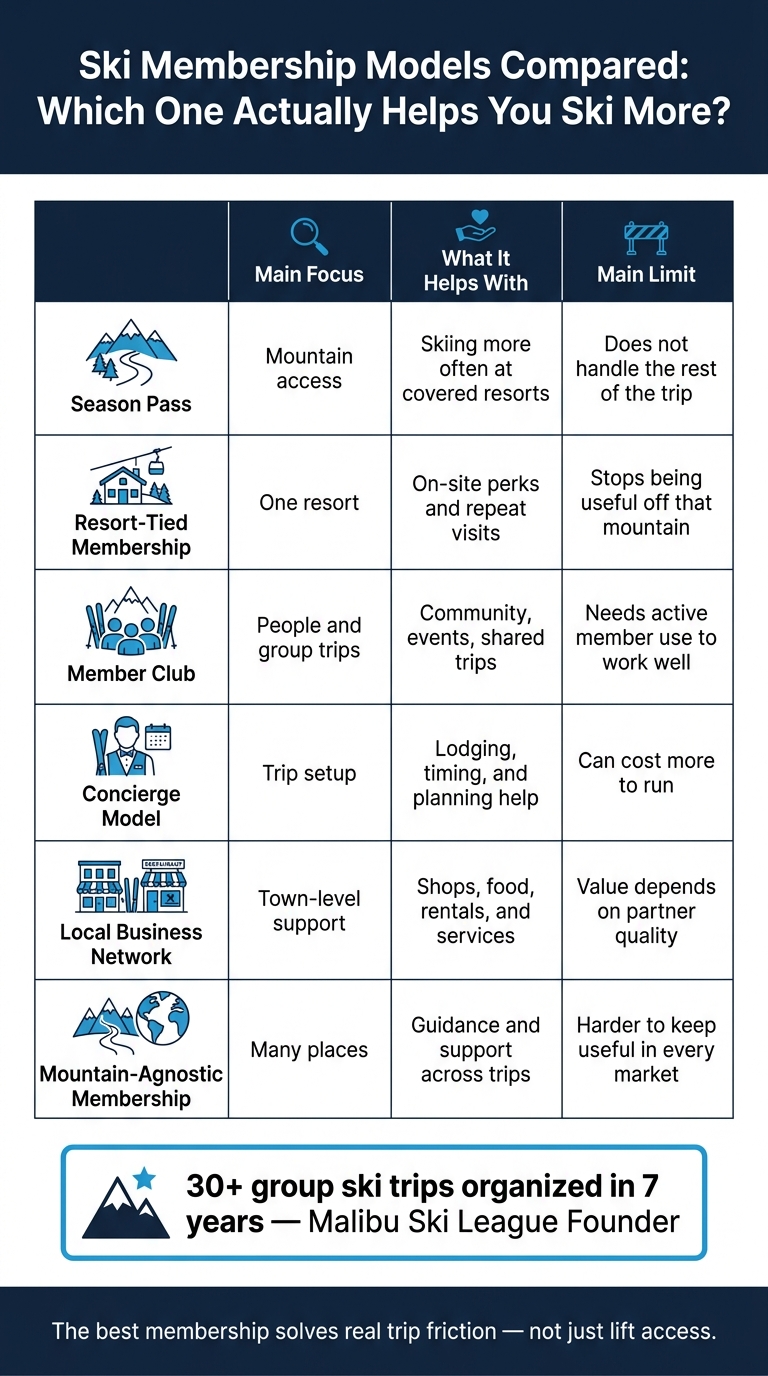
Ski Membership Models Compared: Which One Actually Helps You Ski More?
Beyond Discounts: Year-Round Value Between Ski Days
The easiest trap is calling a discount program a membership. It isn’t.
A real membership earns its place before, during, and after a trip. More than that, it still needs to matter when no trip is happening at all. For skiers who live far from the mountains, an off-season membership can’t just sit there collecting dust. It should keep people connected all year through things like local meetups, pop-up events, and stories or updates that still feel useful on a Tuesday in July, not just during a powder day in February.
"The signal that mattered most was simple: people kept coming back and word of mouth continued to grow." - Lichota Seidewand, Founder, Malibu Ski League
That matters because skiing is more than lift access. It’s also identity, routine, and connection. If a membership only shows value at checkout, it’s missing the point.
Digital Tools, Community, and Group Coordination
Once a membership gives people a reason to stay engaged between trips, the next step is simple: make planning easier. The goal isn’t to pile on another app people forget to open. The goal is to cut friction. Shared calendars, trip notes, and light coordination tools can help people get from “we should go” to “we booked it.”
This gets even more useful with group trips. Anyone who has tried to organize a long weekend with a mix of skiers and snowboarders knows how fast plans can fall apart. One person wants Friday to Sunday. Another can only leave Saturday morning. Someone else is asking about lodging, while another is checking snow reports. It doesn’t take much for the whole thing to stall. A membership that helps line up schedules and connect members who are heading to the same mountain that weekend removes a very real barrier.
Mountain-Agnostic Membership and Stronger Local Partners
A resort-tied membership stops being useful the minute you leave that mountain. A better model travels with the member across different mountains, resort towns, and seasons.
That mountain-agnostic setup also makes it easier to support independent local businesses instead of trying to replace them. Good membership programs should send people toward local operators, not compete with every part of the trip. Discounts can help people save money, sure. But membership should do more than that. It should create a sense of belonging, offer local guidance people can trust, and stay useful all year.
The real test isn’t how many perks a membership stacks into one bundle. It’s whether the membership solves real participation problems without turning into just another discount package. That leads to the next question: which membership models can grow without losing the local value that made them worth joining in the first place?
Possible Futures for Ski Membership - and the Test That Matters
Several Models Worth Watching
If membership is the next layer, the big question is simple: which model actually helps more people ski more often?
The destination network links members to a curated mix of mountain towns, places to stay, and local businesses across many resorts. Think of it less like a hotel loyalty program and more like a trusted local guide you can take with you. The value comes from up-to-date local advice, not just a coupon.
The member club model puts the focus on people rather than place. It works for skiers who live far from the mountains and have a hard time finding others who want to go as often as they do. Malibu Ski League is one example. It offers organized trips, in-person events, and a shared identity built around skiing and the outdoors, all shaped around a community that had already come together on its own.
The concierge-style model takes care of the trip from start to finish: timing, lodging, group planning, and local recommendations. It starts where the pass ends. A local business network links members to independent shops, restaurants, and services in resort towns, helping visitors build stronger ties with the places that give mountain towns their character. Media and physical gathering spaces - seasonal pop-ups, member events, and off-season content - help keep skiing part of people's lives all year.
The strongest memberships will likely mix several of these roles instead of leaning on only one. That's where things get interesting. A model like this can bring trips, events, and community into a single identity layer that moves with the skier from one mountain to another, instead of staying tied to one resort.
"MSL consists of a growing network of professionals across all industries that are united by life outdoors. Builders, creatives, operators of all ages that clock in during the week but find themselves on the mountains or in the ocean by the weekend." - Lichota Seidewand, Founder, Malibu Ski League
Conclusion: The Next Layer of Skiing Should Solve Participation
The goal isn't to pile on perks. It's to fix the reasons ski trips still fall apart.
The season pass was a major step forward. It solved the access problem: where can I ski? But it left a lot untouched. Who am I going with? When do we go? Where do we stay? How do I stay connected to the sport once I'm back home? For many people, those are the real reasons ski trips happen less often than they want.
The next big move in skiing probably isn't another lift, pass, or piece of gear. It's a better way for people to take part in the full world around the sport - before the trip, during it, and long after they get home. That means:
- Solving real friction instead of just bundling perks
- Staying useful year-round and working across mountains
- Helping local operators while building a real sense of belonging
The test for any membership model is plain: does it solve a real problem, again and again, in a way that earns its yearly cost? If people keep showing up, keep bringing friends, and keep renewing, it's doing the job. If it's only a discount card with a logo, it isn't.
FAQs
How is membership different from a season pass?
A season pass is mostly a transaction. It tells you where you can ski by giving you access to the mountain.
A membership does more than that. It’s built to create a sense of belonging and add value beyond time on the slopes, with trip planning, local know-how, social connection, and perks that keep people tied to the sport between ski days.
What problems should a ski membership solve?
A ski membership should do more than get people through the lift line. It should connect the mountain to the rest of a skier’s life and fix the chopped-up travel experience that so many trips still come with. That means helping with planning, sharing local know-how, and making it easier to stay connected with other skiers.
It should also matter when members aren’t on the slopes. Otherwise, the whole thing feels like a one-time purchase with a pass attached. A stronger membership creates a sense of belonging through shared tips, group planning, and steady engagement that keeps people involved between trips.
Why pay for membership year-round?
A year-round membership offers more than days on the mountain. It keeps you close to the sport and connected to a broader community.
It also helps fill the space between winter and summer. With perks like early gear access, members-only events, and shared outdoor trips, people have more ways to stay involved all year. Just as important, it gives them a place to meet up, swap stories, and keep that sense of connection going long after the snow melts.