




A ski town doesn’t lose itself all at once. It happens when local workers, owners, and hangouts can’t stay.
I see the article making one clear point: if you want mountain towns to keep their identity, your choices matter. Lift tickets at major resorts now top $200 a day, local owners are getting priced out, and worker housing is under strain. At the same time, places like Pug Ryan’s, Masato’s Sushi, local gear shops, yoga studios, and town events keep the town feeling like a place people live in, not just visit.
Here’s the article in plain terms:
- What mountain life means: long memory, local routines, shared work, and people who stay.
- Who keeps it going: bartenders, shop owners, event organizers, filmmakers, rink supporters, and long-time business owners.
- What puts it at risk: high housing costs, low seasonal pay, costly tickets, and more copy-and-paste resort development.
- What you can do: spend money at owner-run businesses, go to local events, stay in town, and use local transit.
A few facts stand out:
- $200+: what day tickets now cost at many large ski resorts
- 30 years: how long Travis and Annie Holton ran Pug Ryan’s before selling to local-minded buyers
- 1995: the year Masato Okamoto started Masato’s Sushi in Avon
- $55 million: the remodel tied to Dobson Ice Arena
- March 2026: when Vail moved ahead with Timber Ridge Village for local worker homeownership
What I take from this is simple: mountain towns stay alive when people support the places that locals use week after week. If you visit, where you eat, shop, stay, and show up makes a direct difference.
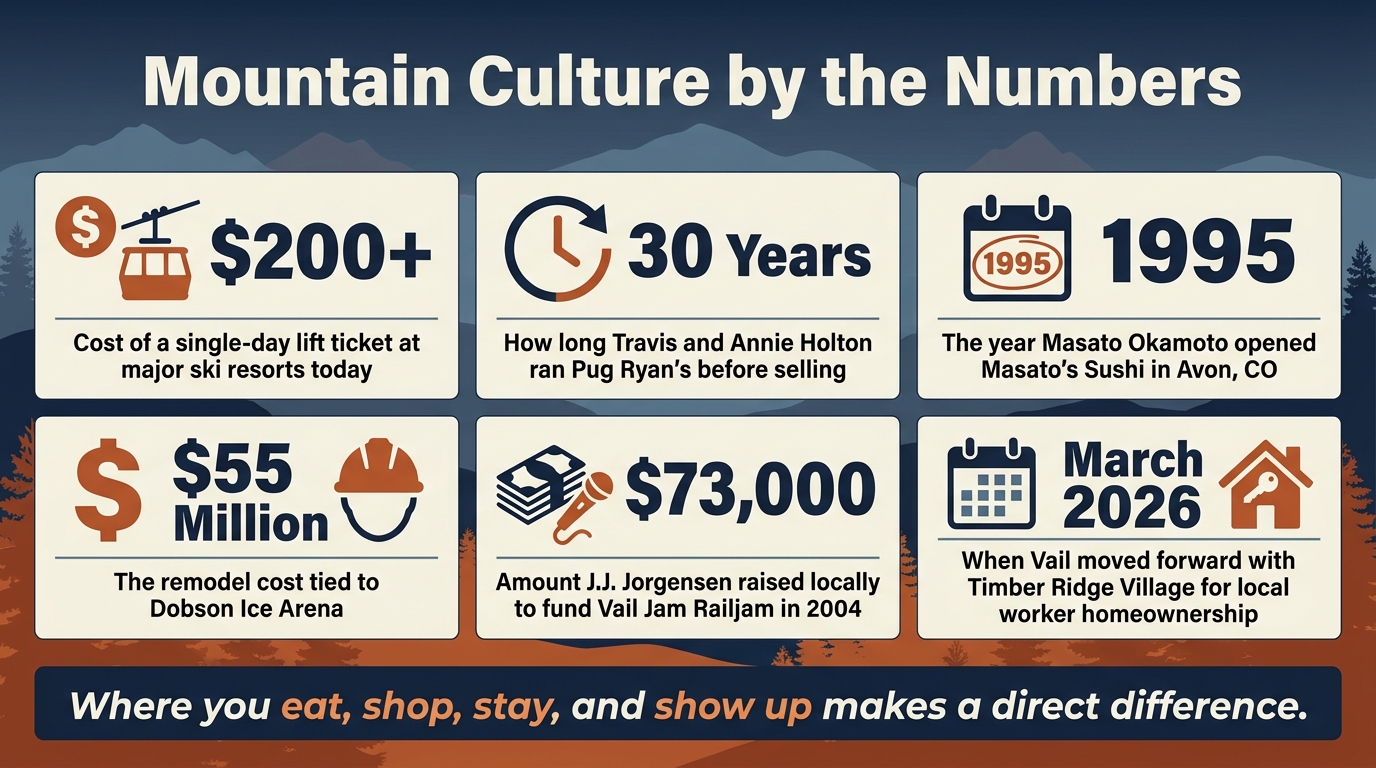
Mountain Culture by the Numbers: Key Facts About Ski Town Identity
What Mountain Culture Actually Is
Mountain culture is a way of life shaped over years in the same place. It grows out of habits, relationships, and shared responsibility. That’s what you notice after last chair: the routines, loyalties, and local memory that keep a ski town from feeling like every other resort town.
Rituals, Local Knowledge, and Shared Responsibility
The practical side is easy to overlook and hard to imitate. Knowing which storm cycles pay off, how a ridge reacts to wind, or which runs turn icy by noon comes from seasons of watching, learning, and being there.
But the social side matters just as much. Mountain culture gets passed along through repetition, work, and shared effort. You can see it in how people take responsibility for the town they call home. That sense of duty turns culture from a nice feeling into something a town can keep alive.
You see that same ethic in how locals back events. In 2004, J.J. Jorgensen raised the $73,000 needed for Vail Jam Railjam through local loans, after selling his car to fund the first Bridge Street Jam in 2001.
Why Mountain Culture Cannot Be Manufactured
This gap becomes clear when a town tries to swap lived identity for a polished image. A resort can sell the idea of mountain life, but it can’t make the history inside a place like Pug Ryan's. It also can’t fake the continuity carried by people who stay long enough to become caretakers of a town.
As Coop Cooper, founder of Cooper Marketing & Media, put it:
"A shop means... Not a point of distribution. A point of identity. A place where the community recognizes itself."
Mountain culture depends on owners who know what is already there, local institutions that last long enough to hold memory across generations, and people who pass habits forward. When those links break, a town may still look polished but feel hollow. Culture is learned through repetition and work, not branding.
sbb-itb-236ebff
The People and Places Carrying It Forward
Workers Who Hold the Town Together
The people who keep a ski town feeling like itself usually aren't the ones on the posters. They're there before the lifts start spinning and still working long after last chair.
J.J. Jorgensen is one of those people. He once raised $25,000 in a single night from locals to book Jurassic 5. It survives because locals keep putting money behind it.
Filmmakers carry that same thread in a different way. Steve Winter bought a used Bolex with his tuition money, filmed Nachos and Fear, and later co-founded Matchstick Productions. That company helped shape ski-film culture for decades.
You see the same thing in the places locals keep coming back to, year after year.
Local Institutions That Keep Continuity
Some places matter for a simple reason: they stay. They open their doors year after year, and people build part of their lives around them.
Masato Okamoto has run Masato's Sushi and Japanese Bistro in Avon since 1995, using techniques he learned in Japan.
When Dobson Ice Arena shut down for a $55 million remodel, the Vail Mountaineers Hockey Club helped fundraise for a temporary Rodeo Rink so the town could keep skating. As Vail Mayor Travis Coggin put it:
"It's about protecting access to ice for our entire community for years to come."
These spots don't just give people somewhere to go. They help a town keep its memory.
Community-Driven Brands and Modern Mountain Identity
Owner-run businesses built around local habits carry that same line forward. Travis and Annie Holton spent 30 years turning Pug Ryan's from a steakhouse into a local brewery before selling it to John and Judy Jordan, who understood why the place mattered.
In Edwards, Mountain Soul Yoga was built around pricing locals could handle and class times that fit around the workday. It was made for people who live there, not for visitors just passing through.
That kind of continuity gets harder to hold onto as housing, wages, and operating costs keep climbing.
What Is Putting Pressure on Mountain Culture
The people and places carrying mountain culture forward now have to fight to remain in place.
Housing Costs, Wages, and the Cost of Staying
Housing is the first thing that decides who gets to stay. When rent goes up faster than seasonal pay, the people who might have put down roots for years often leave. And when locals leave, a town loses more than workers. It loses memory, habits, and the relationships that keep the place running. That kind of churn chips away at the businesses, events, and local groups built on people coming back season after season.
Some towns are starting to act. In March 2026, the Town of Vail moved forward with Timber Ridge Village, a public-private partnership designed to make home ownership possible for local workers. That matters. But in most resort corridors, the gap between wages and housing costs is still wide.
Scale, Standardization, and the Loss of Local Character
As towns get more expensive, they often start to look more alike. Independent shops that stock gear for local conditions lose ground to larger operators. The bars, event spaces, and gathering spots that locals use - rinks, event nights, and hangouts that give a town its feel - get harder to keep going. High day-ticket prices narrow the crowd, and that shift changes which businesses can make it downtown.
Coop Cooper asked:
"The question of whether freeride can stay wild cracked open a larger one: can any of these sports stay wild? Can the culture that built them survive the machine that bought them?"
When the audience leans more exclusive, the businesses and gathering spots that served a broader, scrappier crowd tend to fade under a pile of smaller economic pressures.
How Skiers and Visitors Can Help Keep It Alive
Spend and Participate More Intentionally
One of the clearest ways visitors can help is by spending money where the squeeze is hardest. Where you spend matters.
Grab dinner at a place like Masato's Sushi in Avon, which has had the same owner-operator since 1995, and more of that money stays with a business that has been part of the valley for decades. Put simply: choose owner-run spots over chains when you can.
The same idea applies to gear. Shops like Granite Chief or the Squaw Valley Sport Shop help keep local know-how in town. Buy from them instead of a chain, and that know-how stays in the building instead of fading out.
It goes past shopping, too. Small events need more than goodwill. They need people to show up. Going to something like the Vail Jam Railjam, and paying the entry fee, shows organizers and town councils that the event still has backing.
What These Choices Actually Support
When workers can stay for more than one season, they build relationships and town memory that help the place run day to day. A local studio like Mountain Soul Yoga stays open because locals keep using it. It becomes part of daily life in town, not just another stop on a visitor itinerary.
Taken together, these choices help keep a town functioning, not just looking busy. Taking the shuttle instead of jamming up the parking lot, staying in town instead of at a resort complex cut off from everything else, and picking local businesses over generic ones may sound small. But those habits help decide which places are still there next season.
Conclusion: Culture Changes, but It Does Not Have to Disappear
Mountain culture gets passed down by the people who stick around: owner-operators, event organizers, workers, and the local institutions that hold a town's memory. The pressure on these places is real. Still, visitors who stay in town, shop with independent businesses, and show up for local events play a direct part in keeping a ski town specific, lived-in, and worth coming back to.
FAQs
What makes a ski town feel local?
A ski town feels local when it functions as a community hub, not just a place people pass through on vacation. Independent spots like gear shops often become meeting points where people swap advice, catch up, and build the kind of relationships that give a town its identity.
Mountain culture doesn’t come from branding or surface-level aesthetics. It grows out of shared rituals, mutual care, and local ties built over many years. You see it in the people who grew up on that terrain, and in the ones who’ve spent season after season looking after it.
Why is mountain culture so hard to preserve?
Mountain life is hard to keep intact because it leans on local shops, skilled niche workers, and shared hangouts that usually don’t slot neatly into big-company consolidation.
As growth targets, quarterly returns, and standard models take over, long-term personal ties get swapped out for efficiency-first systems. And that change strips away the honest, place-based character that helped these communities hold together.
How can visitors support local mountain culture?
Spend your money at locally owned spots when you can. Pick independent classes, studios, and events instead of defaulting to the biggest, most standardized names every time.
That same idea applies to how you show up. Go to locally produced events. Back community spaces and programs through donations or fundraisers. And just as important, be a good customer: learn people’s names, ask local staff what matters on this terrain, and treat the place like something everyone helps care for.